
A New Way To Be Found On Google & This Week’s Must-Know Updates

Last updated:
|
11 minutes readKey Takeaways
- Google Search Profiles are appearing in more countries, giving eligible founders and creators greater control over their presence in search results.
- Only 6.9% of ChatGPT conversations in a US study showed purchase intent, highlighting the importance of measuring AI visibility against commercial outcomes.
- Google Ads has introduced Channel Prioritisation and Promotion Mode into PMax setup, giving advertisers more flexibility during peak sales periods.
- Google's Gemini 4 Neon launch signals rapid AI development, so regular monitoring of AI search visibility is increasingly valuable.
- Microsoft Advertising's upgraded smart bidding models promise faster budget pacing and quicker responses to bidding target changes.
- Digital marketing agencies and practitioners should prioritise accurate conversion data, measured experimentation and profitability over reacting to platform updates.
Digital marketing has a talent for moving the goalposts while you’re still presenting last week’s results. One minute, your dashboards look beautifully predictable. The next, there’s a fresh set of decisions to make and a question from the finance team.
For those managing serious budgets, the challenge isn’t keeping up with every headline, but knowing which changes are worth your attention and when to act. Let’s separate the signal from the noise.
Here are the latest in digital marketing in Australia and beyond.
Google Search Profiles Roll Out Globally, Including Australia
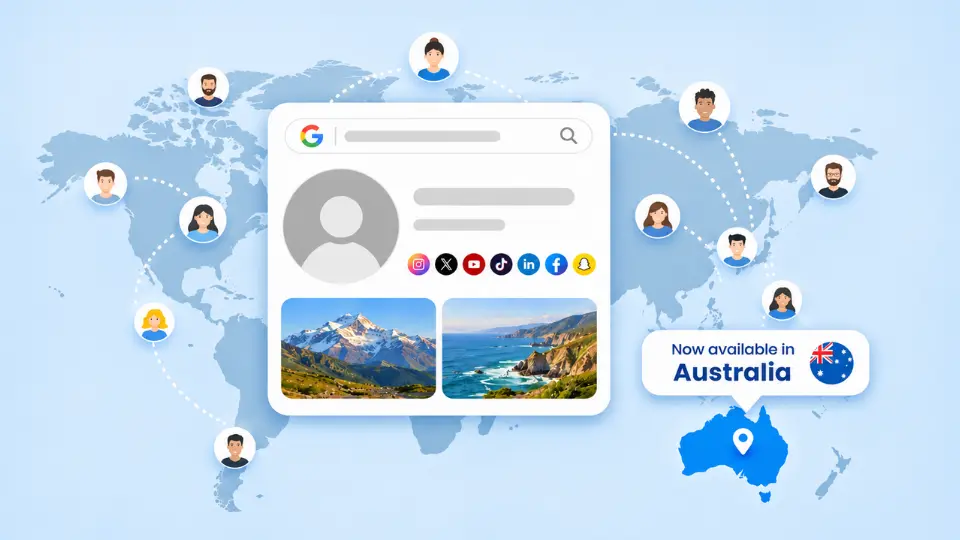
Google Search Profiles appear to be going global, and Australia is joining the conversation. According to Search Engine Roundtable, users in Spain and people accessing accounts registered in Australia, Singapore and Dubai have reported seeing the option to claim a profile. However, Google hasn’t officially confirmed the broader rollout yet.
Search Profiles let eligible creators and publishers manage a dedicated presence in Google Search. They can showcase social accounts, websites and recent content, potentially appearing in a Knowledge Panel. Eligibility currently requires at least 10,000 followers on one supported social platform.
The gurus’ take
Your founder might have 50K LinkedIn followers and a packed speaking calendar, but what happens when someone Googles their name? If the results show outdated bios or disconnected profiles, that’s a credibility gap worth closing. Google Search Profiles offer eligible individuals greater control over their search presence. Think of it as reputation management with a little more input from the person whose reputation is on display.
Here’s where we’d pay attention: the relationship between personal authority and brand credibility. For B2B brands especially, customers often research the people behind a company before making contact. A consistent professional presence establishes that connection.
We recommend auditing your founders, senior specialists and public-facing experts for eligibility, then checking whether their bios and associated websites tell the same story. Conflicting job titles and abandoned social profiles aren’t exactly confidence-inspiring.
There’s another distinction you shouldn’t overlook. Google Search Profiles aren’t Google Business Profiles, and claiming one doesn’t guarantee better rankings. An experienced SEO agency should treat them as part of a broader entity and reputation strategy, rather than another shortcut to page one. Keep practitioner pages on your website updated and connect them to relevant publications and profiles where appropriate. The opportunity is to make your people easier to recognise, verify and trust when potential customers investigate who’s behind the brand.
Your action plan
- Check whether your founders, spokespeople and content creators meet Google’s 10,000-follower eligibility threshold.
- Visit Google’s Search Profile page to test availability and claim eligible profiles.
- Audit personal biographies, job titles and website links for inconsistencies across online platforms.
- Connect verified social accounts and highlight relevant content that demonstrates genuine professional expertise.
- Review how your key people appear in branded Google searches, particularly their Knowledge Panels.
- Keep GBP separate and monitor Google’s official announcements for wider availability and eligibility changes.
Only 6.9% Of ChatGPT Conversations Show Purchase Intent, New Panel Data Finds

ChatGPT might be great at answering questions, but shopping isn’t necessarily what brings people there. According to a SparkToro analysis of 41,961 conversations, only 6.9% showed purchase intent. Of these, 4.9% involved researching purchase options, while 2.1% focused on a specific brand, product or service.
Researchers classified conversations by their primary purpose and examined brand mentions in prompts and responses. Interestingly, 87.9% of responses mentioned no brand, product or business. However, the findings primarily reflect consumer activity on mobile devices, with workplace and desktop usage underrepresented.
The gurus’ take
The obvious takeaway here is that AI visibility and purchase intent aren’t interchangeable. A brand mention in a ChatGPT response might build awareness, but it isn’t automatically a qualified lead. Equally, someone researching a problem without mentioning a product could still become a customer later.
That’s why we’d caution against treating 6.9% as a ceiling on commercial influence. For those invested in generative engine optimisation, a more immediate opportunity may lie where AI meets established search behaviour. Google’s AIOs and AI Mode deserve attention, especially for comparison queries where customers evaluate suppliers. The research suggests a strategic priority, not proof that Google converts better.
We’d approach AI SEO by testing visibility across Google and ChatGPT, then examining which pages appear and whether the resulting traffic converts. Remember, someone might research a category through ChatGPT before returning via branded Google search. Last-click attribution won’t necessarily capture that earlier influence.
Your action plan
- Identify high-value comparison and buying queries. Check how your brand appears in Google’s AI Overviews and AI Mode.
- Test relevant ChatGPT prompts and examine whether your products, services and expertise are represented accurately.
- Compare AI referral traffic, assisted conversions and lead quality before increasing investment.
- Publish credible comparisons, detailed service information and practical answers that help buyers evaluate options.
- Treat US panel findings as directional. Validate your strategy against Australian customer behaviour and your own conversion data.
Google Ads Adds Channel Prioritisation And Promotion Mode To PMax Setup
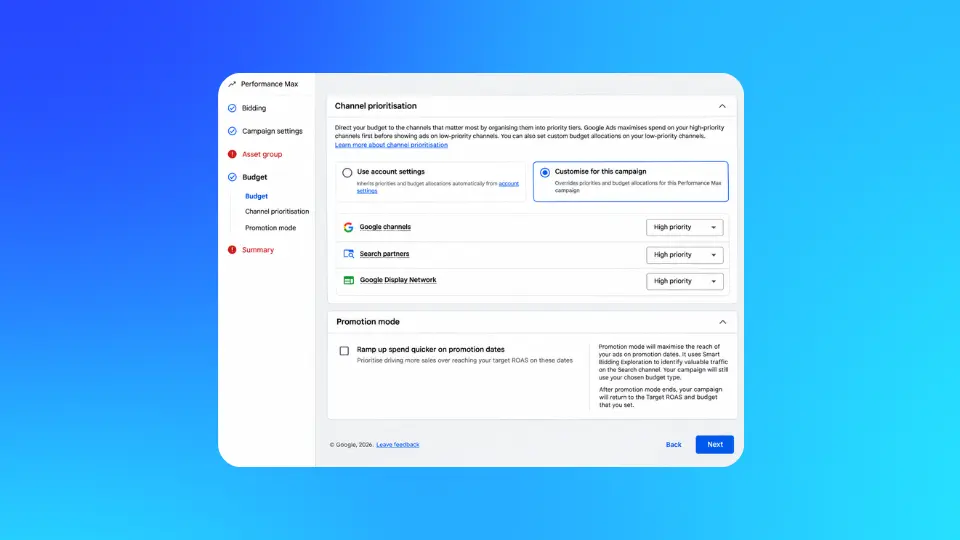
Google Ads is giving advertisers more control over their Performance Max (PMax) campaigns. According to Search Engine Roundtable, Channel Prioritisation and Promotion Mode have been spotted under the Budget menu when creating new campaigns. The features aren’t entirely new, but their appearance during setup is a notable change.
Channel Prioritisation lets advertisers favour certain networks and limit spending on others. Promotion Mode offers a temporary relaxation of return on ad spend (ROAS) targets alongside additional daily budget, allowing campaigns to pursue more conversions during high-demand periods. Availability may vary by account.
The gurus’ take
With Black Friday, Cyber Monday and Boxing Day approaching, these controls have arrived at an interesting time for Aussie retailers. But more control doesn’t automatically mean better performance. We’d recommend reviewing your channel-level results before touching those priority settings.
A placement with modest direct conversions might still influence customers who purchase later through another channel. There’s also an important limitation: PMax groups Search, YouTube and other Google-owned surfaces together, so you can’t prioritise each individually. And Google’s budget allocation percentages operate on a best-effort basis. Treat these settings as spending guidelines, not an airtight budget lock.
Promotion Mode presents another opportunity, especially for retailers expecting short bursts of demand. However, loosening your ROAS target while increasing spend could become expensive if your promotional margins are already tight. Before making adjustments, calculate how much acquisition cost your discounted products can realistically absorb.
Factor in fulfilment costs and expected returns, too. We’d also recommend setting a firm promotional window and monitoring conversion value alongside spend, rather than celebrating increased traffic alone. A seasoned Google Ads agency knows that a campaign can generate impressive sales figures while quietly eating into profitability. The goal is to capture additional demand without sacrificing the returns that make those sales worthwhile.
Your action plan
- Check whether Channel Prioritisation and Promotion Mode are available in your Google Ads account before finalising campaign plans.
- Review channel-level conversion value and acquisition costs before adjusting spending priorities.
- Calculate your break-even ROAS using promotional margins, discounts and fulfilment costs.
- Test lower-priority allocations cautiously and monitor whether previously valuable placements lose conversion volume.
- Set clear start and end dates for temporary promotional budgets and relaxed ROAS targets.
- Monitor daily spend, conversion value and campaign pacing throughout Black Friday and Cyber Monday.
- Review campaign performance after each sale period and restore your usual bidding targets and budgets where appropriate.
Google Rolls Out Gemini 4 Neon As Its Latest Search-Ready AI Model

Google’s Gemini family has another addition. On November 18th, Google introduced Gemini 4 Neon, following recent releases of Gemini 4 Carbon and Hydrogen. Designed for complex reasoning and demanding enterprise tasks, Neon delivers high-level performance with faster processing and lower costs than larger models. It can also analyse text, images, audio and video within a one-million-token context window.
There’s an important distinction for marketers, though. Google has confirmed that Hydrogen is powering its latest Search upgrade, while Neon is currently rolling out across Gemini and developer platforms. Neon hasn’t been announced for deployment in Search.
The gurus’ take
Another Gemini model, another reason to check your search visibility reports. But before rushing to overhaul your content strategy, remember that a new AI model doesn’t automatically mean a new search ranking system. What’s more relevant is Google’s confirmed Hydrogen upgrade, which improves how Search interprets complex questions and discovers supporting information through query fan-out.
For digital marketers, this strengthens the case for content that answers specific questions thoroughly. We’d focus on the gaps competitors aren’t addressing, particularly detailed comparisons and technical information that helps buyers make informed decisions.
Here’s where we’d get more analytical. Rather than tracking AI visibility as one big metric, segment your monitoring by search intent. A brand appearing in an informational AI Overview tells a different story from being cited when someone compares competing services. Track both, but pay closer attention to the queries influencing commercial decisions. Google’s generative AI performance reports in Search Console provide another useful source of visibility data.
Combine those findings with regular manual checks of AI Mode responses and your conversion analytics. We’d recommend reviewing high-priority queries weekly, especially while Google continues updating its models. Just don’t rewrite a perfectly good page because it disappeared from one AI response. Look for sustained patterns before making substantial changes.
Your action plan
- Monitor Google’s official announcements to distinguish confirmed Search deployments from standalone Gemini model releases.
- Review AIOsand AI Mode visibility for your highest-value commercial queries every week.
- Record which competitors receive citations and identify the topics their referenced pages cover more effectively.
- Use Search Console’s generative AI performance reports to spot changes in impressions and visibility.
- Compare AI search visibility trends against organic traffic, qualified enquiries and conversions.
- Update content where genuine information gaps exist, especially in comparisons and detailed product information.
- Track visibility across several weeks before making major content changes based on individual AI responses.
Microsoft Advertising Rolls Out Its Biggest Bidding Upgrade In A Decade
Microsoft began automatically rolling out its biggest automated bidding overhaul in a decade on November 18. The rebuilt models use additional signals to predict which clicks will convert and how much those conversions could be worth.
Microsoft says campaigns can reach full budgets sooner, distribute spending more evenly and respond to CPA or ROAS target changes nearly twice as quickly. Its internal data also reports 10% more conversion value per click at a similar ROAS for certain value-based bidding strategies.
The gurus’ take
The first question shouldn’t be how quickly you can adjust bids. It should be whether you’re giving Microsoft’s algorithm the right definition of success. Faster optimisation means little if your conversion tracking treats a qualified enquiry and a junk lead equally.
For eCommerce, check that conversion values reflect actual transaction amounts. For lead-gen, consider feeding qualified lead data back from your CRM. And don’t overlook your sales team. They might notice a drop in lead quality long before your dashboards suggest anything’s wrong. Better bidding starts with better conversion data, not more aggressive targets.
The other consideration is timing. With peak shopping season approaching, changes in consumer demand could coincide with Microsoft’s bidding updates, making performance fluctuations harder to diagnose. We’d recommend establishing a baseline before making major adjustments. Compare daily spending patterns, conversion delays and ROAS against previous periods, accounting for seasonal promotions. Remember, a faster algorithm doesn’t make customers purchase any sooner.
This is where working with an expert Microsoft Bing Ads agency pays off. Sometimes, the smartest optimisation decision is leaving a healthy campaign alone long enough to understand what’s changing.
Your action plan
- Record your current daily spend, CPA, ROAS and conversion volume to establish a performance baseline.
- Compare hourly spending patterns against historical performance, accounting for seasonal changes in demand.
- Audit conversion tracking to confirm purchase values and qualified leads are being recorded accurately.
- Adjust CPA or ROAS targets in increments of approximately 15% to minimise bidding volatility.
- Allow at least one conversion cycle before evaluating incremental target changes.
- Avoid changing bid strategies and conversion goals simultaneously, as this complicates performance analysis.
- Review maximum CPC caps that could restrict automated bidding from pursuing valuable conversions.
- Monitor campaign performance daily throughout Black Friday and Cyber Monday.
Big changes deserve smarter marketing decisions
Platforms rarely coordinate their updates with your campaign calendar. For marketing teams, the advantage is knowing which changes need closer monitoring and which can wait until the data tells a different story.
At Online Marketing Gurus, over 14 years of experience and world-class SEO expertise shape our approach to those decisions. We turn developments in paid media and generative engine optimisation into practical priorities, with performance data rather than platform hype guiding the work.
Whether you’re reviewing bidding efficiency or reconsidering your AI search visibility, our gurus can identify where your investment could work harder. Contact us for a free strategy session to uncover performance gaps and plan your next moves.

About the author
Read More Blogs
-
 11 minutes read
A New Way To Be Found On Google & This Week’s Must-Know Updates

Last updated on:
-
10 minutes read
The Google & Meta Moves To Act On Before Peak Season
Last updated on:
-
Last updated on:

Stop Guessing What Your Marketing Should Do Next.
Your free $4,000 strategy session shows where your digital marketing is leaking performance across search, paid media, content and conversion. You leave knowing what to fix first and what a stronger strategy could produce.