

The Tech Titan’s Battle: Will Facebook and Google Leave Australia?


Last updated:
25 July 2025
|
13 minutes readKey Takeaways
- Coverage of proposed legislation in Australia requiring tech platforms to pay news publishers, prompting threats from Facebook and Google to withdraw.
- Legislation prompted by ACCC requires digital giants to collectively bargain with news outlets.
- News publishers depend heavily on referral traffic from Google and Facebook, while platforms rely on news content for ad inventory.
- Social platforms warn that mandatory payments could reduce access to news for Australians.
- Nearly 94% of Australians use Google, so a platform withdrawal could significantly impact information access and online advertising.
Will Facebook and / or Google Really Leave Australia?
There is so much chatter but will Facebook and / or Google leave Australia? Unless you’ve been living under a rock, you’ll have heard that Australia could soon pass a law that forces Facebook and Google to pay for news. And Google has threatened to leave Australia as a result.
This is a game-changer.
The News Media Bargaining Legislation has the potential to change the way media companies publish news, the type of news we see online, how we consume content, and where digital advertisers spend their marketing dollars.
And, as we’re already seeing, the legislation has the power to impact the future of Facebook and Google in Australia.
If it sounds like we’re being over-dramatic, read on.
Whatever your role, whatever your business, it pays to understand the News Media Bargaining Legislation and what it means for the digital landscape. Now, especially the digital marketing landscape in Australia and how this may affect Australia’s SEO agencies approach to organic and paid search marketing.
Because things are about to change, big time!
Why is Google threatening to leave Australia?
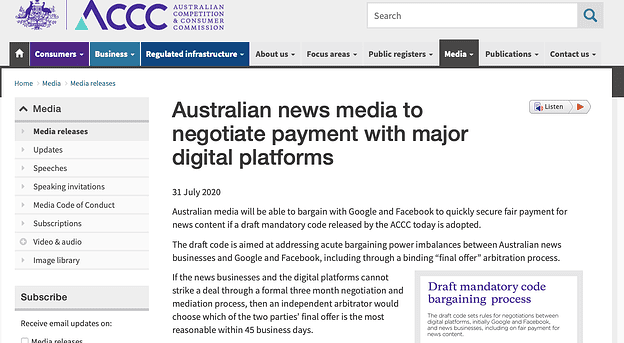
A new law will say if Google will leave Australia. The proposed law, announced by the Australian Competition and Consumer Commission (ACCC) in July, allows Australian news media companies to bargain – individually or collectively – with Google and Facebook so they will be paid for content published on their platforms.
That’s right – under the new code, Facebook and Google pay news companies in Australia such as Nine Entertainment and News Corp Australia for the existence of articles on their platforms.
Why will Google leave Australia – if they do?
The news payments proposal comes off the back of the ACCC’s Digital Platforms Inquiry, which was established in 2017 by the Federal Government, to explore the potentially detrimental impact digital platform giants are having on Australia’s media and advertising landscape.
The inquiry found Google and Facebook’s failure to pay for news content is eating into the advertising revenues which fund large media companies like Murdoch’s News Corp.
According to Australian Competition and Consumer Commission chair Rod Sims, the draft code aims to address “a significant bargaining power imbalance” between news publishers and major digital platforms, to bring about fair payment for news.
As Treasurer Josh Frydenberg said: “It is only fair that the search engines and social media giants pay for the original news content that they use to drive traffic to their sites.”
The situation in Australia
At the core, it’s about the relative market power of the Australian news publishers and the tech giants.
The reality is that Australian news publishers and the digital platforms need each other. Google and Facebook are gateways to the internet for almost every Australian, so news companies have little choice but to distribute their content via these platforms.
As a result, more than half the Australian population finds news via the platforms, a 2019 University of Canberra digital news report found.
Publishers get the benefit when Google and Facebook send readers back to their news websites. And it benefits the platforms because they monetise these audiences by selling advertising against the attention paid to news posts. Of course, the platforms also collect masses of data about those users, which helps them target advertising.
The problem is, this causes Facebook and Google to become more attractive to advertisers than the media publishers, who are competing for advertising dollars and losing.
The ACCC estimates that Google collects 47% of all online advertising in Australia and Facebook collects 21% (excluding classifieds).
What does the law mean for Google and Facebook?
Facebook and Google are NOT happy. Both have published open letters telling the public exactly how unhappy they are.
Facebook said the proposed legislation misunderstands “the dynamic of the internet” and will actually damage “the very news organisations the government is trying to protect”.
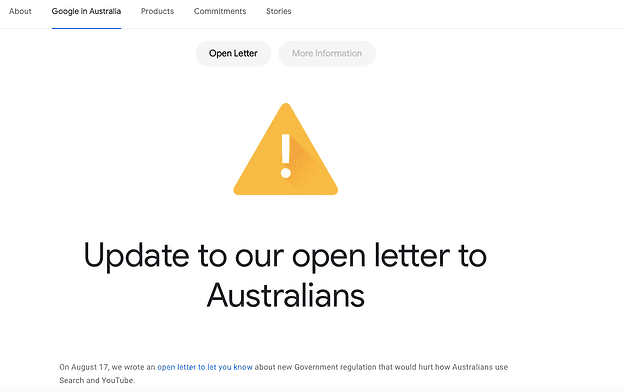
In Google’s open letter, it says the law “would force us to provide you with a dramatically worse Google Search and YouTube.” And it has flagged it may pull its services from Australia entirely.
In Australia, Google accounts for 94.45% of the search engine market (statcounter), with its nearest competitors, Bing and DuckDuckGo, accounting for 3.61% and 0.85%, respectively.
Meanwhile, Facebook is pulling out the big guns. The social media behemoth is threatening to ban news from being shared by people and publishers on its main app and Instagram in Australia.
Facebook said: “We are left with a choice of either removing news entirely or accepting a system that lets publishers charge us for as much content as they want at a price with no clear limits. Unfortunately, no business can operate that way.”
What do the major news publishers say?
As you’d expect, Nine Entertainment, Guardian Australia and News Corp Australia support the draft code as a way to offset the loss of advertising revenue to the tech giants.
What does this mean for the digital landscape?
If something affects Google and Facebook, it affects the whole digital landscape.
We can’t possibly understand the full implications on the digital landscape yet, but there are some early indications of what we should watch:
Risk to data sharing and privacy
One of the biggest issues raised by Google and Facebook is around what they will have to give up to the media companies: DATA.
It’s no secret how important data is to these platforms. Data is their currency. It’s how they make billions of dollars in revenue through advertising. And this law is asking them to give up some of that data to news organisations.
Specifically, under the proposed law, the platforms have to tell news businesses “how they can gain access” to data about how people use their products.
Google argues that there’s no way of knowing if any data handed over would be protected, or how it might be used by news organisations. That raises issues of data privacy.
According to The Office of the Australian Information Commissioner (OAIC), which manages privacy requirements, the digital platforms collect large amounts of user data about individuals, but it’s not always possible to draw a line between personal information and de-identified information.
The OAIC has recommended the ACCC conduct a privacy impact assessment for any proposals to share user data under the bargaining code, and identify measures for managing, minimising or eliminating any privacy impacts.
That’s not all.
The OAIC has proposed a new, binding privacy code that will apply to social media platforms and other online platforms that trade in personal data.
The code will require platforms to:
- Be more transparent about data sharing
- Meet best practice consent requirements when collecting, using and disclosing personal information
- Stop using or disclosing personal information on request
- Comply with specific rules to protect the personal information of children and vulnerable groups.
Algorithm transparency
The issue of algorithm transparency is a big one. The code lists some “minimum standards” that digital platforms need to meet. One of them is that tech giants must provide news businesses with advance notice of significant core changes to their algorithms.
Why?
Because when Google makes changes to the underlying algorithm, it affects how sites are ranked and which content is served up in response to search queries.
The Press Council argued that it takes considerable time and cost for publishers to adjust their sites after an algorithm change to ensure their pages don’t lose ranking in search results. For small publishers, this is especially important.
This is incredibly controversial.
The code will state that if an algorithm change is likely to impact either the ranking of paywalled content or referral traffic to the news, Facebook and Google have to give news businesses 28 days’ notice of the change:
“The notice must describe the change and effect on referral traffic in a way that is readily comprehensible and must describe how a registered news business can minimise the effects of the change on the ranking of its news content.”
That’s right – they will have to explain their very complex algorithms in layman’s terms to help news businesses work around it.
If this seems unfair to every other business with a website, that’s because it is. News organisations get insider information on future intentions and projects of Google and Facebook, with instructions on how to benefit.
Google argues that “news media businesses alone would be given information that would help them artificially inflate their ranking over everyone else, even when someone else provides a better result.”
Rethinking digital advertising if Facebook and / or Google Leave Australia
The law will inevitably shift the dynamics of digital advertising. Many businesses have become dependent on Facebook and Google to get their products and services in front of the right audiences.
However, if the law goes ahead, there are advantages to be gained by spending digital marketing dollars with the media companies.
With increased traffic to serve ads, media organisations should be able to pass on a better, more complete picture of who their audiences are. This is a valuable drawcard for advertisers.
However, again, we will only understand the full impact when the law is in place.
User generated content
The ACCC’s draft code raises a range of issues for user generated content, or user comments. In fact, it could infringe on the freedom of speech in Australia.
The draft code gives news businesses the ability to:
- Remove or filter user comments
- Disable entirely the making of user comments
- Block user comments by particular users and accounts
Media businesses are allowed to tamper with the comments section of their news content on Facebook. Not just their own media platforms, but Facebook too.
What about copyright?
Will it become illegal for users to share news on Facebook?
The answer is, no.
In a submission to the ACCC, the non-profit group Australian Digital Alliance wanted to continue to allow individuals and organisations to share news under Australian copyright law.
It’s asked for the ACCC to “avoid language such as ‘licence’ or ‘royalty’, as this implies that a use is remunerable under intellectual property law.”
Striving for a healthy news environment
No doubt the ACCC is faced with a dilemma. Google warned that if Australia goes ahead with the plan, the quality of regional search results and YouTube recommendations will suffer. In Google’s words, they will become “less relevant and helpful” – which directly goes against everything Google strives for.
The result?
Lower grade content will be left to thrive. We’re talking about clickbait and even fake news.
How do we know Google is not bluffing?
Because it’s not the first time a country has tried to force Google and Facebook to pay companies for republishing their news. Nor is it the first time they have responded aggressively.
We saw it in Spain in 2014 when Google was asked to pay publishers for the news snippets it displayed. In response, the company removed the Google News service from Spain and took Spanish publishers off its global news service.
In 2019, France wrote into law an EU copyright directive that demands Google pays for the news content that appears on its sites.
Google responded by removing French publishers’ snippets from its search results and did not pay for links.
Update** Did Google leave Australia?
No, Google did not leave Australia in the end. The tech giant had initially threatened to withdraw its search engine services from the country in response to the Australian government’s News Media Bargaining Code, which was designed to force platforms like Google and Facebook to pay news publishers for their content.
The dispute peaked in early 2021, with Google warning that the proposed legislation would make it difficult to continue offering free search services in Australia. However, rather than exiting the market, Google ultimately negotiated agreements with major Australian news organisations, including News Corp, Nine Entertainment, and the Australian Broadcasting Corporation (ABC). These deals allowed Google to continue operating in the country while compensating news publishers for their content through initiatives like Google News Showcase.
Facebook (now Meta) also took a strong stance, temporarily blocking Australian news content on its platform in February 2021. However, after further negotiations, Facebook also struck deals with publishers, and the government made some amendments to the legislation to address concerns from tech companies.
In the end, the News Media Bargaining Code became law, but Google remained in Australia, reaching commercial agreements with publishers rather than exiting the market. The situation set a global precedent, with other countries considering similar legislation to regulate how tech giants interact with news media organisations.
Update** Did Facebook leave Australia?
Actually for a short period yes. Facebook (now Meta) temporarily blocked news content in Australia in February 2021 in response to the News Media Bargaining Code, but it did not leave the country permanently. The Australian government introduced this law to force major tech platforms like Facebook and Google to pay Australian news publishers for their content. In protest, Facebook restricted Australian users from viewing or sharing news articles on its platform, which also affected government, health, and emergency service pages unintentionally.
However, after negotiations with the Australian government, Facebook restored news content and reached agreements with major Australian media companies to pay for news under commercial deals. The law was later amended to allow tech companies to make their own agreements with publishers before facing government intervention.
While Facebook initially took a strong stance, it ultimately remained in Australia and continues to operate, demonstrating the complex relationship between big tech companies and government regulations regarding digital content and media payments.
Will Google leave Australia? We don’t know for sure yet so stay ahead of the game
What this shows us, more than anything else, is that digital marketing is an ever changing, ever-shifting landscape. You need to stay on top of the changes and ahead of the game if you want to win. That’s true whether you’re a news giant, social media behemoth or a small business wanting to increase your sales revenue.
That’s why we recommend getting ahead of the game with our proven formula for high-ROI, high-revenue with digital – it’s all right here in this guide. Download your Digital Marketing Game Plan now! Or reach our if you have questions about SEO or need help with PPC ads like – Google AdWords ads or Facebook ads.

About the author
Read More Blogs
-
 10 minutes read
Are Your Search Campaigns Ready for the Google Ads Migration?

Last updated on:
-
10 minutes read
More AI In Search, More Ads In AI & More Choice For Social Users: This Week’s Updates
Last updated on:
-
Last updated on:



Stop Guessing What Your Marketing Should Do Next.
Your free $4,000 strategy session shows where your digital marketing is leaking performance across search, paid media, content and conversion. You leave knowing what to fix first and what a stronger strategy could produce.