

Why Online Digital Marketing Fails (And What To Do About It)


Last updated:
11 July 2025
|
17 minutes readKey Takeaways
- Without an audience-focused plan, marketing efforts often lack direction.
- Running ads without quality content or engagement won’t sustain results.
- Not knowing your customer’s needs leads to irrelevant messaging and low ROI.
- Measuring clicks instead of conversions ignores real business impact.
- Lack of analytics and testing causes campaigns to underperform or stagnate.
Guide To Identify and Recover From Digital Marketing Fails
Digital marketing fails are more common than most people realise. It’s not uncommon for results to fall flat. But that doesn’t mean you should settle for unsatisfactory results.
Done right, digital marketing delivers spectacular results in terms of quality leads and business growth. Take a look at the digital marketing stats.
So why are some businesses getting results while others scream in frustration?
In this article, we uncover the most common reasons why digital marketing fails and how to dodge digital marketing mistakes.
Ditch These 8 Digital Marketing Fails
Mistake #1. Not Having a Clear Strategy
This is the number one mistake, yet many marketers and small business owners don’t realise they’re making it.
You don’t have a clear marketing plan.
The classic approach is to do a bit of this and a bit of that, measure nothing and burn through a lot of cash.
Maybe you think that a learning a bit about SEO, occasional content posting and sporadic Facebook posts counts as a online marketing strategy.
The worrying fact is that:
45% of marketers report having no clear strategy at all, or at least not one they could articulate.
Yet effective marketing strategies are proven to help create a digital marketing machine that brings sustained organic growth and a return on investment.
“Focus on long-term planning and forecasting by prioritising strategy over tactics. Don’t focus on being in every communication channel, focus on the ones that are most appropriate for your business and will deliver the greatest result.
Use tactics sparingly but focus on strategy.” — Jamie Black, Salted Stone
In other words, document your strategy and have a clear view of the steps you’re going to take in the future.
It’s the only way to ensure you are consistent and goals-driven with your marketing tactics.
As part of your strategy, create a realistic marketing budget. A decent budget is critical to ensure you have the resources for getting the results you need.
Mistake #2. Not Using Automation Tools
One of the biggest digital marketing fails is not recognising the scale of the job you’re facing.
You try to do everything yourself and end up running out of time.
Rather than pulling ahead of the competition, you’re constantly playing catch-up. As a result, you constantly miss out on opportunities to win new leads and customers.
There is a solution:
Marketing automation tools.
Did you know…
Spending on marketing automation tools is expected to reach $25.1 billion annually by 2023 (Martech Today, 2018).
Here’s why:
- Companies that automate lead management see at least a 10% increase in revenue in 6-9 months. (Strategic IC, 2017)
- 79% of top-performing companies have been using marketing automation for 3+ years. (Venture Harbour, 2017)
- Two-thirds of marketing leaders currently use a marketing automation platform. (Salesforce, 2017)
- Almost two-thirds of marketers claim to have seen the benefit of marketing automation within 6 months of implementation.
- Marketers who rely on automation generate 2X the number of leads than those who use blast emails.
The question is, which tools should you invest in?
Start with something like Zapier or HubSpot, which let you automate everything.
HubSpot is probably the best-known marketing automation software. You can access a stack of sales, marketing and customer service tools based on a central CRM.
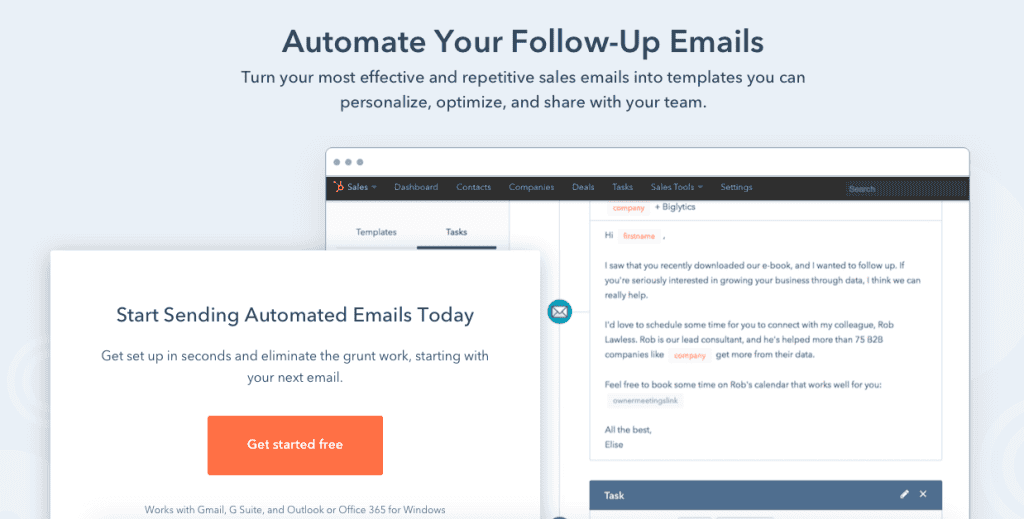
(Source: HubSpot)
Then there are tools like Google Analytics, which provide up-to-date stats on your digital marketing performance. These are insights that you can act on to improve your campaigns and get results.
Mistake #3. You Don’t Provide Content for Every Stage of the Customer Journey
Fact: You have a marketing funnel.
Even if you don’t realise it yet, your customers go through several stages to become a customer:
- Awareness
- Consideration
- Purchasing
- Retention
- Advocacy
Here’s a top marketing fail that trips many people up:
Each stage of the funnel requires different content.
Let’s see how that works:
At the awareness stage, people have figured out that they have a problem and they’re looking for ways to solve it. They want to read blog posts and eBooks that help them whittle their broad questions down into something more precise.
Those at the consideration stage understand the problem and now want to find a solution. They’re looking at multiple solutions, of which you offer one. You need content that positions your solution as the best of the bunch.
At the purchasing stage, the customer is ready to buy something. The content you created for the consideration stage has established you as an option. Your purchasing pages need to offer the solution as quickly and effectively as possible.
As for retention, you’re looking at the long-term goals of the customer. You want to consistently delight them by showing that you’re supporting them and can offer services that make their lives easier. Emails, newsletters, and social media platforms all offer you the chance to engage with existing customers and personalise your interactions and content.
Finally, when you want to keep an existing customer as a loyal advocate, you need to continue to nurture the relationship. How? With engaging articles and helpful videos focusing on how to get the best from their product or service.
All of these stages fall into your wider digital marketing plan, so don’t focus on only one type of content.
Every piece of content that you create has to appeal to a specific stage of the marketing funnel.
Moreover, you have to target it to the right audience for maximum effect.
That means crafting your website content with the entire customer journey in mind.
That goes for all your digital marketing tactics.
Take paid search ads.
Consumers at different stages of the funnel use different phrases when searching for what they want. So, you need to do keyword research for each stage and target these keywords in your pay per click (PPC) strategy.
Bottom line? Know your target market and what they are searching for at each stage of the marketing funnel. It’s the only way to make sure you are serving the right content, at the right time, for maximum conversions.
Mistake #4. Failing to Promote
What do you do after creating a piece of content?
If you just put the content on your blog and wrap up, you are making one of the most common digital marketing mistakes.
Unless you already have a massively popular website, that isn’t going to cut it. The content may as well not be there at all.
Why?
Because you’re focusing on one channel and doing nothing to promote what you create.
Hitting publish is just the beginning.
To get your content seen by the right people on the right channels, you need to invest time and budget into paid, earned and owned media.
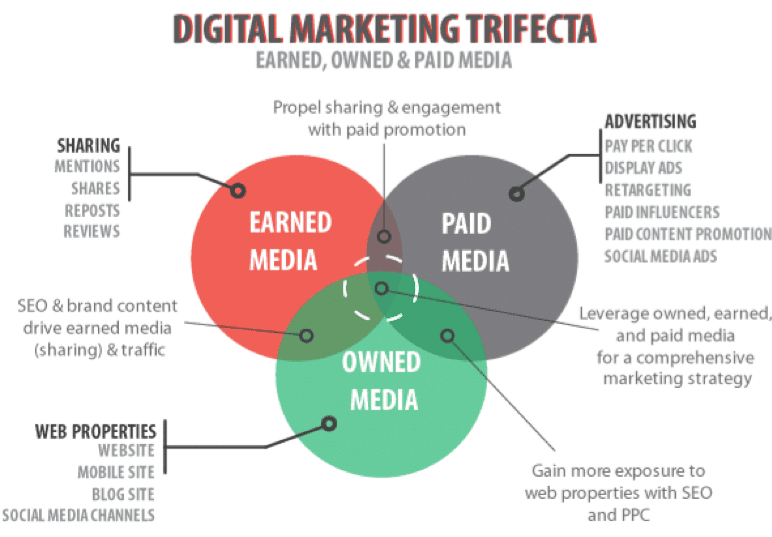
(Source: Medium)
Use social media platforms to build influence – Facebook, LinkedIn, and Twitter are all great places to share content.
But don’t just rely on organic posts.
Invest in paid social too.
According to Social Media Examiner, Facebook is the most popular paid content promotion platform used by marketers (and we’re not just talking social media marketers).
A staggering 84% of B2B marketers use Facebook ads to regularly drive traffic to their content.
Why? Because results show how it converts visitors into leads and customers.
Social media advertising is scalable and affordable – you can spend as little or as much as your digital marketing budget allows.
But by far the best thing about paid social is the incredible targeting capabilities. By getting your content in front of highly targeted audiences, you can ensure you drive conversions and get the best bang for your buck.
In the same Social Media Examiner report mentioned above, Google Ads (previously known as Adwords) came out as the second most popular paid content promotion strategy.
Again, Google Ads offers extensive research and targeting tools so you can be confident your content is reaching the right audience at the right time, while you wait for your long term organic search strategy to kick in.
Paid social and Google Ads are just two ways to promote your content. The trick is to leverage every channel you have to get your content seen by the right people at the right time.
Mistake #5. Failing to Split-Test
Data is the biggest source of truth when it comes to your digital marketing efforts.
Many people assume that their website, landing pages and paid ads are already performing to an optimal capacity.
The truth is that you should constantly test new ideas to see which work better.
That’s where split-testing comes in.
Use split testing for everything – your PPC ads, landing pages, web design, email marketing, and more.
Don’t try too many variations at once. The trick is to keep your variations simple, for example:
- Change the colour of a Call To Action / CTA button
- Change the placement of the CTA button
- Use different wording for headlines
- Test different images
- Different subject lines for email campaigns
Then, run both versions side by side and see which performs better by checking the data on Google Analytics.
If you find that variation B gets more engagements than variation A, you’ve just discovered a way to better optimise your page, PPC ad, or whatever you were testing.
This is what Conversion Rate Optimisation is about.
Conversion rate optimisation is an essential digital marketing tactic.
Think about it – you can always invest more budget to attract more traffic to your site.
But if you invest in converting MORE of those visitors, that’s where the real sustainable business growth lies.
Mistake #6. Failing to Keep Track of KPIs
Take a look at the top marketing challenges for companies:
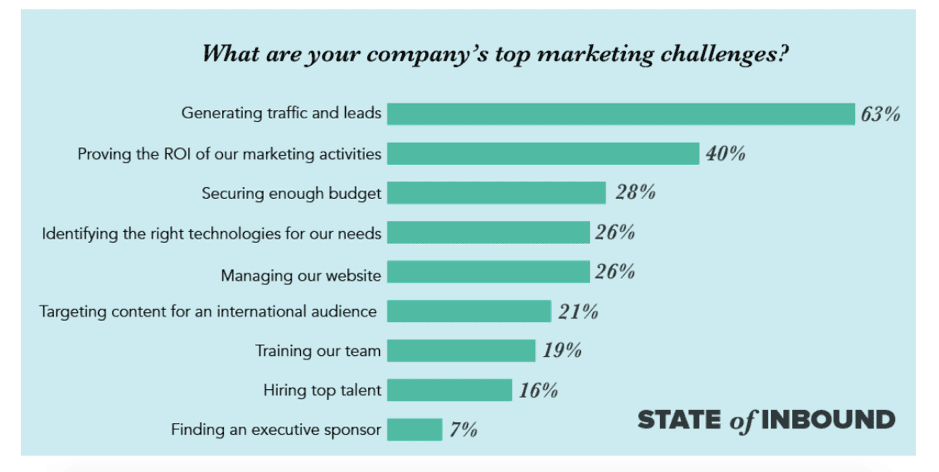
Source: HubSpot 2019
See the second challenge on the list?
Proving the ROI of our marketing activities.
The truth is proving the return on investment of your marketing efforts isn’t rocket science.
You simply need to measure the right KPIs (key performance indicators) for your marketing campaigns.
You’ll have these for every aspect of the business. They’re essentially the metrics against which you measure the business’s success.
Great KPIs for online marketing include:
- Increase in organic traffic
- Number of leads that a campaign generates
- Increase in qualified leads per month
- Cost per lead
- Conversion rate
- Return on Ad Spend (ROAS)
There are plenty more that may be relevant to your business.
Despite their importance, many companies don’t even create online marketing KPIs. And some of those that do don’t check them frequently enough for them to make a difference.
Worse still, many businesses don’t really understand what they’re looking for in a digital marketing KPI.
One of the biggest digital marketing mistakes is the assumption that heaps of Page 1 results or Facebook likes means you’re doing well.
But those results mean nothing if you’re not converting people into customers.
Good KPIs include your conversion rates or the amount of shares your content receives. You’re looking to measure engagement and, ultimately, conversions.
Define your KPIs before you invest in any marketing tactics.
Make sure your KPIs are:
- Measurable and actionable
- Directly tied to your company’s core growth goals
- Measure the metrics that are most crucial to the success of the business
- Limited to less than 10 major metrics
- Applied throughout the entire business
Once you have KPIs, keep track of them.
Another top reason why digital marketing fails is because marketers don’t stay on top of the data.
Use Google Analytics to track the most important metrics, such as your conversion rate, dwell time and average time on page, bounce rate, organic search rankings and more.
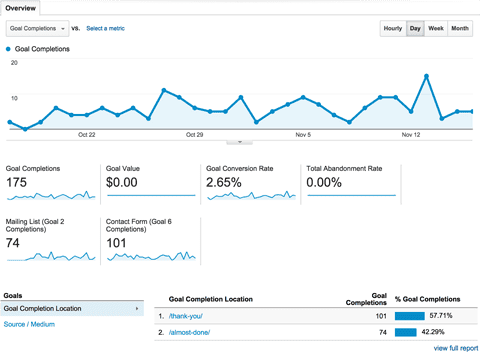
Image Credit: Social Media Examiner
Measuring actions is as important as numbers, so long as you do something with what you find out.
Mistake #7. Keeping silos between channels
Digital marketing success depends on more than using each channel in isolation. Generating a killer ROI is all about integrating channels, from search to chat, display, video, email and even offline.
Take a look at what happens when you integrate Pay-Per-Click / PPC advertising and email.
Did you know almost 50% of recipients open an email based solely on the subject line?
By using PPC to test the right subject lines, you can win the greatest engagement.
Now, look at social media and email.
You can use social media to drive email sign-ups.
While emails that include social media sharing buttons have a 158% higher click-through rate than emails sent without them.
What happens when you bring ALL your channels together?
At OMG, we worked with a leading fashion retailer, which had witnessed its search engine rankings collapse following a migration of its website. The brand wanted to rebuild its vanishing online presence.
So, we used the trifecta of PPC, website content and SEO together.
The result?
The client’s website had seen incremental growth of more than $2 million!
Mistake #8. Giving up too early
Last but not least – don’t give up too early.
Even though many channels will start producing uplifts really quickly, it takes TIME to mature a campaign to the point where it will consistently produce a high ROI.
And ROI is always the long term goal.
Here’s our rule of thumb: success takes time.
Google Ads and Facebooks Ads often offer the quickest ROI, but still expect 3-4 months of setting up campaigns, testing, and optimising before you’ve created a well-oiled machine.
In comparison, SEO often brings in the highest ROI. However, you’ll need an average of 8-12 months to “mature” an SEO campaign. Over time, you’ll generate the highest quality and quantity of traffic you can get.
Patience is the key!
Top 10 reasons Why Digital Marketing Fails & How to Improve Your Strategy
Digital marketing is a powerful way to grow a business, but many campaigns fall short due to poor execution, misaligned goals, or a lack of strategy. If your digital marketing efforts aren’t delivering results, understanding common pitfalls and how to address them can make a significant difference.
1. No Clear Strategy or Goals
One of the biggest reasons digital marketing fails is the lack of a structured strategy. Many businesses invest in campaigns without setting measurable objectives, leading to wasted time and resources. Without a clear roadmap, it’s difficult to track success or adjust efforts effectively.
To improve, businesses should define SMART goals—specific, measurable, achievable, relevant, and time-bound. A documented digital marketing strategy should outline key objectives, audience targeting, content plans, and performance metrics. Aligning marketing efforts with broader business goals ensures that every campaign contributes to long-term growth.
2. Targeting the Wrong Audience
Even the best campaigns will fail if they don’t reach the right people. Poor audience segmentation leads to low engagement, high bounce rates, and ineffective ad spend. Businesses often target too broad an audience or fail to understand their ideal customer’s pain points and motivations.
A successful digital marketing strategy requires well-defined buyer personas based on real data. Insights from Google Analytics, Facebook Ads, and customer feedback can help refine audience targeting. Continually testing and optimising campaigns based on performance metrics ensures better engagement and higher conversion rates.
3. Poor Website User Experience (UX)
A well-designed website is crucial for digital marketing success. If a site is slow, difficult to navigate, or not mobile-friendly, visitors will leave before taking action. Poor user experience affects SEO rankings, conversion rates, and brand credibility.
Improving website UX starts with fast loading speeds, intuitive navigation, and a mobile-responsive design. Conducting regular website audits, using heatmaps to analyse user behaviour, and optimising landing pages can enhance the customer journey and improve conversions.
4. Ignoring SEO Best Practices
Without proper search engine optimisation (SEO), even the best content may never reach its intended audience. Many businesses overlook SEO, relying only on paid ads or social media to drive traffic. However, SEO is a long-term strategy that builds sustainable organic visibility.
To improve, businesses should focus on high-quality content, proper keyword usage, on-page optimisation, and technical SEO. Regularly updating content, building authoritative backlinks, and ensuring mobile-friendliness can significantly enhance search rankings and increase organic traffic.
5. Over-Reliance on Paid Ads Without Organic Growth
While paid advertising is a great way to boost visibility, relying solely on ads without investing in organic digital marketing efforts can be costly and unsustainable. Once the ad budget runs out, so does the traffic.
A balanced strategy should include both paid and organic marketing efforts. SEO, content marketing, and social media engagement provide long-term benefits, while paid ads can be used strategically for short-term gains. Diversifying marketing efforts ensures sustained growth even when ad spend fluctuates.
6. Weak or Inconsistent Content Marketing
Content is at the core of digital marketing, but many businesses either produce low-quality content or fail to maintain consistency. Irrelevant, outdated, or sales-heavy content does not engage audiences or add value.
A strong content marketing strategy should focus on providing useful, high-quality information that aligns with customer needs. Blog posts, videos, case studies, and infographics should be well-researched, engaging, and optimised for search engines. A content calendar helps maintain consistency and ensures regular updates.
7. Lack of Social Media Engagement
Social media is a powerful tool for brand awareness, customer engagement, and community building, but many businesses either neglect it or use it ineffectively. Simply posting content without engaging with followers limits reach and impact.
To improve, businesses should actively interact with their audience through comments, direct messages, and social listening. Content should be tailored to each platform, and engagement metrics should be tracked to refine the social media strategy.
8. Failure to Track and Analyse Performance
Without tracking and analysing marketing performance, businesses cannot determine what’s working and what needs improvement. Many marketing efforts fail because they lack proper measurement and optimisation.
Using tools like Google Analytics, Search Console, and social media insights allows businesses to track key performance indicators such as website traffic, conversion rates, and audience engagement. Regular performance reviews enable data-driven decisions and ongoing improvements.
9. Poor Email Marketing Strategy
Email marketing remains one of the most effective digital marketing tools, but it often fails due to generic messaging, poor segmentation, or lack of personalisation. Many businesses either spam their subscribers or fail to nurture leads effectively.
A successful email marketing strategy includes well-segmented lists, personalised messaging, and automated workflows. Providing value through exclusive content, promotions, and useful insights encourages higher engagement and conversions.
10. Unrealistic Expectations and Lack of Patience
Many businesses expect immediate results from digital marketing and give up too soon. SEO, content marketing, and organic growth take time, and abandoning strategies too early can result in lost opportunities.
Digital marketing is a long-term investment that requires consistent effort, testing, and optimisation. Setting realistic expectations and continuously refining strategies based on data ensures sustainable success over time.
Digital marketing fails when businesses lack strategy, fail to engage their audience, or ignore key optimisation practices. By setting clear goals, refining targeting, improving website experience, and tracking performance, businesses can create a more effective and sustainable digital marketing strategy.
Over to you
At the end of the day, digital CAN deliver huge growth, real sales, and tangible impact when you’re onto a winning campaign. Why not skip all the hurdles and hiccups, and go straight for the proven formula?
We’ve figured out a repeatable process for high-ROI, high-revenue with digital in this guide.
If you need help then reach out. As Australia’s number 1 rated digital marketing agency and the top Australian SEO services agency this is what we do and no one does it better!

About the author
Read More Blogs
-
 10 minutes read
Are Your Search Campaigns Ready for the Google Ads Migration?

Last updated on:
-
10 minutes read
More AI In Search, More Ads In AI & More Choice For Social Users: This Week’s Updates
Last updated on:
-
Last updated on:




Stop Guessing What Your Marketing Should Do Next.
Your free $4,000 strategy session shows where your digital marketing is leaking performance across search, paid media, content and conversion. You leave knowing what to fix first and what a stronger strategy could produce.