

How to Implement Faceted Navigation for Improved SEO and UX


Last updated:
25 July 2025
|
14 minutes readKey Takeaways
- Faceted navigation is a filtering system, common in ecommerce, that lets users refine product listings by attributes like size or colour.
- Improper implementation can cause duplicate content, diluted link equity, and unnecessary crawl paths.
- Best practices include selective indexing, canonical tags, and using robots directives to manage faceted URLs.
- Auditing with tools like Screaming Frog helps assess crawl vs. index ratios and identify SEO issues.
- Applying “nofollow” to deep facets prevents link dilution while maintaining UX functionality.
Guide to improving your SEO and UX with faceted navigation
If you work with large eCommerce sites, you likely need or work with a system for faceted search. While faceted navigation makes it easy for customers to find what they’re looking for using specific search parameters, it can be a nightmare for SEO, twist your rankings and cause duplicate content.
Imagine having hundreds of thousands of product pages and the most important ones being missed by Google. That could hit your organic traffic bad and you don’t want that. That’s why, when using faceted navigation, it’s important to be aware of what kinds of problems it could have for your SEO and know how to handle these situations.
In this guide, we’ll walk you through what kinds of sites typically use faceted navigation and the common issues faceted navigation can cause for Search Engine Optimisation (SEO). We’ll also provide you with some of the best ways to implement faceted navigation so you won’t have to worry about it holding back your ecommerce site’s success.
Let’s get started.
What are ‘Faceted Navigation’ and ‘Faceted Search’?
Faceted search, or faceted navigation, is a navigation system that exists on-page for ecommerce sites and any website that deals with extensive lists of results. Choosing faceted navigation makes the user interface easier to navigate when dealing with large amounts of products or information.
And why is that? Faceted search enables shoppers to personalise a page for what they’re searching for, and it can also help shoppers search specific long-tail keywords related to the product they’re trying to find. Usually, faceted navigation menus are located on an ecommerce site’s sidebar and offer multiple categories, facets, and files.
Now you’re probably thinking, what’s the difference between filters and facets?
Filters Vs. Facets
Many people think that filters and facets are the same things. After all, they both serve the same purpose: to help narrow down the search results by eliminating irrelevant results or pages.
Let’s start with filters:
Filters are broad categories that a user can select to narrow down their search results. Sometimes, users can choose the filters they want before submitting the search query, or the page presents them with filter options after receiving their search results. Filters won’t change between search queries. They will stay the same and not adjust depending on the search results. Because of this, the filters should be very general. On an ecommerce site, filters will be your broad categories, such as Boots or Hats.
Okay that was pretty straightforward.
How do facets fit into this picture then?
Unlike filters, facets are particular. They are directly related to your search results and will adjust each time you enter a search query.” Facets are always relevant to a specific search query. Different facets will be displayed for each separate search query. Multiple facets can be selected at one time, making them very specific and efficient. They are vital when wading through vast volumes of pages.
Let’s take the eCommerce gym apparel site Ryderwear, for example.
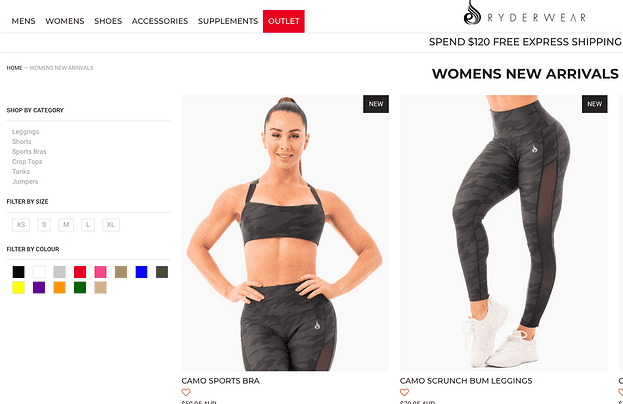
When we go to the Women’s New Arrivals shopping page, the clothing sizes and colours would be filters.
Let’s say we click on the filter “S”. The URL changes to /womens-new-arrivals/size-xs.
If we adjust the filters again, and want to narrow our search down to “S” and “Black” clothing, we get a new URL /womens-new-arrivals/size-xs+colour-black. We can see that it has excluded all products outside of the filters i.e. that aren’t black and all other sizes apart from S.
On the other hand, the categories such as Leggings, Shorts and Sports Bras are facets. When we select the facet “Crop Tops”, the search results we get are now dependent on our previous filters by “S” and “Black”.
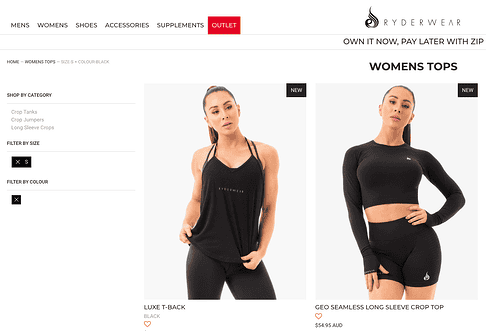
Source: Ryderwear
We can also see that if we select “Crop Tops”, the categories i.e. facets change again based on the last search query, so the page now displays the categories “Crop Tanks”, “Crop Jumpers” and “Long Sleeve Crops”. This is helpful if a user realises the products displayed on the page are still not specific enough to what they were looking for.
Say they were actually wanting a cropped jumper in Black and S, in that case, they can click on the faucet “Crop Jumpers” to refine the search.
What types of sites use faceted navigation?
The most common type of site to use faceted navigation is eCommerce sites. Other types can include publisher sites for filtering by content type, date, or topic and classified sites to help job searchers or house hunters filter for factors like location. Any other large websites of any type can also use faceted navigation to help users find what they need. Most large websites will have some kind of faceted navigation.
The best set up and implementation of faceted navigation depends on the individual website, industry and products / services. It differs so vastly from one website to another. If you don’t know 100% what you’re doing, it’s better to ask for an expert’s opinion.
Depending on your website build and design, there may be other factors that influence your SEO. For instance, Shopify dictates your hierarchical structure and technical issues often arise with duplicate product page URLs.
For more tips for your eCommerce site, it might be worth taking a look at our ultimate guides to Magento and Shopify SEO, or get in touch with us for a no-obligation Free Online Digital Marketing Audit to discuss your SEO game plan.
What problems can faceted navigation cause for SEO?
Now that we know what faceted navigation is, you’re wondering why is it a problem for your eCommerce site?
This causes several SEO problems:
Duplicate content
While faceted navigation is excellent for search users it can be a problem for SEO because facets create multiple versions of the same URL.
Many facets don’t change the page content much or at all. Sometimes facets will show the exact same products, just in a different order.
With faceted navigation, a unique URL is created for every faceted search query. The system either dynamically creates it, or it will include factors that specify how the category URL behaves. For every possibility, the system is creating new landing pages in real-time.
What does that mean?
If you’re not careful, the faceted navigation can create a significant problem with duplicate pages and content. Duplicate content drains authority and link equity.
Diluted link equity
Internal linking will be spread across multiple URLs because instead of one variation of a page to link to, there can be hundreds of pages. Instead of one page getting the benefit of all the links, some of the links go to duplicate pages.
That’s why you have to anticipate problems with dynamically generated URLs and understand how to fix them.
Crawl waste and crawl traps
URLs and slugs give web crawlers information about how the page fits into your website architecture and how to understand the information on the page. Using the wrong URLs can confuse the search engines, and they can cause duplicate pages to be indexed.
Update your robots.txt file and make sure that duplicate pages won’t be crawled and indexed, and you want the process to happen automatically when each duplicated is created. If your duplicate pages can be crawled, then you’ll end up with crawl waste where Google will spend too much time crawling duplicate pages and may not have time and may miss crawling your most important pages.
Examples of SEO issues created by faceted navigation
Now that you know faceted navigation is, let’s take you through some examples of SEO issues that you might run into.
If you’re not careful, an e-Commerce consumer goods or retail site with about 100,000 product pages can actually have millions of accessible pages when crawled by search engine bots.
To provide an example of these issues, let’s imagine an eCommerce website just like Ryderwear that sells clothing.
Let’s say you have a category page for t-shirts. You can narrow down your search using size, colour, fit, men’s or women’s. If you select filters to only show you women’s pink tees in size medium, you’ll be shown a new page with only the results that are relevant to your filters. This new page will have a unique URL compared to the main category page, but this page shows you the exact same products as before, just not as many products as before.
For each set of filters a customer chooses, the products are the same, only narrowed down. What’s more, it’s possible to have two or more different URLs for the same results page if the same filters are chosen but in different orders.
It’s easy to see how any website using faceted navigation with many pages can end up with millions of pages. So how do search engine bots crawl and index all these pages? The answer is that they don’t. There are simply too many, and it’s too confusing for search engines to index your pages properly.
The question is which pages aren’t being crawled? If the duplicate pages are excluded, that’s no problem. But are some of your most important product pages being missed by search engines? If so, your organic SEO is going to suffer.
It’s crucial that you have a way to tell search engine bots what pages they should crawl and index, and it’s never more important than on sites with faceted navigation.
Best practices for faceted navigation pages
Now you want to know what’s the best way to use faced navigation? Sites with faceted navigation are complex, and it can be difficult to determine how you should treat your faceted navigation pages.
Google’s best practices for faceted navigation talks about what a page should look like and what you should avoid. We’ll break down the key points below:
Generally, there are three options for how you can treat these pages. You’ll want to put them in “index,” “don’t index,” or “block crawl” categories. The goal here is to increase the number of useful pages indexed and limit indexing of any irrelevant pages.
- First, decide if there is enough search demand for the page for it to exist. If not, you should delete the page or block crawling.
- Now, if the page has user value, you need to decide if it should be indexed. The answer here isn’t always clear, but you can start with one general rule.
- If the page has sufficient inventory to support it, it should be indexed. If it doesn’t, it should fall into your no index category.
You can decide what sufficient means to you, but your quick rule should be that if a page has less than “x” products, don’t index. Also, if the search demand is below the “x” number of searches, don’t index the page.
It’s best to start by blocking any pages you aren’t sure should be indexed and to add them in as you go gradually. Run tests to determine your parameters for the number of products per page and search volume.
How to do a Faceted Navigation Audit for SEO
Once you understand the issues that can arise when using faceted navigation on your site, you can begin to take steps to solve and prevent them.
Here are our tips for auditing your faceted navigation so you can enjoy its benefits without sabotaging SEO.
1. Crawl your site
When there’s duplicate content on your site, bots will often crawl it, identify it as duplicate content, and then refuse to index it. When this happens, the authority is diminished for the domain’s pages that you do want to crawl.
The first step is to determine how the bots are crawling and indexing your site so you can identify and fix any problems. You can use Google Search Console or Screaming Frog to crawl your site and figure out your index to crawl ratio.
The index to crawl ratio is the number of pages index to the number of pages crawled and can alert you to a potential problem. If the number of pages indexed dramatically outnumbers the number of pages crawled, there might be a potential problem. Your faceted navigation may be to blame.
For a more detailed report, you can use many paid crawling and digital marketing tools that will give you a full list of URLs, duplicates, and errors.
2. Set canonical tags
Once you’ve identified any problems, you’ll need to check the canonical tags on your website. Canonical tags tell Google that you have a preferred version when there is a group of similar pages. All URLs created as a result of faceted navigation should canonicalise to the root ecommerce category page or another preferred page on your site. Your equity should be focused on your root category pages.
3. Disallow via X-robots-tag or Robots Meta Tag
Faceted navigation can create URLs that you don’t want crawlers to index. Using a robots meta tag can block any pages you don’t want to be indexed. All you need to do is add a noindex tag in the <head> section on each page you wish to block.
The noindex tag looks like this: <meta name=” robots” content=” noindex”>
With the noindex tag, search engines won’t index these pages, but if you want more crawl budget to work with or want to preserve more link equity, you’ll also need to include a nofollow as well: <meta name=” robots” content=” noindex, nofollow”>
However, if there are a huge number of pages on your site, it may be impossible to go through and manually add noindex tags to every page you want to block. The solution is to add an X-robots-tag.
Using the X-robots meta tag, you can disallow specific directories from crawling or indexing.
4. Apply nofollow to internal links
If you add internal links to pages on your website with more than two facets applied, it’s best practice to add a nofollow tag to the link to preserve link equity. A nofollow tag on these links will tell bots that you don’t want them to crawl the link.
For example, if you have a blog and write a post about women’s holiday-themed graphic tees, you may want to link to that specific list of products. If you don’t add a nofollow, bots will crawl that page, and it will steal link equity from your more important pages. Make it a practice to add a nofollow in these situations.
Check out our guide to eCommerce link building to learn more about how it can support your SEO results.
Over to you
We made it! Now you’ve got the tips and tricks to master faceted navigation and know why you need to do it. While faceted navigation can be challenging to get right from an SEO standpoint, if done right, it’s sure to set you up well to skyrocket your organic traffic. Need help? Our top Australian SEO agency Gurus are standing by!

About the author
Read More Blogs
-


Last updated on:
-
Last updated on:
-
 11 minutes read
Google’s Fourth Spam Update of the Year Landed, and Search Console Got Multimodal Filters
Last updated on:


Stop Guessing What Your Marketing Should Do Next.
Your free $4,000 strategy session shows where your digital marketing is leaking performance across search, paid media, content and conversion. You leave knowing what to fix first and what a stronger strategy could produce.