

The Great AI Search Shake-Up: A Simple Guide to What’s Changing

Last updated:
30 December 2025
|
17 minutes readKey Takeaways
- AI is reshaping search with features like AI Overviews and conversational AI Mode, changing how users interact with results.
- Click-through rates are dropping due to zero-click searches, so being cited in AI answers is now crucial.
- Content must be high-quality, conversational, and structured, with strong E-E-A-T signals to stand out.
- Multimedia matters; labeled images, videos, and audio improve your chances of AI recognition.
- Technical SEO still counts, but now includes optimising for how AI reads and summarises content.
- The goal has shifted from just ranking links to being the trusted source AI tools reference.
AI search is no longer the future – it’s here and rewriting the optimisation rules right now!
Have you noticed your internet search results looking a bit different lately? You’re not imagining things! Instead of just a list of blue website links, you might often see a new summary box popping up right at the top, giving you a direct answer or a quick overview of what you’re looking for. Perhaps you’ve also heard the buzz about “AI search” and how it’s changing the game.
As a digital marketing leader in Australia, we find it important to educate, breakdown and explain things as they happen Especially when SEO services and approaches to search engine optimisation are greatly affected.
This helpful summary is created by Artificial Intelligence (AI). It’s what people in the tech world might call “AI Mode,” “AI Overviews,” or “Search Generative Experience (SGE).” Think of it as having your own personal research assistant built into your search engine, aiming to give you the main points without you needing to wade through lots of different websites.
This isn’t some far-off futuristic idea; AI is actively transforming how search engines work and what we all see when we look for information online right now. This article is your straightforward guide to understanding this big shift. We’ll explain what this new AI-powered search is all about, delve into some specific AI-driven features, take a look at how this AI wizardry actually comes up with these answers in simple terms, explore why it’s a significant change for everyone who uses the internet, and discuss what it means for those who create the websites and information we rely on every day.
Understanding The 2 New Key AI Search Features:
As search engines increasingly integrate artificial intelligence, several terms and features have emerged. Two prominent ones you might encounter are “AI Overviews” and the more interactive “AI Mode.” While related and built on similar underlying technology, they represent different facets of the evolving search experience.
1: AI Overviews (Formerly part of Search Generative Experience – SGE)
What it is:
AI Overviews are AI-generated summaries that appear at the top of Google’s search results for certain queries. They aim to provide a quick, comprehensive answer or summary by synthesising information from multiple web pages. These overviews often include links to the source websites, allowing users to delve deeper if they wish. They are designed to help users get a baseline understanding of a topic quickly, without needing to click through numerous links.
History and Launch:
The journey to AI Overviews began with Google’s experimentation in Search Labs with a feature called Search Generative Experience (SGE), first unveiled around May 2023. SGE was an opt-in experiment allowing users to test AI-powered snapshots in their search results. Over the following year, Google gathered feedback and refined the experience. In May 2024, Google announced the broad rollout of AI Overviews to users in the U.S., with plans to expand to more countries and languages. This marked a significant step from an experimental phase to a more integrated feature within Google Search.
How it Affects SEO:
AI Overviews have a substantial impact on SEO. Because they provide direct answers, they can lead to a decrease in click-through rates (CTR) to individual websites, especially for informational queries where the overview itself satisfies the user’s need (often termed “zero-click searches”). This means websites might see less organic traffic for certain terms. However, being cited as a source within an AI Overview can provide visibility and may drive highly qualified traffic. SEO strategies are now shifting to focus on creating high-quality, authoritative content that is likely to be picked up and referenced by these AI systems. Optimising for E-E-A-T (Experience, Expertise, Authoritativeness, Trustworthiness), using structured data, and clearly answering user questions become even more critical. There’s also an emerging focus on “Answer Engine Optimisation” (AEO) – optimising content to be the source for these AI-generated answers.
2: AI Mode in Search
What it is:
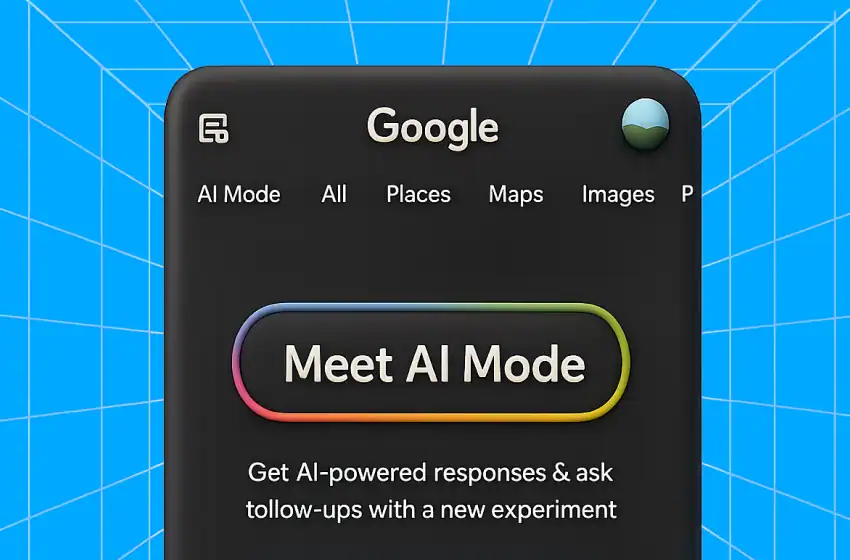
“AI Mode” generally refers to a more deeply integrated and often more conversational AI experience within a search engine. While “AI Overviews” are typically static summaries for a given query, an “AI Mode” often implies a dedicated interface or tab where users can engage in a more interactive, chatbot-like dialogue with the search AI. Users can ask complex, multi-part questions, get follow-up suggestions, and refine their search through conversation. Google’s version of this, also referred to as “AI Mode,” leverages its Gemini models to provide more advanced reasoning, multimodal understanding (text, images, etc.), and personalised results based on context and search history.
History and Launch:
The concept of a more interactive “AI Mode” has been evolving as AI models become more powerful. For Google, after the initial SGE experiments that led to AI Overviews, the company began testing a more comprehensive “AI Mode” in Search Labs. In May 2025, Google announced the rollout of this more advanced AI Mode in the U.S., designed to offer deeper insights and a more dynamic search experience. This mode aims to eventually be a more powerful successor or companion to the initial AI Overviews for users seeking more in-depth exploration. Other search platforms and AI-powered answer engines also offer similar dedicated conversational AI search modes.
How AI Search Affects SEO:
AI Mode further intensifies the shifts seen with AI Overviews. The emphasis on conversational queries means SEO strategies need to consider long-tail keywords and natural language questions even more. Since AI Mode can synthesise information from many sources into a single, comprehensive answer, the fight for visibility within these AI-generated responses becomes paramount. Authority, trustworthiness, and the ability for your content to contribute unique insights or data points that the AI can leverage are crucial. As AI Mode can also offer personalised results, understanding user intent and context at a deeper level will be essential. Businesses need to focus on becoming a trusted entity in their niche, so the AI is more likely to cite their information. The potential for even fewer direct clicks to websites is a significant concern, pushing businesses to find value in being mentioned and seen as authoritative within the AI’s response, rather than solely relying on direct traffic.
The Evolving Nature of AI Search:
It’s important to remember that both AI Overviews and AI Mode are part of a rapidly evolving landscape. Search engines are continuously updating their AI models, user interfaces, and the way they integrate these features. What we see today is likely to change and improve over time, influenced by user feedback, technological advancements, and the ongoing effort to provide the most helpful and relevant information. This means SEO professionals and content creators must remain adaptable and keep learning.
How This New-Fangled AI Search Does Its Homework
When you pop a question into Google, it’s not as simple as the old days.
Here’s a more detailed look at the journey your query takes in this AI-enhanced search world:
- Specialised AI Collaboration: First off, it’s not just one super-brain doing all the heavy lifting. The system employs a squad of specialised AI helpers, often known as Large Language Models (LLMs). Each of these LLMs has its own area of expertise, and they work together in a multi-stage process to dissect your query.
- Deep Understanding of Intent: Then, this AI is getting remarkably good at understanding what you really mean. It’s not just about matching the exact words you’ve typed; it’s about grasping the intent and context behind your search. This natural language understanding is a massive leap forward.
- Comprehensive Information Gathering: Once it has a good handle on your query, the AI doesn’t just do a single, narrow search. Instead, it often expands your initial question into a multitude of related mini-questions – a technique sometimes called “query fan-out.” This allows it to cast a much wider net and gather a more comprehensive set of information from across the web. It’s not just scanning entire web pages either; it has the smarts to pinpoint and understand the meaning within specific, relevant paragraphs or sections of text, extracting the most valuable nuggets of information.
- Synthesising Coherent Summaries: This collected information, drawn from various (usually highly-ranked and trustworthy) web pages, is then handed over to “reasoning models.” These are the AI components that synthesise all the different pieces of information into a coherent, easy-to-digest summary – that “AI Overview” you see at the top of the results. The aim is to give you a solid answer or overview straight up.
- Multimodal Capabilities: And it’s not just limited to text. This AI is “multimodal,” meaning it can understand and integrate various types of information, including images, videos, and even the spoken words from audio files, to construct its answers. This allows for richer, more comprehensive responses.
- Conversational Interaction: Furthermore, the experience is becoming more conversational. You can ask more complex, nuanced questions, and the AI will often provide suggestions for follow-up questions, allowing you to dive deeper into a topic in a more interactive way.
- Prioritising Trustworthy Sources (E-E-A-T): Crucially, the AI is designed to prioritise information from websites that demonstrate strong signals of Experience, Expertise, Authoritativeness, and Trustworthiness (E-E-A-T). This is Google’s way of trying to ensure the information surfaced by AI is reliable and comes from credible sources.
How Websites and SEO Experts Are Pivoting Towards AI Search
This shift towards AI-driven search results is a pretty big shake-up for Search Engine Optimisation (SEO) experts. Their entire job is to help websites get found, and if AI is answering questions directly, the game changes. So, they’re not resting on their laurels; they’re actively adapting their strategies.
A more in-depth look at how they’re tackling this new landscape:
1: Elevating Content Quality and Purpose
Doubling Down on Genuinely Brilliant, Unique Content:
This has always been important, but now it’s absolutely paramount. Websites can no longer get by with thin, rehashed articles. The emphasis is on creating content that offers real, tangible value – think original research, insightful analysis, practical first-hand experiences, in-depth case studies, or truly unique perspectives that AI would want to reference. It’s about becoming an indispensable source of information.
Crafting Content That Answers Real Questions, Naturally:
The focus is shifting towards addressing the specific questions users are asking, in a clear, conversational, and comprehensive manner. This means creating detailed FAQ pages and sections, thorough “how-to” guides, and articles that anticipate follow-up questions. Optimising for these longer, more specific “long-tail” queries is becoming increasingly important, as these often signal a user who is further along in their information-gathering journey.
Building Deep Topical Authority:
Rather than just targeting isolated keywords, websites are now striving to be seen as the definitive authority on broader topics. This involves creating comprehensive “content clusters” – a main “pillar” page covering a general topic in depth, supported by many “cluster” articles that delve into specific sub-topics, all interlinked. This signals to AI that the website has a deep and wide understanding of that subject area.
Embracing Multimedia to Enrich Content:
Given that AI Overviews are multimodal, forward-thinking websites are incorporating a richer variety of content formats. This means using high-quality, relevant images, informative videos, engaging infographics, and even audio where appropriate. Critically, these multimedia elements also need to be optimised with descriptive text so the AI can understand their content and relevance.
2: Solidifying Trust and Demonstrating Expertise
Becoming a Beacon of Trust and Expertise (E-E-A-T):
Websites need to focus on EEAT and meticulously demonstrate their credentials. This involves showcasing the real-world experience and deep expertise of their authors, providing clear author biographies, citing reputable sources, and generally proving they are an authoritative and trustworthy voice in their field. For topics that can significantly impact someone’s life or finances (“Your Money or Your Life” – YMYL), these standards are even higher. Google’s AI is being trained to recognise and reward this.
Cultivating a Strong and Positive Brand Reputation:
AI doesn’t just look at what’s on a website; it also considers the broader online perception of the brand. This includes online reviews, mentions in reputable media outlets, and social media sentiment. Building and maintaining a positive digital footprint is crucial for being seen as a trustworthy source by the AI. The goal is increasingly to become the brand that AI cites.
3: Mastering Technical SEO and AI Language
Speaking AI’s Language with Structured Data:
This is a more that the usual approach to technical search engine optimisation techniques. Now websites need to more to get the results. For example, implementing schema markup, which is a form of code that explicitly tells search engines like Google and Bing (and AI) what specific pieces of information on a page mean is a new “must”. For example, it can define a piece of text as a recipe ingredient, an event date, a product price, or an answer to a frequently asked question. This helps AI accurately interpret and extract information, increasing the chances of that content being featured in an AI Overview or a rich snippet.
Ensuring the Website is Technically Flawless:
All the great content in the world won’t help if the website itself is a clunker.
Core technical SEO remains vital:
The website must be fast and load quickly, be perfectly usable on mobile phones, have a clear and logical structure that’s easy for both users and search engine bots / crawlers (including AI bots) to navigate, and be secure.
Sharpening Focus on Local Search Signals:
For businesses serving specific geographic areas, optimising their Google Business Profile with accurate and detailed information is more important than ever. Encouraging customer reviews and using localised content helps AI understand when a business is relevant to a user searching for nearby services or products.
4: Adapting Strategies for the New AI Search Reality
Strategising for a World with “Zero-Click” Searches:
SEO experts are grappling with the reality of “zero click” searches – if an AI provides a direct answer, users might not need to click through to a website. While this might mean fewer clicks overall, the strategy is shifting towards getting key information featured within the AI-generated snapshot. The clicks that do come through are often from users who are more qualified and genuinely interested in digging deeper.
In essence, the rise of AI in search is pushing websites and SEO professionals to elevate their game significantly. The new benchmark is about creating genuinely exceptional, deeply informative, and highly trustworthy content that is well-structured and presented within a technically sound and user-friendly and responsive website. It’s a move away from merely trying to satisfy algorithms and a much stronger lean towards genuinely satisfying human (and AI) needs for high-quality information.
The Great AI Shake-Up: Why SEO Experts Are On Edge (And Why This is a Big Deal)
Now, all these changes – with AI dishing out answers directly – haven’t gone unnoticed by the folks who live and breathe website rankings, the Search Engine Optimisation (SEO) experts. To put it mildly, there’s a fair bit of concern, and some are even calling this the biggest darn shake-up the SEO world has ever seen. It’s not just another little tweak to how Google works; for many, it feels like the entire playbook is being rewritten.
Imagine spending years perfecting the art of getting your website to the top of the search results, only for a new AI summary box to pop up above even that coveted number one spot, potentially answering the user’s question before they even think about clicking your link. That’s the reality SEOs are facing, and it’s causing a fair few sleepless nights.
Key AI Search Concerns for SEO Professionals:
- Reduced Website Traffic: One of the biggest worries is a pretty straightforward one: a drop in website traffic. If the AI gives a good enough answer right there on the search page, why would someone need to click through to a website? Many businesses and publishers rely on that organic traffic – the visitors who find them through a non-paid search result – for readers, customers, and revenue. Early reports and studies have shown that the presence of AI Overviews can indeed lead to fewer clicks on the traditional blue links, and that’s a genuine concern for anyone whose livelihood depends on website visits.
- “Top-of-Funnel” Content: Then there’s the challenge of “top-of-funnel” content. This is the kind of helpful, informational stuff – like “what is X?” or “how do I do Y?” – that websites create to attract people at the beginning of their research journey. AI is getting pretty good at summarising this type of information, which means a lot of that introductory content might not draw in the crowds it used to. SEO experts are now wrestling with how to adapt their content strategies when the AI can potentially serve up the basics without a click.
- Navigating Uncharted Waters: Adding to the anxiety is a sense of navigating uncharted waters with a sometimes unreliable map. For a while, there’s been frustration in the SEO community about the limited tools and data available to track exactly how their content is performing within these AI Overviews. If you can’t measure what’s happening, it’s much harder to figure out what’s working and what’s not. There have also been instances of AI Overviews pulling information from less-than-perfect sources or even getting things a bit wrong, which raises questions about quality control and how trustworthy these AI-generated answers will consistently be.
AI Search is a Fundamental Shift in Optimisation Goals:
This isn’t just about adjusting a few keywords or building a few more links. It’s a fundamental shift in how search itself works and how users interact with it. The old goal was to be the top link. The new goal? Well, that’s evolving, but it seems to involve becoming so authoritative and creating such high-quality, unique content that your site is the one the AI relies on and cites in its answers. It’s a massive pivot, moving from optimising for a list of results to optimising for an AIO response inclusion.
So, yes, there’s a definite current of concern rippling through the SEO world. It’s a period of significant uncertainty and challenge, arguably more so than any previous Google update. But, as with all big changes, it’s also spurring a wave of innovation and forcing a re-evaluation of what truly high-quality, valuable online content looks like. SEO pros are a resilient bunch, and they’re already deep in the trenches, figuring out how to navigate this new, AI-driven landscape.
Need Help?
That is what Online Marketing Gurus are for. We literally spend a tremendous amount of time and money to make sure we full / deep understanding and stay ahead of shifts in the online marketing and SEO world.
So instead of panicking about this monumental shift in website ranking and visibility, reach out today so that you can have everything you need to thrive in this new and exciting landscape.

About the author
Read More Blogs
-
 10 minutes read
Are Your Search Campaigns Ready for the Google Ads Migration?

Last updated on:
-
10 minutes read
More AI In Search, More Ads In AI & More Choice For Social Users: This Week’s Updates
Last updated on:
-
Last updated on:



Stop Guessing What Your Marketing Should Do Next.
Your free $4,000 strategy session shows where your digital marketing is leaking performance across search, paid media, content and conversion. You leave knowing what to fix first and what a stronger strategy could produce.