

Google Page Experience Guide

Last updated:
11 July 2025
|
11 minutes readKey Takeaways
- Page Experience is a ranking factor based on user-perceived experience beyond content quality.
- Core Web Vitals—LCP, FID, and CLS—are central metrics to speed, interactivity, and visual stability.
- Additional signals include mobile-friendliness, HTTPS security, and safe browsing.
- Improving GPE boosts rankings and user satisfaction—use tools like PageSpeed Insights to audit performance.
- Optimisation steps include compressing resources, trimming third-party scripts, and adopting responsive design.
- A seamless page experience increases engagement, reduces bounce, and supports higher conversion rates.
Your Comprehensive Guide To Google’s Page Experience Metrics
We’ve all been there — stuck at a loading screen, watching that little circle spin endlessly. It’s frustrating. Well, Google knows it, too, and thankfully, they’re doing something about it. Introducing Google Page Experience (GPE).
GPE is the search engine’s new way of prioritising websites that offer a seamless, enjoyable user experience. In this guide, we’ll break down everything you need to know about GPE, including what factors matter most, how they impact your rankings and most importantly, how to optimise your website and keep both Google and your visitors happy.
What Exactly Is Google Page Experience?
Google Page Experience is essentially a set of signals that Google uses to measure how users perceive the overall experience of interacting with your web page beyond just the content itself. The engine doesn’t just want to send you to a website with the information you’re looking for, but a website you’ll actually enjoy using. It’s like the difference between finding a restaurant with decent reviews and one with a fantastic ambience and top-notch service.
We’re talking about factors like how fast your website pages load, whether it’s easy to navigate on a mobile device and if it’s secure. Why does this matter? Because a happy visitor is more likely to stick around, engage with your content and ultimately, convert into a customer. In short, Google’s just giving you the recipe for a more delightful digital experience — it’s up to you to cook it up!
Google Page Experience vs Core Web Vitals
Now, you might have heard whispers of something called Core Web Vitals in the same breath as GPE. They’re really more like close relatives, but not identical twins. Core Web Vitals are a subset of the broader Google Page Experience factors. They’re the “VIPs” of user experience metrics if you will.
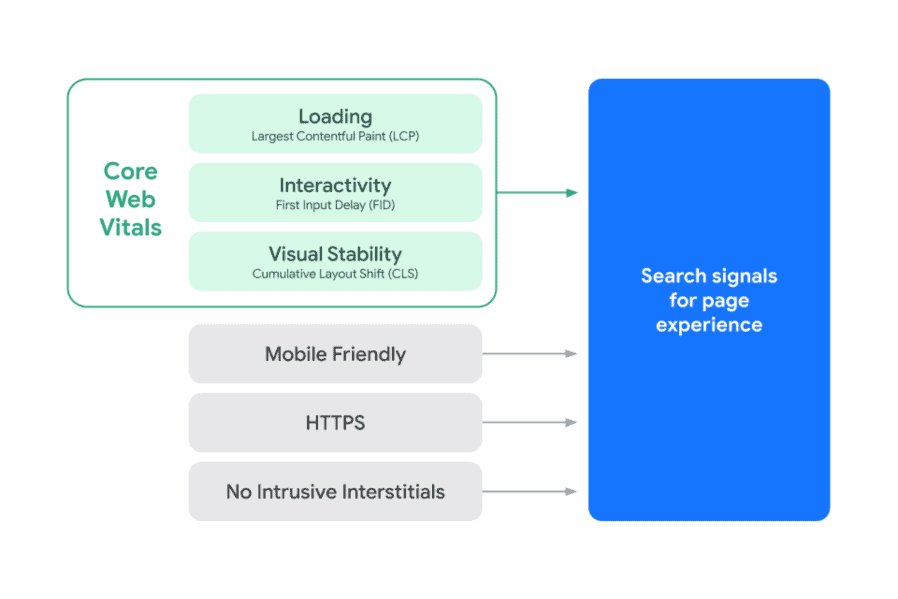
Core Web Vitals are a set of specific, measurable metrics that Google uses to quantify key aspects of how users experience your website. More than arbitrary numbers, they reflect real-world user interactions and pain points.
Let’s Break Down Each of These Vital Signs:
1. Largest Contentful Paint (LCP)
- What it is — Measures loading performance. In simple terms, it’s the time it takes for the largest content element on your page (like a hero image or a block of text) to become visible to the user.
- Why it matters — A slow LCP can make users think your site is sluggish or broken. Google recommends an LCP of 2.5 seconds or less. Picture it like this: if your website were a restaurant, LCP would be the time it takes for the main course to arrive at your table. You wouldn’t want to wait an hour for your meal, would you?
2. First Input Delay (FID) / Interaction to Next Paint (INP)
- What it is — FID has been a metric used to measure interactivity. That is, the time it takes for your website to respond to a user’s first interaction, like clicking a button or a link.
- Why it matters — A high FID means your site feels unresponsive, leaving users frustrated. Google has replaced FID with INP in March 2024. INP takes into account all page interactions. The new INP metric has a recommended threshold of under 200 milliseconds.
3. Cumulative Layout Shift (CLS)
- What it is — CLS measures visual stability. Ever been reading something online when suddenly the text jumps, and you lose your place? That’s a layout shift, and it’s incredibly annoying. CLS quantifies how much elements on your page move around unexpectedly during loading.
- Why it matters — A high CLS can lead to accidental clicks, user frustration and a generally poor experience. It is recommended to have a CLS score of 0.1 or less.
Breaking Down the Google Page Experience Factors
We’ve already established that Core Web Vitals are heavy hitters when it comes to Google Page Experience, but they’re not the only ones on the field. They’re like the star players on what should ideally be a well-rounded team. To win the user-experience game, you need a solid strategy that incorporates all the key factors.
1. Mobile-friendliness — thumbs up for mobile!

With today’s digital marketplace being largely focused around Google’s mobile-first indexing, this one’s a no-brainer. Mobile-friendliness means your website is easy to use and navigate on a smartphone or tablet. Here are a few questions to ask yourself about your pages:
- Are the buttons easy to tap?
- Is the text readable without needing to zoom in?
- Does it look great and function perfectly on different screen sizes?
If you do not have a website that is mobile-friendly, you’re slamming the door in the face of a massive chunk of your potential audience. Google will definitely penalise you for this in its rankings.
2. Safe browsing — keeping it clean and safe
Google wants to ensure your website doesn’t harbour nasty surprises like malware, phishing scams or deceptive content designed to trick users. Nobody wants to stumble onto a website that will infect their computer with a virus or try to steal their personal information. Google takes this very seriously, and so should you. It protects your users and your reputation.
3. HTTPS: the security seal of approval
HTTPS (Hypertext Transfer Protocol Secure) is the secure version of HTTP. It essentially means that the connection between your website and the user’s browser is encrypted, protecting sensitive data from prying eyes. You will notice a little padlock icon in the address bar when a site is secure.
HTTPS is crucial for building trust in an era of increasing online security concerns. It’s like having a bouncer at the entrance of your website, verifying that everything is safe and above board. It is also critical if you are collecting data such as credit card details and personal information.
4. No intrusive interstitials — pop-up party crashers not welcome
We’re all accustomed to those annoying pop-ups and banners that suddenly appear, blocking the content you’re trying to read. While some are necessary (like age verification prompts), others are a major user experience no-no. Intrusive interstitials are disruptive and can drive users away. They’re particularly awful on mobile devices as they can cover the entire screen.
Why is Google Page Experience Important for Your Business?
Putting time and resources into optimising your web page GPE might seem like another item on your overflowing to-do list. But trust us, it’s an investment that pays off in spades.
1. Improved search rankings and increased organic leads
Google’s primary goal is to provide its users with the best possible search results in it’s SERPs. And, as we’ve learned, a good user experience is a huge part of that. Websites that offer a seamless, enjoyable experience are more likely to satisfy users, and therefore, Google rewards them with higher rankings.
When your website appears on the first page of Google search results (ideally in the top few positions), you’re much more likely to attract organic traffic. And as you’re well aware, organic traffic is the holy grail of digital marketing. These are visitors actively searching for information or products related to your business.
2. Lower bounce rates
If your site takes forever to load or is difficult to navigate, users will likely hit the back button faster than you can say hello. This is known as a “bounce.” By optimising for Google Page Experience, particularly Core Web Vitals like LCP and FID, you can create and develop a website design that’s snappy and responds instantly to user interactions. This keeps visitors engaged and encourages them to explore further.
3. Higher conversion
When users enjoy their time on your website, they’re more likely to trust your brand, explore your products or services and ultimately take the desired action — whether that’s making a purchase, signing up for your newsletter or filling out a contact form. Higher conversion rates mean more of your website visitors turn into paying customers or valuable leads. This translates directly into increased revenue and a better return on your marketing dollars.
4. Enhanced brand reputation
Your website is your digital online storefront — it’s the first impression you make on potential customers. A slow or frustrating site reflects poorly on your brand, while a fast, user-friendly and visually appealing one creates a positive and professional image. When users have a great experience on your website, they’re more likely to recommend your brand to others and become loyal customers themselves.
How to Measure and Improve Page Experience
If you’re ready to roll up your sleeves and optimise your website for a stellar GPE, the first step is understanding where you stand now. Fortunately, several powerful tools are available to help you measure your site’s performance and identify areas for improvement.
Measuring Your Page Experience
- PageSpeed Insights — This is your go-to tool for analysing both mobile and desktop performance. It provides a detailed report on your Core Web Vitals, along with specific recommendations for improvement. Simply enter your website URL and let PageSpeed Insights do the work.
- Google Search Console (Core Web Vitals report) — The Core Web Vitals report gives you a comprehensive overview of how your site is performing in terms of Core Web Vitals based on real-world usage data. This report in Google Search Console GSC will also flags specific URLs that need attention.
- Lighthouse — This is an open-source, automated tool that you can run against any web page, public or requiring authentication. It provides a detailed audit of your site’s performance, accessibility, Search Engine Optimisation / SEO and more, including detailed Core Web Vitals scores. You can find it in the Chrome DevTools.
- Web Vitals Extension — This handy Chrome extension provides a real-time view of your Core Web Vitals as you browse your website. It’s a great way to quickly assess performance and identify potential issues.
Straight from the Gurus — Actionable Tips for Improving Page Experience
Now that you have the tools to measure, here’s the lowdown on improving those crucial Google Page Experience factors:
1. Improving Largest Contentful Paint (LCP)
- Optimise images — Compress images without sacrificing too much quality. Use modern image formats like WebP.
- Leverage browser caching — Set appropriate caching headers to allow browsers to store static assets locally.
- Use a Content Delivery Network (CDN) — Distribute your content across multiple servers geographically closer to your users, reducing latency.
- Use lazy loading on large images — Make sure your server is optimised and use a content delivery network.
2. Improving First Input Delay (FID)/Interaction to Next Paint (INP)
- Minimise JavaScript execution time — Defer non-critical JavaScript and optimise your code for efficiency.
- Break up long tasks — Avoid long-running JavaScript tasks that block the main thread and make your site unresponsive.
3. Improving Cumulative Layout Shift (CLS)
- Specify image and ad dimensions — Always include width and height attributes for photos and video elements.
- Reserve space for dynamically loaded content — Avoid inserting content above existing content unless it is in response to a user interaction.
4. Implementing safe browsing
- Regularly scan for malware — Use security tools to detect and remove any malicious code.
- Avoid deceptive practices — Be transparent and honest with your users.
- Obtain an SSL certificate — You can get an SLL certificate from a Certificate Authority (CA) or often through your web hosting provider.
- Configure your server — Set up your server to redirect HTTP traffic to HTTPS.
5. Avoiding intrusive interstitials
- Less is more — Instead of full-screen pop-ups, consider using slide-ins, banners or other less disruptive methods for promotions and calls to action.
Give Your Website a Glow-Up Today!
As we’ve explored, improving page experience is no longer a nice-to-have but a non-negotiable for online success. By prioritising your users, you’re investing in higher rankings, increased traffic and, ultimately, a more profitable business. We understand that mastering these factors — not to mention staying on top of other algorithm changes — can be overwhelming. But you don’t have to do it alone.
If you’re ready to take your website past a current marketing roadblock or to new heights, Online Marketing Gurus can help. We’re Australia’s leading digital marketing agency with over a decade of experience and 40+ prestigious awards. Our world-class Australian SEO agency services experts have the insider information you need to deal with the intricacies of Google Page Experience and craft a winning digital strategy. Reach out to one of our Gurus today and claim your free in-depth and comprehensive website audit and strategy session.

About the author
Read More Blogs
-


Last updated on:
-
Last updated on:
-
Last updated on:


Stop Guessing What Your Marketing Should Do Next.
Your free $4,000 strategy session shows where your digital marketing is leaking performance across search, paid media, content and conversion. You leave knowing what to fix first and what a stronger strategy could produce.