

What Is CPC?

Last updated:
2 December 2025
|
12 minutes readKey Takeaways
- CPC (cost per click) is the price you pay for each click in PPC campaigns on platforms like Google Ads, Bing, and Facebook.
- Calculated as total spend ÷ total clicks (e.g., $100 ÷ 10 clicks = $10 CPC).
- In Google Ads , actual CPC is determined by (competitor AdRank ÷ Quality Score) + $0.01.
- CPC guides campaign budgeting and serves as a benchmark for industry performance (average ~$2.69/click)
- Optimising AdRank and Quality Score (via relevance and landing page experience) can lower CPC.
- Alternative bidding strategies include CPM or CPA, depending on your objectives
Everything you need to know about CPC
Cost per click (CPC) is the price you pay for each click in your pay-per-click / PPC advertising campaigns. It’s also a key digital marketing metric you should measure if you are managing ads as part of an online advertising campaign.
In this article, we’ll explore:
- What it is
- Why it’s important
- Key metrics that define a ‘good’ CPC
- Advanced tips for lowering cost
Defining CPC
Cost per click, or CPC, is the price you pay for an individual click on one of your pay-per-click (PPC) ads.
Pay-per-click campaigns can be run on digital platforms such as Google Ads (previously known as Google AdWords), Bing / Microsoft Ads and Social Media advertising campaigns.
Here’s how it works.
You only pay when people click on your ad.
Remember – CPC is the price you pay to get a potential customer to visit your website in the first place. It is not the cost per conversion.
What is the CPC formula?
The calculation for you Cost Per Click / CPC is:
Total Amount You Spend On PPC Advertising / Total Number Of Clicks = CPC
Example:
Say you spent a total of $100 on a campaign and got a total of 10 click from you ads to your site.
Then your CPC in this example is: 100 / 10 = 10 – your your CPC is $10 since it cost you $10 for every click you got.
How is CPC determined?
There are lots of factors that go into calculating the cost per click. It varies depending on which ad platform you’re using. Here, we’ll use the most popular platform to explain – Google Ads.
In Google Ads, the formula for cost per click is:
Competitor AdRank / Your Quality Score + .01 = Actual CPC.
Sounds complicated?
Let’s break it down.
Because of how Adwords auction works, your actual CPC is influenced by three things:
- Your ad rank
- Maximum Bid
- Quality Score
The maximum bid is the most you are willing to spend per click for each keyword. At the end of the day, your CPC will always be the same or less than your maximum bid.
The Quality Score is the Google Ads rating system. It’s a score ranging from 1 to 10 that ranks your ad based on:
- Landing page experience
- Relevance to keywords
- Quality of the ad
- Historic click through rate (CTR)
Just to confuse things, the CPC you pay is also influenced by your closest competitor’s ad rank, maximum bid and Quality Score.
Why is CPC important?
CPC is important for two main reasons:
- As a key metric you need to measure if you want to get the best out of your PPC campaigns.
- As a benchmark you can track to see how much you should be bidding for a keyword.
Let’s look at these in more detail.
CPC as a metric
CPC can give you the data you need to better optimise your Adwords campaigns for a better return on investment (ROI).
Think about it.
Pay-per-click ads are proven to accelerate growth for many businesses. Your ROI is determined by the cost per click AND the quality of traffic from those clicks. In other words, how likely those clicks will turn into conversions.
So, if you can make your ads more effective and drive your CPC down, you can generate an eye-watering boost to your ROI.
CPC as a benchmark
The average CPC varies depending on your industry. So, by understanding the CPC benchmark for your industry, you can make sure you’re not overspending or underspending on your paid ad campaigns.
Studies suggest an overall average of $2.69 per click across all industries.
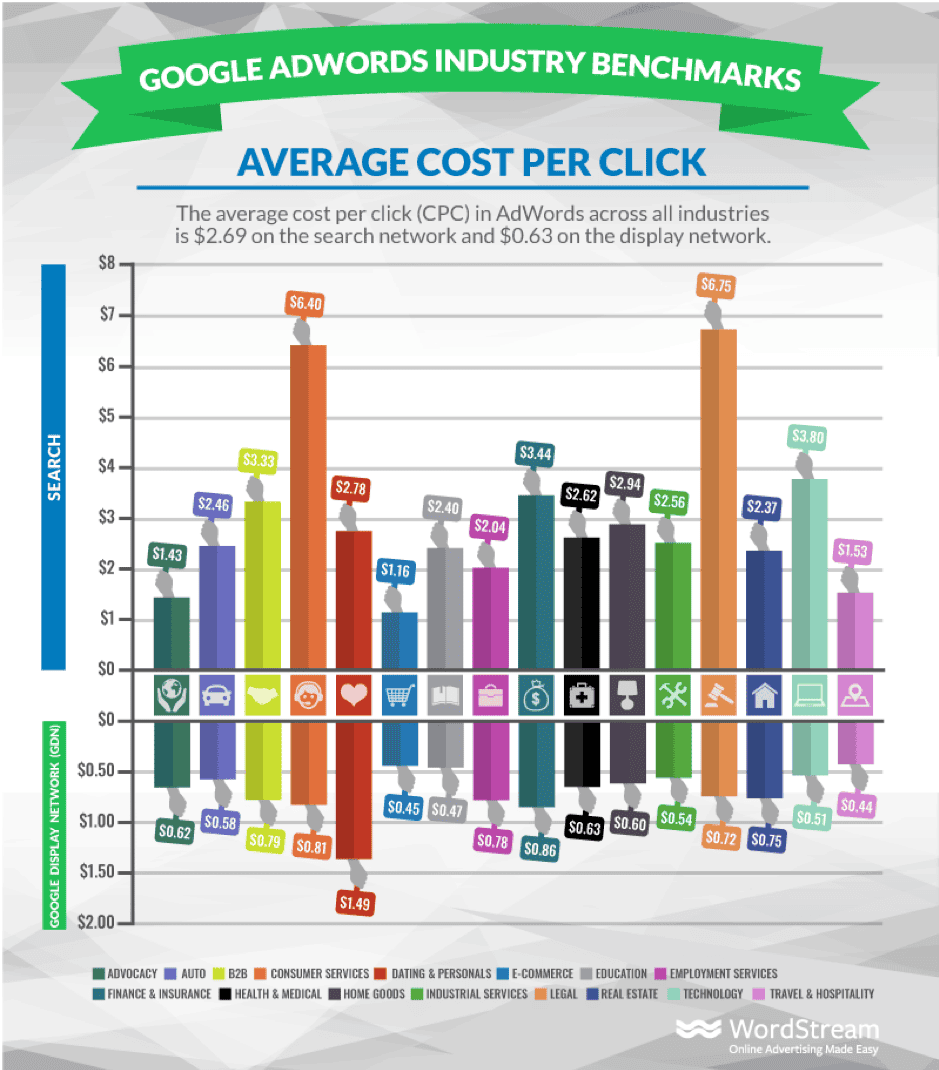
Image Credit: wordstream.com
More competitive industries and those with higher-priced conversions tend to go above this. In the chart above, it’s obvious that the legal and consumer services sectors are soaring above other industries when it comes to CPC.
Both spend on average $6+ per click.
Most other sectors come in around the $3 range.
That’s because advertisers are only willing to pay an amount that still gives them an opportunity to make a profit.
So, when setting your CPC benchmark, you need to understand how your industry will affect your budget.
Then, take a look at the average CPC for your sector and see whether you are overspending or underspending on your campaigns.
What is a cost-per-click CPC bidding strategy?
Cost-per-click (CPC) bidding is a digital advertising strategy where advertisers pay for each click on their ad rather than for impressions. This approach ensures that businesses are only charged when a user actively engages with their ad by clicking on it.
CPC bidding is widely used in platforms like Google Ads and Microsoft Advertising, allowing advertisers to control how much they’re willing to pay per click.
There are two main types of CPC bidding:
- Manual CPC – Advertisers set their maximum bid for each keyword or ad placement, giving them full control over costs.
- Enhanced CPC (ECPC) – A semi-automated option where the platform adjusts bids based on the likelihood of conversion, aiming to maximise results while staying within budget.
CPC bidding is particularly effective for driving website traffic and generating leads. The actual cost per click varies based on factors like competition, keyword relevance, and Quality Score (on Google Ads). A well-optimised CPC strategy ensures advertisers get the most value from their ad spend while maintaining control over costs.
What makes a good CPC?
That’s where the benchmark comes in. Cost per click should never be considered by itself. You might be striving for a lower CPC, but some keywords with a high CPC will produce a better return on investment.
How?
Because they drive better value.
Take the legal industry with its $6 average cost per click.
The people who click through to a legal services website are more likely to pay more for their services, meaning the $6 CPC isn’t a waste of money. So long as you’re bringing in the right quality of traffic who are ready to convert, you can still generate a very healthy ROI.
In other words, cost per click is all relative.
It all depends on your business, product or service, and customers.
If you’re making a good profit from each conversion, the high cost per click doesn’t really matter.
What is considered a bad CPC?
A bad cost-per-click (CPC) is one that is too high relative to the value it delivers. In digital advertising, CPC is not inherently “good” or “bad” on its own—it depends on factors like industry benchmarks, conversion rates, and overall return on investment (ROI).
Here’s what typically makes a CPC bad:
- High CPC with Low Conversions – If you’re paying a high price per click but those clicks aren’t turning into leads or sales, your CPC is inefficient.
- CPC Higher Than Customer Value – If your cost per click is so high that your customer acquisition cost exceeds the revenue generated per customer, you’re losing money.
- Industry Comparison – If your CPC is significantly above the average for your industry, location, or competition without a strong conversion rate to justify it, it’s problematic.
- Poor Quality Score (Google Ads) – A low Quality Score (Google Ads metric) can drive up CPC costs unnecessarily due to poor ad relevance, low expected click-through rates (CTR) in Google adwords, or a weak landing page experience.
What’s considered a “bad” CPC varies by industry. For example, in competitive fields like legal services or finance, CPCs can be $50+ per click, but if those clicks convert into high-value clients, they’re still profitable. In contrast, an eCommerce store selling low-cost items might struggle with a cost per click above $2-$3 if it doesn’t lead to a sale.
To reduce a bad CPC, advertisers should focus on improving ad relevance, refining keyword targeting, and optimising landing pages to increase conversions without overspending.
What influences cost per click?
The cost per click (CPC) in digital advertising is influenced by several factors that determine how much advertisers pay for each click on their ads. These factors vary across platforms like Google Ads, Microsoft Advertising, and social media ads, but the core influences remain consistent.
- Competition & Industry: Highly competitive industries, such as legal services, finance, and insurance, tend to have higher CPCs because multiple businesses are bidding on the same high-value keywords. Niche industries with lower competition usually see lower CPCs.
- Keyword Relevance & Search Intent: Keywords with high commercial intent, such as “best mortgage broker Sydney”, often have higher CPCs because they indicate strong purchase intent. Broad, generic keywords typically cost less but may attract unqualified traffic.
- Quality Score (Google Ads): Google Ads assigns a Quality Score to each keyword based on expected click-through rate, ad relevance, and landing page experience. Higher Quality Scores lead to lower CPCs, while lower scores increase costs.
- Ad Rank & Bidding Strategy: Ad Rank determines your ad placement. If competitors have higher bids or better Quality Scores, you may need to bid more to compete. Bidding strategies such as Manual CPC, Enhanced CPC, or Maximise Clicks can also impact CPC.
- Audience Targeting & Demographics: Refined targeting, such as location, age, interests, and device type, affects CPC. For example, mobile users may have a different CPC than desktop users, and targeting premium audiences often increases costs.
- Ad Placement & Network: CPC varies depending on whether ads appear on Google Search, Google Display Network, or social media platforms like Facebook or LinkedIn.
- Seasonality & Market Trends: During peak periods, such as Black Friday, Christmas, or tax season, advertisers increase bids, leading to higher CPCs. Market fluctuations and economic conditions can also influence CPC over time.
By managing these factors effectively, advertisers can control costs and maximise ROI from their CPC campaigns.
Pro tips for a lower CPC
How do you lower the price you’re paying for each click but still sustain the quality of traffic and maximise conversions?
Focus your efforts on improving your Quality Score, as this can significantly lower your CPC.
How to improve your Quality Score:
- Increase your Click-Through Rate – Click-through rate (CTR) measures how often your ad is clicked on in the search results. The more compelling your ad and the more relevant it is to the search query, the higher chance it will be clicked.
- Improve your Keyword Relevance – Make sure your ad text is highly relevant to the keywords you are bidding on in your PPC campaign. Include the keywords in the headline and ad text. This tends to result in higher Quality Scores and CTRs.
- Ad & Landing Page Quality – Make sure your landing page and ads are high quality and relevant. It’s critical your landing page is aligned with your ad, so users get what they’re searching for.
What are alternatives to cost per click?
While cost-per-click (CPC) bidding is one of the most common digital advertising models, businesses can explore alternative pricing structures depending on their goals, budget, and campaign objectives.
Here are the key alternatives to CPC:
- Cost Per Mille (CPM) – Cost Per Thousand Impressions
- Advertisers pay for every 1,000 ad impressions, regardless of clicks.
- Best for brand awareness and high-visibility campaigns.
- Used on Google Display Network, Facebook Ads, and programmatic advertising.
Ideal for: Businesses looking to increase brand exposure rather than direct conversions.
- Cost Per Acquisition (CPA) – Cost Per Conversion
- Advertisers only pay when a user completes a desired action (e.g., form submission, purchase, sign-up).
- Common in Google Ads (Target CPA), Facebook Ads, and affiliate marketing.
- Costs may be higher, but it ensures payment only for valuable actions.
Ideal for: Businesses focused on generating leads or sales with measurable ROI.
- Cost Per Lead (CPL)
- Similar to CPA, but specifically for lead generation (e.g., email sign-ups, quote requests).
- Used in LinkedIn Ads, Google Ads, and Facebook Lead Ads.
- CPL models work well for B2B businesses and service-based industries.
Ideal for: Companies aiming to build a qualified lead pipeline.
- Cost Per Engagement (CPE)
- Advertisers pay only when users interact with an ad (e.g., video views, shares, likes).
- Common on social media advertising platforms like Instagram, Facebook and TikTok.
- Helps measure brand interaction and audience engagement.
Ideal for: Social media advertisers aiming to boost engagement rather than direct clicks.
- Cost Per View (CPV)
- Used in video advertising, particularly on YouTube Ads.
- Advertisers pay when a user watches a video ad for a set duration (e.g., 30 seconds).
- Works well for video marketing and storytelling campaigns.
Ideal for: Brands investing in video ads to drive awareness and engagement.
- Flat-Rate & Subscription-Based Advertising
- Fixed pricing for ad placements on websites, directories, or influencer channels.
- Works well for sponsored content, direct media buys, and influencer marketing.
- Predictable costs but may lack performance-based flexibility.
Ideal for: Businesses looking for long-term exposure without fluctuating bid costs.
Choosing the Right Model
The best alternative depends on campaign goals:
- Brand Awareness? → CPM, CPE, or CPV
- Lead Generation? → CPL or CPA
- Sales-Driven? → CPA or CPC
- Video Ads? → CPV
For many advertisers, a hybrid approach (e.g., CPC for search ads + CPM for display ads) ensures a balanced, cost-effective strategy.
Summary
Understanding your CPC is an absolute must if you want to squeeze the best from your PPC campaigns.
While many advertisers get hung up on cost per click, it’s important to remember that it’s part of a bigger picture.
CPC is only one metric you should be measuring to maximise your Adwords ROI. Cost Per Acquisition (CPA) is way more important in the long run.
Need help? Reach out to us at OMG – Australia’s Leading Digital Marketing Agency and Top Australian SEO Services Agency – we are here to help!
Are you an Australian Business? Need Help With Paid Ads and / or SEO? Then simply reach Out:
PPC Sydney | PPC Melbourne | PPC Brisbane | PPC Gold Coast | PPC Perth | PPC Adelaide | PPC Hobart | PPC Canberra
SEO Sydney | SEO Melbourne | SEO Brisbane | SEO Hobart | SEO Perth | SEO Adelaide | SEO Gold Coast | SEO Canberra | SEO Darwin

About the author
Read More Blogs
-
 10 minutes read
Are Your Search Campaigns Ready for the Google Ads Migration?

Last updated on:
-
10 minutes read
More AI In Search, More Ads In AI & More Choice For Social Users: This Week’s Updates
Last updated on:
-
Last updated on:



Stop Guessing What Your Marketing Should Do Next.
Your free $4,000 strategy session shows where your digital marketing is leaking performance across search, paid media, content and conversion. You leave knowing what to fix first and what a stronger strategy could produce.