

How ASC Consolidation Scaled a Large Product Catalog
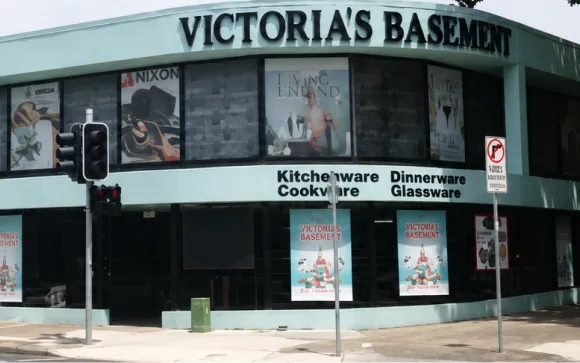
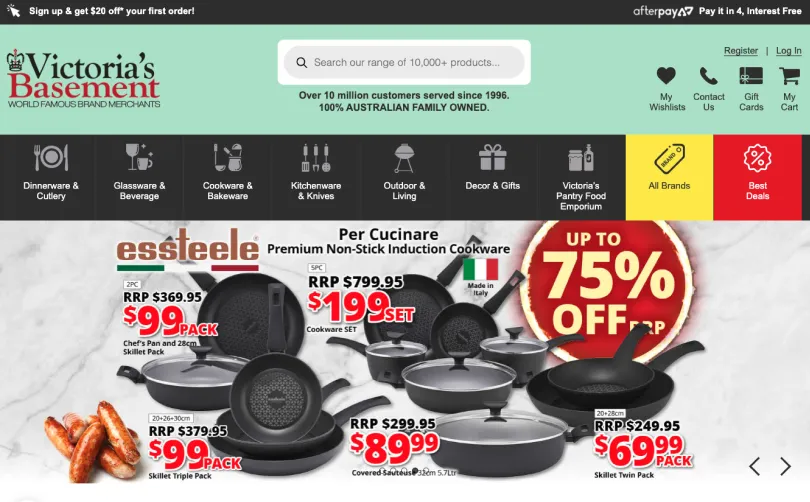
Victoria’s Basement had a large product feed of more than 11,000 products and a client preference for bespoke static ads that mirrored weekly EDM and organic social promotions. We proved that an algorithm-led catalog campaign could outperform a high-touch static approach.
17:1
ROAS increased from 12:1
8,301
Purchases
11,000+
Products in feed
Services
Industries
- Retail & E-Commerce
Challenges
The client was old school and understandably cautious. Their preference was to run bespoke static ads featuring specific products, prices and URLs, updated weekly or fortnightly to match EDMs and organic social.
They were initially untrusting of the BAU ASC catalog strategy. The concern was that Meta would show a random spread of products from a huge catalog, rather than the specific items the business wanted pushed. At one point, it looked like the ASC strategy may be rejected entirely, which would have locked the account into constant weekly static ad refreshes.
Strategy & Execution
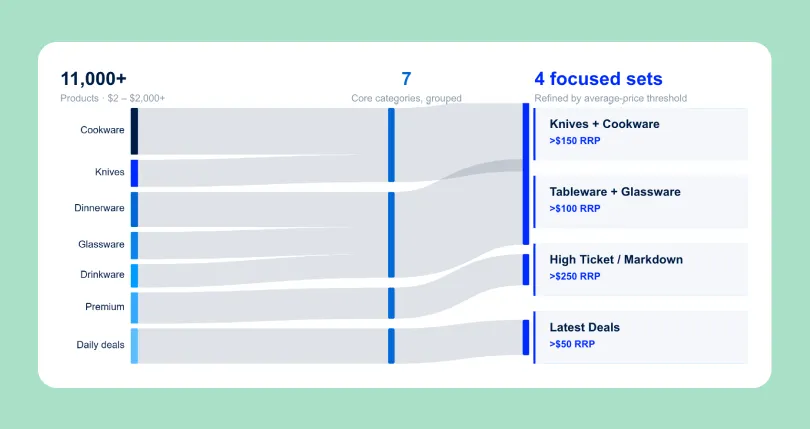
We did not simply hand Meta the full product feed and hope for the best. We used the client questionnaire, onboarding notes and product priorities to identify which products were likely to create the strongest commercial value.
- The client prioritised cookware, knives, dinnerware, glassware and higher-value product sets.
- They specifically believed sets were stronger than individual low-value items.
- We therefore built custom Commerce Manager product sets using category, price, brand, product type and stock filters.
Key Product Buckets Built
- Cookware + Knives: Scanpan, Global, Chasseur, cookware sets, knife blocks, knife sets, pots and pans.
- Tableware + Glassware: dinnerware sets, drinkware, serving sets and entertaining pieces above higher price thresholds.
- High Ticket / High RRP Markdown: premium items with strong perceived value and large price gaps.
- Daily Deals / Promo Products: products aligned to weekly or fortnightly promotional pushes.
The Side-By-Side Test
To get buy-in, we agreed to test both approaches side by side rather than force the ASC strategy through. This gave the client the control they wanted while allowing us to prove whether the algorithm-led structure could compete.
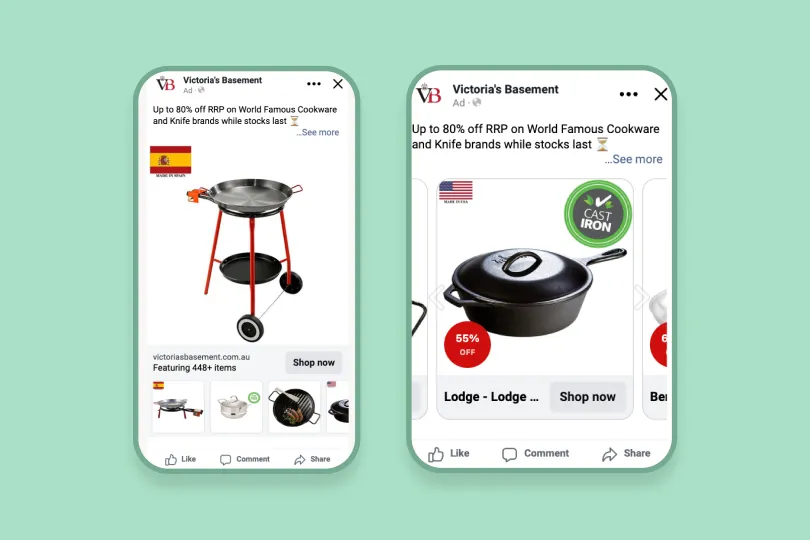
- Manual static product campaign: bespoke product graphics, closer to EDM and organic social style.
- BAU ASC catalog campaign: custom product sets, algorithm-led delivery and dynamic product matching.
- Retargeting: layered in to recover add-to-cart and checkout users, then later paused as the ASC consolidation performed more efficiently.
After roughly one month, both the static product campaign and ASC were performing strongly at around 11x to 12x ROAS. The static campaign proved the client’s promo-led approach could work. However, the ASC campaign produced comparable performance with far greater scale and less manual work.
The Budget Pivot
Once we had enough data, we made the key decision to move budget away from the manual TOF/products campaign and retargeting activity, then concentrate more spend into the BAU ASC catalog campaign.
This paid off. The ASC campaign continued to improve as Meta received more conversion signals. After the pivot, ROAS climbed and has held strongly, with current performance sitting comfortably around 16.5x+.
Why It Worked
- Fewer overlapping campaigns gave Meta cleaner signals.
- Budget concentration allowed the best-performing campaign to learn faster.
- The curated product buckets kept Meta focused on commercially valuable products.
- Stopping retargeting reduced audience saturation and appears to have improved overall efficiency.
- The market seemed sensitive to being overloaded with too many ads, suggesting there is a delivery sweet spot for this client.
Key Results
All-Time Campaign Results
All-time Meta results from the campaign export show the ASC catalog campaign as the clear scalable winner.
- 14.20x blended ROAS across the account
- 15.29x ROAS on the BAU ASC catalog campaign
- 12.12x ROAS on the static product / TOF promo campaign
- 10.23x ROAS on the retargeting catalog test
- 8.98x ROAS on full-catalog retargeting
- 8,301 total purchases delivered across all campaigns
Key Learning: Trust The Algorithm, But Control The Inputs
The client’s concern was that ASC would behave like a random catalog campaign. The result showed the opposite. Once the product feed was structured into meaningful buckets, Meta was able to find the right buyers and deliver the right products at the right time.
The manual static campaign had strong creative control, but the ASC campaign had stronger scalability. It did not need new individual ads, URLs and graphics every week to keep performing.
The stronger outcome came from combining human strategy with algorithmic delivery: we chose the right product universe, then let Meta optimise within it.
Retargeting Learning
Retargeting was profitable, but it did not outperform the core ASC campaign. When retargeting was paused and budget was concentrated into ASC, overall ROAS increased again. This suggests the audience may have been sensitive to being hit by too many overlapping ads.
For Victoria’s Basement, there appears to be a sweet spot in delivery. More campaigns and more retargeting pressure did not automatically mean better performance. A cleaner structure with more budget concentrated into the strongest campaign performed better.
Conclusion
Victoria’s Basement started with a large catalog and a client who was sceptical of algorithm-led catalog advertising. The account could easily have become a high-touch weekly static ad build. Instead, we structured the feed, tested the client’s preferred approach against ASC, then made the call to concentrate budget into the winner.
The decision to move budget into the BAU ASC catalog campaign paid off. Performance improved after consolidation, retargeting proved less necessary than expected, and the ASC campaign continued climbing from around 12x ROAS after one month to roughly 16.5x+ in current views.
The clear lesson is that Meta’s algorithm can be highly effective for large ecommerce catalogs when the product feed is properly structured. The right move was not to avoid automation, but to guide it with the right product buckets and then give it enough budget to work.
More Case Studies
-

12:1
Medik8, a B Corp certified British dermatological skincare brand, partnered with Online Marketing Gurus to scale revenue across digital advertising channels. Through ongoing testing, audience refinement, creative learnings, and full-funnel optimisation, OMG helped Medik8 deliver strong month-on-month performance and significant year-on-year growth through Meta Ads.

Medik8
-
15:1
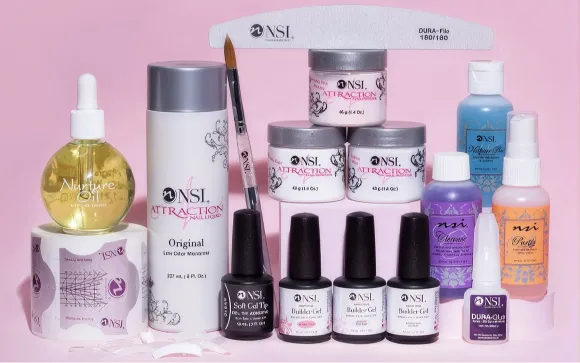
NSI Nails is a wholesale nail supplier in Australia. Largely known for their classy acrylics range appealing to both at-home nail artists and professional nail techs. Since the 1950s, NSI has manufactured high quality monomers, polymers and other enhancement products for the nail industry.
NSI Nails
-
151%
Since partnering with OMG, O Cosmedics has strengthened its digital presence through an integrated digital marketing strategy. By improving site performance, expanding content, and building authority, OMG helped O Cosmedics achieve stronger visibility, traffic, and conversions.
O Cosmedics





Find Out What Your Social Budget Is Actually Producing.
Your paid social review is included in a digital strategy worth $4,000 at no cost. We review what each platform is returning, where budget is going, and what to fix, stop or scale first.