

Smash Your ROI and Increase CTR: 5 Tips For Getting The Most Out Of PPC


Last updated:
11 July 2025
|
13 minutes readKey Takeaways
- CTR measures clicks divided by impressions, 3.17% is the average for PPC campaigns.
- Use power words (“free”, “get”, “now”, “save”) to make ads compelling and action-oriented.
- Place strong CTAs (“get”, “buy”, “try”) in headlines and descriptions, avoid neutral terms like “click.”
- Keep tone positive, use varied language at around a 9th-grade reading level, and incorporate credible numbers.
- Use punctuation wisely; one exclamation point often boosts CTR, while question marks and price tags may reduce clicks.
How To Increase CTR In PPC / Pay Per Click Ads
Let’s explore how you can increase CTR which will increase your ROI…. Pay-Per-Click advertising, aka PPC, can have a massive impact on your business. Google estimates that for every dollar spent in AdWords, businesses achieve $8 of profit through a combination of AdWords and search. Your campaign may not achieve those figures, even if you have a clear and custom designed landing page and have used split-testing to optimise everything. There’s a simple explanation if you’re not pulling in enough traffic to make a campaign viable. That’s because your ads aren’t geared towards achieving a high click-through rate (CTR).
What is CTR?
When it comes to the success of a PPC campaign, the CTR is the simplest metric to measure. It’s the ratio of people who click on the ad compared to the number of impressions it gets.
Average CTRs vary depending on your industry. However, across all industries it stands at 3.17%. That means a little over three clicks per 100 ad impressions.
Your aim is to exceed that benchmark. Happily, WordStream recently conducted a study that looks into how to boost your CTR marketing.
What is considered a good click through ratio for PPC campaigns?
A good click-through rate (CTR) for PPC campaigns can vary based on the industry, ad placement, and type of campaign. However, as a general guideline, a CTR of 2% to 5% is often considered good for most industries. This means that for every 100 times your ad is shown, 2 to 5 people click on it.
It’s important to note that what constitutes a “good” CTR depends on several factors:
- Industry Standards: Different industries have different averages. For example, in competitive industries like legal or insurance, a CTR closer to 1-2% might be common, while less competitive sectors may see higher CTRs.
- Campaign Goals: If your PPC campaign is focused on brand awareness and impressions rather than immediate clicks, a lower CTR might still be considered effective. On the other hand, campaigns focused on direct conversions or sales often aim for a higher CTR to maximise ROI.
- Ad Relevance: The more relevant and targeted your ad is to your audience, the higher the likelihood of clicks. A well-crafted ad with specific messaging that speaks to your target audience will naturally perform better.
- Ad Position: Ads that appear in the top positions on search engine results pages (SERPs) tend to have a higher CTR, as they are more visible to users. However, you’ll need to balance this with the cost-per-click (CPC), as top positions can be more expensive.
It’s crucial to continuously monitor and optimize your campaigns. Improving your CTR can help lower your cost-per-click and improve the overall effectiveness of your PPC strategy.
Is CTR considered the top PPC ad metric for success?
While click-through rate (CTR) is an important metric for measuring the effectiveness of your PPC ads, it is not necessarily the top metric for determining the overall success of your campaigns. While a high CTR indicates that your ads are engaging and relevant to your target audience, it doesn’t necessarily translate to conversions or sales.
A few other key metrics to consider alongside CTR for a more holistic view of your PPC campaign’s success:
- Conversion Rate: This is often considered the most important metric because it directly ties to your business goals. A high conversion rate means your PPC ads are effectively driving actions, such as sales, form submissions, or other valuable customer interactions.
- Cost per Conversion (CPC or CPA): The CPC metric helps you assess the financial efficiency of your PPC campaign. It tells you how much you’re paying to acquire each customer or lead. Even if your CTR is high, if your cost per conversion is too high, your campaign may not be profitable.
- Return on Ad Spend (ROAS): This metric is crucial for understanding the revenue generated from your PPC investment. A higher ROAS indicates that your ad spend is yielding significant returns. For most businesses, driving sales and revenue is the ultimate goal.
- Quality Score: This metric, specific to Google Ads, measures the relevance of your ads, keywords, and landing pages to users. A higher Quality Score can lead to lower cost-per-click and better ad positioning, helping to improve overall campaign performance.
- Impression Share: This indicates the percentage of available impressions your ads are actually receiving. Low impression share may suggest that your ads are not appearing as often as they could, potentially limiting the visibility and reach of your campaign.
Without a doubt, CTR is one of the most valuable indicators of ad relevance and user engagement. Conversion-related metrics (like conversion rate, cost per conversion, and ROAS) should also be prioritized for measuring the true success of your PPC efforts. Balancing these metrics will help you maximize the effectiveness and profitability of your campaigns.
Let the numbers do the talking: The Increase CTR Study
Wordstream offers an array of online advertising software for digital marketers.
They’re also experts on how to boost click-through rate.
The company publishes in-depth studies and figures that related to how to increase CTR
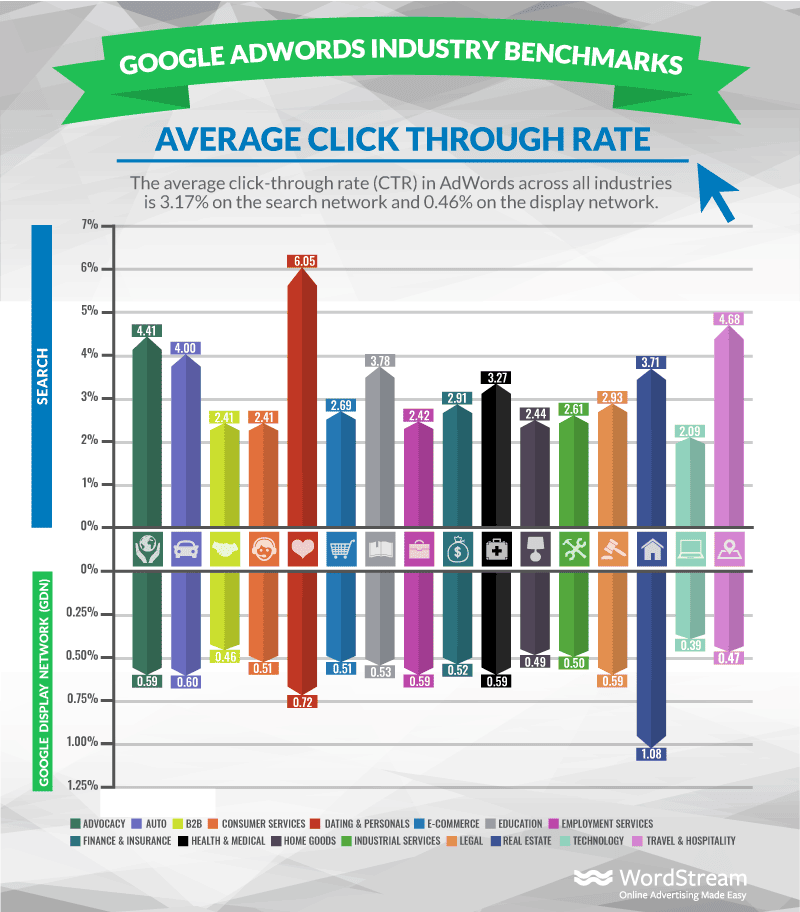
Figure 1 -https://www.wordstream.com/blog/ws/2016/02/29/google-adwords-industry-benchmarks?camplink=FeaturedPosts
In 2017, the company put out an invaluable study that focused on the Google ads that maximise CTR.
Their aim was to create a formula for creating ads that help you to boost your click-through rate.
This is the ad that they created:

Wordstream studied over 600 ads to find the ones that achieve the highest CTR.
With this study, they focused on something new. They wanted to look at the words that people use to grab attention and tempt out a click.
Then, they dug deeper. Not only did they analyse words and language patterns, but they also looked at punctuation and use of numbers.
After pulling the data together, they came to a conclusion. If you want to increase CTR for your ad it needs to have:
- Power words
- A great CTA
- A single exclamation point
- A positive slant
- Diverse language
- Writing that suits readers of a 9th grade reading level
We’re going to look at how they reached these conclusions. Plus, we’re going to offer tips on how to meet these criteria for your own ads so that you can boost your CTR.
5 Actionable steps to increase CTR
Tip #1 – Increase CTR by Using “Power Words” That Urge People to Act
The unveiling of Expanded Text Ads in 2016 led to tons of confusion among PPC marketers.
On the one hand, having more words at your disposal gives you plenty of room to play with language. On the other, expanded text gives you license to get less creative with your content.
Wordstream looked at how the words used in ads plays a role when trying to maximise CTR.
It found that the number of words that you use isn’t the key factor. It’s the type of words that play the biggest role:
- Now, fast
- Book
- Get, find, search, call, shop, try, save
- We, you, our
- Best, great, up, official, new
- Free, prices
Wordstream discounted conjunctions and articles to create a list of the power words that get people to click.
It found that 335 best-performing ads that it examined all used at least one of the following words:
- Your
- Free
- Now
- Get
- Online
- Our
- Save
- Best
- Shipping
- You
The top result is perhaps the most important. The ads with the best CTRs deliver a personalised message to users. They tell people what they get from clicking the ad, rather than what the company can offer them.
You can boost click-through rate if you make the ad relevant to the customer.
Then we get into the power words.
Words like “free” and “best” make obvious appearances. “Get” is also a useful term because it applies to practically every type of business.
“Shipping” is also a great power word for ecommerce businesses. You’ll likely combine this with “free” or “cheap” to give people another reason to click.
Here’s the key takeaway.
It’s not the amount of words that you use that encourage people to click an ad. It’s the type.
Focus your ad copy around words that urge people to act. Keep it personal and use words that draw attention.
It’s best to use these words in the ad’s headline so you instantly tell people what they’re getting.
Tip #2 – Create a Great CTA…And Know Where to Put it
You could argue that a strong call-to-action (CTA) is the most important part of your ad copy.
It’s with this that you tell the user what you want them to do.
Wordstream’s study broke this down into two components:
- Where you should put the CTA
- The words that you should use
The “where” is the simpler question to answer.
You want a CTA in your ad’s headline. It’s great if you can get it into the description too. The headline needs to tell people what you’re offering and what they need to do to get it.
As for the language, you’d assume “click” is a good choice.
Not so much:
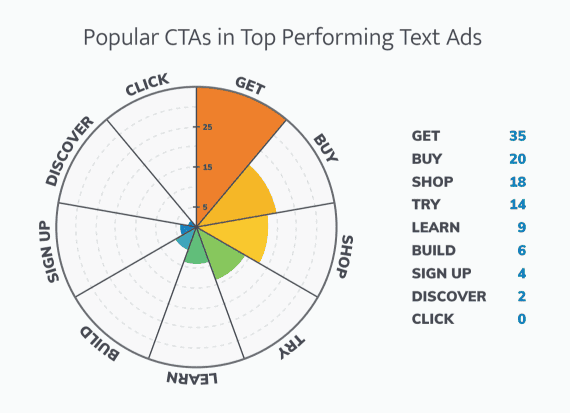
Wordstream’s analysis of the top ads found that none of the best performers used “click” in their CTAs.
“Get” is actually the top performer, followed closely by purchasing words, such as “buy” and “shop”.
It makes sense.
A click isn’t really a tangible action. It doesn’t really tell the person what you want them to do beyond clicking the ad.
They don’t know what you’ll want from them once they land on your page. For many, that’s enough to put them off.
More powerful words, like “get” and “buy”, tell the user exactly what you expect from them.
Of course, the action verbs you use depend on the purpose of the ad. If you’re looking to get leads, words like “try” and “learn” work best. The more direct purchasing words work for businesses that sell products directly, such as ecommerce stores.
Tip #3 – Increase CTR by Optimising Ad Language for Your Audience
Now you have the right words, you have to turn them into compelling ad copy.
There are three aspects to look at here:
- Message tone
- Lexical diversity
- Average reading level
Message Tone
To figure out the tone that can maximise CTR, Wordstream plugged each ad they examined into the Vader sentiment analysis tool.
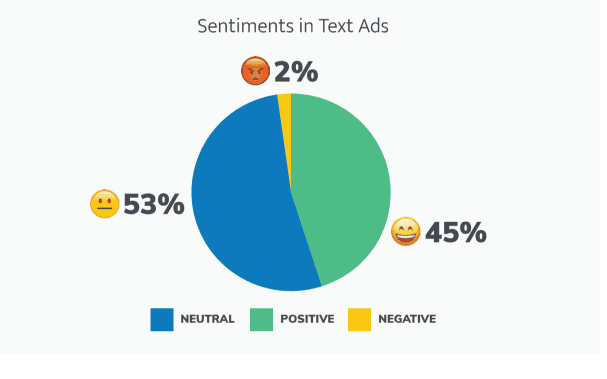
They found that the top performers almost completely avoid negative language:
Only 2% use ad copy with a negative slant. The other 98% either go neutral or positive.
It’s simple.
Don’t create ads that tell people what others can’t offer them.
Tell them what you can do to improve their situation.
There is a caveat to this though. You still want the copy to spur an emotional response. If fear is all that you have, then go with it.
Just know that positivity seems to win out among the top performers.
Lexical Diversity
Lexical diversity is a complicated way of saying vary your language.
Just look at this ad:

So… this company sells widgets.
If this was a piece of copy for a website, you’d call it keyword stuffed. And it will turn off people who would click on ads too.
Mix it up a little. Employ synonyms to good effect to make your copy more diverse.
And cut out extra copy. Just because you can write more, doesn’t mean that you have to.
Average Reading Level
This is a simple one.
Wordstream checked ad content against the Fleish-Kincaid scale to determine its readability.
They found that copywriting at a Grade 9 (or 14-year-old’s) level works best.
Just check your content against the same scale to make sure it’s at the right level.
Tip #4 – Consider Using Numbers to Build Credibility and Increase CTR
The study discovered that 37% of non-branded ads used numbers to increase CTR. That goes up to 40% for branded ads.
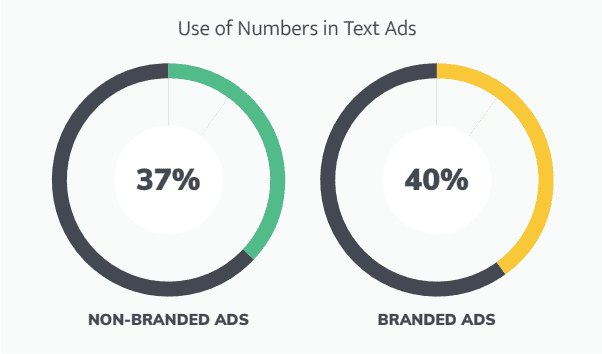
Let’s say that advertisers use numbers in a third of cases.
It seems like this indicates that you should avoid them. However, it’s a little more complex than that.
You can use numbers to great effect, in the right context.
The example ad that Wordstream created offers a great example. The use of the number “1” saves a little space and convey a more powerful message than the word “one”.
You may also use numbers if you’re making a direct offer that involves pricing. However, you may not want to do that, as we’ll explain in a little while.
It comes down to the message that you’re trying to convey. Don’t slot numbers in needlessly. Something like “100% Free” won’t be of much use. You’ve already conveyed the sentiment with the word “free” which makes the “100%” superfluous.
When you use numbers, make sure they add value and power to the copy.
Tip #5 – Use Punctuation for Power
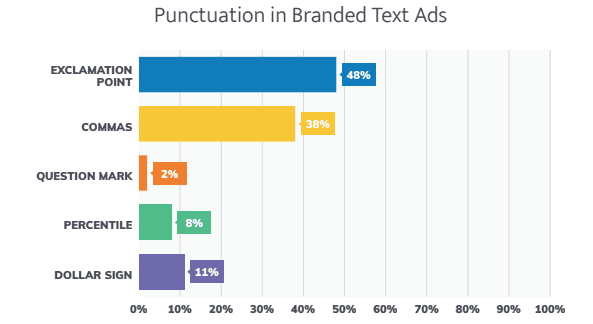
It shouldn’t come as much of a shock that exclamation points and commas are the most popular punctuation marks for both branded ads:
And non-branded ads:
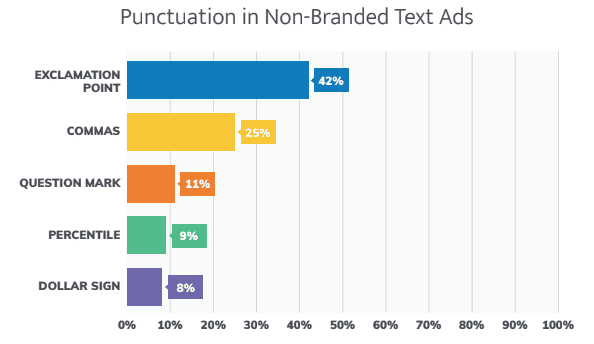
The exclamation point puts a stamp on your copy and makes it seem important. Plus, you’ll need commas to break up the copy.
What’s really surprising is the lack of dollar signs and question marks in both cases.
It seems like you can increase your CTR
if you avoid mentioning prices. Perhaps having the price in the ad offers too much information. If people know how much you want, they’re not going to click.
The counter-argument to that is those who do click are probably more likely to convert.
As for question marks, it makes more sense when you think about it.
You want your ad to encourage an action.
Questions don’t do that. They get people thinking instead of clicking.
The simple takeaway here is that your ad probably needs an exclamation point. Don’t go overboard though. One at the end of the description should do the job.
Over to you
Wordstream’s study offers some valuable insight into what the best ad copy offers.
From the data, we can see that you can boost click-through rates with the right language. The tone plays a part, as does language complexity and diversity.
Punctuation is a big factor and you need to use power words to really sell the ad. Importantly, your CTA must include verbs that prompt specific actions. Clicking isn’t enough.
Of course, CTR is just part of the puzzle. You could have the greatest CTR in the world and get absolutely no sales.
This just offers some insight into how to attract more clicks.
As Australia’s top SEO services agency, Online Marketing Gurus can help you apply this information and create campaigns that generate an amazing return.
Interested in what OMG could potentially offer?
Let us help you make 10x your traffic, leads and sales through the power of masterful Search Engine Optimisation / SEO, PPC and razor focused online digital marketing campaigns!

About the author
Read More Blogs
-
 10 minutes read
Are Your Search Campaigns Ready for the Google Ads Migration?

Last updated on:
-
10 minutes read
More AI In Search, More Ads In AI & More Choice For Social Users: This Week’s Updates
Last updated on:
-
Last updated on:


Stop Guessing What Your Marketing Should Do Next.
Your free $4,000 strategy session shows where your digital marketing is leaking performance across search, paid media, content and conversion. You leave knowing what to fix first and what a stronger strategy could produce.