

The History Of Google AI & Where It’s Headed

Last updated:
19 November 2025
|
11 minutes readFrom humble algorithms to world-changing neural networks, the story of Google AI is the story of how search, software and science collided to shape the digital world. Whether you’re deep in the tech industry or exploring AI’s impact on SEO, this timeline offers a comprehensive look at the history of Google AI and where it’s headed next.
The early AI foundations: PageRank and MapReduce
Before “artificial intelligence” became the buzzword of the decade, Google was already using intelligent systems to rank and process information at scale.
PageRank, developed by Larry Page and Sergey Brin in the late 1990s, was one of Google’s first steps into intelligent information retrieval. It treated the web like a voting system: links from one page to another were votes of importance. But not all votes were equal. PageRank weighted these votes based on the quality and authority of the linking page. Over time, this led to a more intuitive way of surfacing relevant search results. While Google has since layered in hundreds of other ranking factors, a modernised version of PageRank still plays a role in how Google AI understands site authority.
In 2004, Google tackled the challenge of processing massive data sets with the development of MapReduce. This system allowed developers to process data across distributed clusters efficiently by breaking it into “map” and “reduce” steps. For years, MapReduce was the backbone of Google’s internal data analysis. Though it’s been largely replaced by more modern systems like Apache Beam and Cloud Dataflow, it set the stage for large-scale AI pipelines that power today’s search, analytics and machine learning services.
These tools were early glimpses into the future of Google AI — a future driven by automation, scalability and data-rich reasoning.
From research to revolution: Key Google AI milestones
The history of Google AI accelerated dramatically after the company acquired DeepMind in 2014. The London-based startup brought cutting-edge reinforcement learning to Google’s research stack and soon became a pillar of its most advanced breakthroughs.
Not long after, in 2015, Google open-sourced TensorFlow, a flexible machine learning framework that quickly became the backbone of AI development worldwide. TensorFlow made it easier for developers to train models, test them at scale and deploy AI into apps and products. This marked a turning point in the accessibility and commercial viability of AI.
Then came AlphaGo. In 2016, DeepMind’s AI beat the world champion Go player — a milestone previously thought to be decades away. AlphaGo’s success demonstrated that machine learning models could exceed human expertise in highly complex, strategic environments.
More recently, Veo 3, a multimodal model designed for cinematic video generation, has emerged as part of Google AI’s creativity push. Integrated into tools like Flow, it showcases how Google AI is evolving to support not just language and vision tasks, but full-spectrum creativity across formats.
AI in consumer products: Seamless intelligence
Over time, the technology behind Google AI moved from the lab into people’s pockets. This transition didn’t happen all at once, but gradually through smart integrations into Google’s core products.
Google Photos was one of the first to use on-device machine learning for facial recognition, scene detection and automated album creation. It allowed users to search their photo collections using natural language, pioneering a new kind of AI-powered memory.
Google Assistant, launched in 2016, brought conversational AI into daily life. It lets users ask complex queries, set reminders, manage calendars or even control smart home devices using voice alone. All of it was powered by natural language understanding refined through the evolution of Google AI.
Meanwhile, Search, Google’s flagship product, underwent its own transformation. AI now powers everything from autocomplete suggestions to semantic analysis and video recommendations. The newest feature is AI Mode with Gemini 2.5 Pro, which answers questions conversationally and synthesises information across the web.
These advances have made Google AI tools a seamless part of daily digital interaction.
Google AI for the enterprise: Vertex AI and Cloud ML
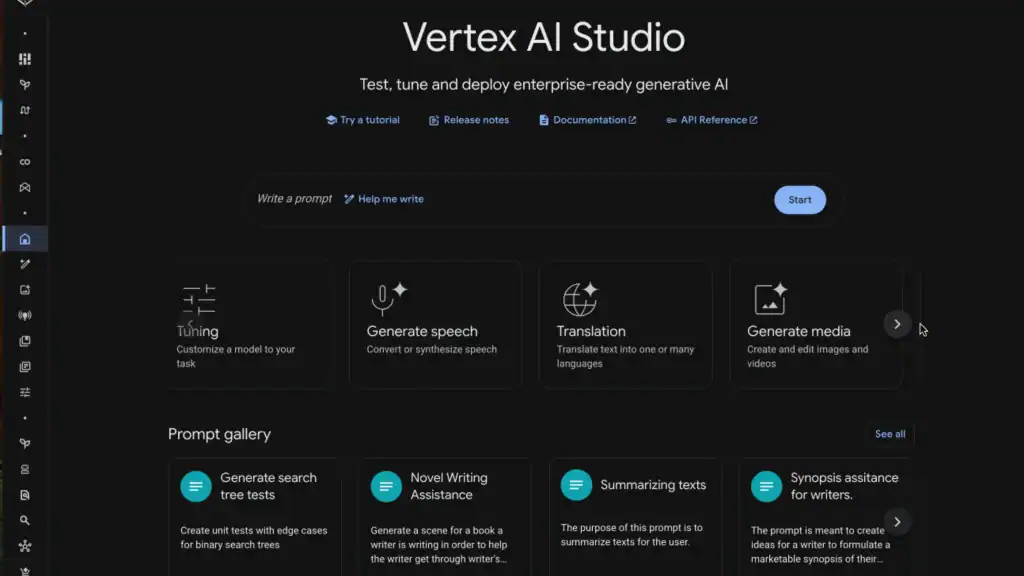
The future of Google AI involves scaling AI capabilities for business. That’s where Vertex AI and Cloud Machine Learning (Cloud ML) come into play.
Vertex AI is Google Cloud’s unified platform for building, training and deploying machine learning models. It supports prebuilt APIs for vision, speech and text and also gives data scientists full control over model training using custom data. For teams managing massive content libraries or running predictive analytics at scale, Vertex AI brings power and usability together.
Vertex AI Agent Builder, an extension of this platform, lets teams create Gemini-powered chatbots grounded in proprietary data, like internal SEO documentation or customer FAQs. These agents can assist with everything from site audits to client support workflows.
Meanwhile, Cloud ML APIs allow developers to use pre-trained models for tasks like image classification, document parsing or speech recognition—all without needing to write complex ML code.
The future of Google AI in enterprise lies in empowering more teams, such as marketers, analysts, product managers, to embed AI into daily decision-making without needing a research background.
Google AI and ethical responsibility
With great power comes a greater need for ethical boundaries, and Google has taken a public stance on that responsibility. In 2018, the company introduced its AI Principles, a foundational set of commitments that guide how it develops, tests and deploys artificial intelligence. These principles emphasise fairness, safety, accountability, transparency and privacy, setting the tone for how Google AI should operate in both consumer and enterprise contexts.
To operationalise these commitments, Google has built internal review processes and external-facing tools. These include systems to detect and reduce algorithmic bias, improve interpretability and ensure that AI-generated content is clearly labelled and responsibly used. Special attention is placed on how data is sourced, how decisions are made and whether models act fairly across different demographic or regional contexts.
This framework is especially important as Google AI takes on more significant roles in sectors like healthcare, finance, education and law — areas where small errors can have major real-world consequences. Google’s AI teams work with researchers, ethicists and policymakers to shape safeguards that reflect the stakes involved in real-life applications.
For SEOs and digital marketers, this directly affects content strategy. Google’s AI systems, particularly those that surface AI-generated overviews in Search, are built to uphold these ethical standards by design. That means content related to YMYL (Your Money or Your Life) topics is subjected to stricter quality, accuracy and transparency checks before it’s considered eligible for inclusion.
Recent advances: Gemini, Bard, Veo 3 and agentive AI
The future of Google AI is being built around Gemini, its most advanced family of large language models. Gemini replaces Bard and extends far beyond it, offering multimodal intelligence that spans text, image, audio and even video comprehension.
Gemini 2.5 Pro, now available in tools like Search’s AI Mode and NotebookLM, delivers advanced reasoning and code understanding. These models power consumer experiences in Gmail, Docs and Assistant, as well as enterprise features in Workspace and Vertex AI.
Veo 3, a new entrant in the generative video space, creates high-quality, cinematic outputs from text prompts. Available in Gemini Pro tiers through tools like Flow, it marks Google’s leap toward AI-enhanced storytelling.
Meanwhile, Google’s new agentive features (Agentic AI), like Search calling businesses on your behalf or the AI assistance built into Chrome DevTools, represent a shift towards AI that acts for you, not just with you. These tools are designed to handle tasks end-to-end, like checking local prices or debugging CSS without needing a line-by-line manual review.
And in Search, Deep Search is redefining how information is found, reasoning across sources to generate structured, cited summaries. It’s a signal that the future of Google AI will make finding, understanding and using information faster and more complete than ever.
Research breakthroughs and open‑sourcing
Google has long shaped the research landscape of AI, and that continues with its contributions to open science and public infrastructure.
TensorFlow, launched in 2015, remains one of the most widely used open-source machine learning frameworks. It’s backed by Google’s scale and still receives major updates that align with the latest research.
Google Research teams regularly publish papers that set new benchmarks in areas like protein folding, text-to-image synthesis, speech recognition and large-scale retrieval. AlphaFold, developed by DeepMind (a Google company), has been described as one of the most important scientific breakthroughs in decades.
In 2024 and 2025, Google open-sourced models like Gemma, a lightweight and accessible model family designed to help developers safely experiment with AI outside proprietary platforms. These releases highlight Google’s dual approach, delivering enterprise tools while supporting a more open AI ecosystem.
Recent research also includes explorations of multimodal grounding, long-context memory and language agent frameworks, all of which contribute to the scalable future of Google AI.
Future directions: What’s on the roadmap
Google’s AI roadmap is focused on three areas: power, autonomy and integration.
- The models themselves are becoming more capable and agentic. Gemini 3, expected later in 2025, will bring improvements in multistep reasoning, autonomy and domain-specific knowledge. Google is also exploring new architectures designed for real-time responsiveness across voice and visual inputs.
- AI will continue to become embedded in everyday tools. We’re already seeing this with Gemini in Workspace, and upcoming integrations will deepen its role in YouTube, Meet and Search. For example, Gemini will soon be able to generate presentation visuals on the fly or summarise live meetings in real time.
- Project Astra and Project Mariner represent long-term visions for truly universal AI assistants. Astra focuses on real-time multimodal understanding, while Mariner is a browser-based AI agent designed to automate online tasks like booking, researching and filling out forms.
For SEOs and marketers, this means a shift in how users engage with content. With AI handling more of the research and summarisation process, strategies may need to evolve for zero-click experiences and richer, structured data to ensure visibility.
Societal implications and AI oversight
As the capabilities of Google AI grow, so does its impact on society. Google acknowledges this with its AI Principles, a public commitment to building responsible AI. These principles emphasise safety, fairness, transparency and accountability and guide decisions around product design, deployment and research.
In practical terms, this means AI models are trained with constraints around misinformation, bias and harmful outputs. But challenges remain, especially around hallucination, consented data use and explainability.
Google is working with regulators, academic bodies and civil society organisations to establish frameworks for ethical AI deployment. Internally, teams like Google DeepMind’s Ethics and Society unit are tasked with stress-testing AI systems before launch.
For users and businesses, this translates to clearer guardrails and better transparency around how Google AI systems work. Expect more controls, audit tools and documentation as regulatory frameworks evolve.
In SEO and content publishing, it also means understanding where and how AI summaries appear and how structured content, citations and freshness impact inclusion.
Expert predictions and next-gen Google AI
Leading AI researchers and Google insiders agree on one point: we’re moving from AI tools to AI teammates.
Expect to see more autonomous agents that can complete tasks across multiple apps and platforms. Google is experimenting with persistent agents that remember user context across sessions and provide follow-up assistance, which could change how people work, learn and communicate.
The next generation of Gemini is likely to have longer context windows, better memory and deeper integration into mobile and cloud ecosystems. We’re also watching for enhancements in multilingual support, real-time translation and fine-grained control over AI behaviour.
In terms of practical applications, AI will help with everything from writing and coding to design, research, customer support and even strategy. It will do so across interfaces, from voice and text to video and augmented environments.
For SEO professionals, this means a wider impact: from how search rankings are calculated to how content is consumed and summarised by AI systems. Staying informed and adaptive will be key.
Build the future with Online Marketing Gurus
Navigating the future of Google AI takes more than curiosity, it takes strategy, speed and the right partner. At Online Marketing Gurus, we help forward-thinking brands optimise for an AI-first web. Whether you’re looking to future-proof your SEO or create evergreen content, our experts are here to guide the way.
Talk to us today about how to build smarter, rank stronger and stay ahead in the age of Google AI.

About the author
Read More Blogs
-
 10 minutes read
Are Your Search Campaigns Ready for the Google Ads Migration?

Last updated on:
-
10 minutes read
More AI In Search, More Ads In AI & More Choice For Social Users: This Week’s Updates
Last updated on:
-
Last updated on:



Stop Guessing What Your Marketing Should Do Next.
Your free $4,000 strategy session shows where your digital marketing is leaking performance across search, paid media, content and conversion. You leave knowing what to fix first and what a stronger strategy could produce.