

Discover Volatility Is The Point Of Google’s February 2026 Core Update


Last updated:
16 February 2026
|
13 minutes readKey Takeaways
- Google is treating Discover and Search separately, allowing visibility to shift without ranking changes.
- Meta is pushing AI deeper into messaging and campaign infrastructure rather than standalone tools.
- Google is reducing the impact of self-promotional listicles and low-credibility comparison content.
- Google Ads is adding clearer creative feedback inside automated formats like Performance Max.
- Reddit and Threads are prioritising infrastructure, making early setup more important than immediate scale.
February’s updates landed without theatrics, but not without consequence. Across Google, Meta and other major platforms, the signal is consistent: volatility is no longer a side effect of change but a deliberate feature of how discovery, attention and performance are shaped.
Recent shifts make this clear. Visibility can move without obvious technical triggers, and performance can change even when core settings remain stable. Rather than signalling instability, these patterns reflect platforms refining how different surfaces operate, tightening quality signals and rewarding relevance that aligns with real user behaviour rather than formulaic optimisation.
This creates a different challenge than in previous update cycles. Interpreting performance now requires understanding where change is happening, why that surface matters and how intent is being captured within it, particularly as search engine optimisation becomes more fragmented across multiple discovery environments.
In this week’s digital marketing updates, we talk about a more fragmented but more intentional digital landscape.
Google Rolls Out February 2026 Discover Core Update
Visibility in Google Discover can now shift independently of traditional search rankings. That separation makes it critical to assess Discover performance on its own terms rather than through a standard search engine optimisation lens.
Early signals suggest the update places greater emphasis on content quality, originality, topical relevance and engagement, while continuing to reduce the reach of sensational or click-driven formats. Importantly, Discover is being treated as a separate ecosystem from Search, with its own signals and evaluation criteria.
The Gurus’ take
The significance of this update is not volatility itself, but intent. Google is reinforcing that Discover is not a traffic bonus layer for SEO-optimised pages, but a surface designed to respond to user interests, behaviour and context. That shifts the conversation away from rankings and towards how content earns attention when there is no explicit query driving demand.
This creates a different optimisation challenge. Success in Discover is less about keywords and more about relevance, authority and engagement signals that reflect real user curiosity. It also means traffic fluctuations tied to Discover should be read carefully. A drop does not necessarily indicate a problem with broader search engine optimisation. It may simply reflect how Google is recalibrating what it considers valuable, timely and trustworthy in-feed content.
Your action plan
To respond to this update with purpose:
- Monitor Discover traffic separately in Google Search Console rather than assuming broader SEO performance issues.
- Review content surfaced in Discover for depth, originality and relevance rather than format or volume.
- Strengthen topical authority in key areas rather than publishing broadly.
- Ensure content clearly reflects audience context and regional relevance, particularly for digital marketing in Australia.
- Use Discover performance insights to inform broader search engine optimisation and content strategy decisions.
Google Hits Self-Promotional Listicles in Recent Unconfirmed Updates
Recent unconfirmed Google updates appear to have impacted self-promotional, self-serving listicle content, particularly articles designed to rank while primarily promoting the publisher’s own products, tools or services. These pieces often follow a familiar format: “Best X for Y” lists where the author’s offering dominates the recommendations, sometimes without meaningful comparison, evidence or third-party validation.
Industry analysis suggests that pages benefiting from these tactics have seen sharp declines in visibility over the past month. This includes many positioned as part of early generative engine optimisation (GEO) strategies. While Google has not formally confirmed a targeted update, the timing and pattern of losses point to a recalibration of how credibility, independence and usefulness are assessed within search results.
The Gurus’ take
What’s changing here is not Google’s stance on listicles, but its tolerance for thin authority and implied bias. Self-referential content that exists primarily to game rankings, rather than help users make informed decisions, is increasingly misaligned with how Google evaluates trust and value. This is especially true as generative answers and summaries become more prominent across search surfaces.
This matters for brands experimenting with GEO-led content strategies. Many early generative engine optimisation plays relied on publishing high-volume “best of” or comparison content that subtly funnels users towards owned solutions. The recent volatility suggests that approach is fragile. If credibility isn’t clear, comparisons aren’t balanced or value isn’t obvious, performance gains can disappear quickly.
Your action plan
- Audit listicle and comparison content for bias, depth and genuine usefulness.
- Separate educational content from commercial intent where possible.
- Strengthen evidence signals, including real comparisons, use-case clarity and limitations.
- Reassess GEO strategies that rely heavily on self-promotion rather than authority.
- Prioritise content that would remain useful even if your brand were removed from the page.
- Align generative engine optimisation efforts with long-term credibility, not short-term visibility.
Meta Develops AI Chatbot Built for Group Conversations
Meta is developing a dedicated AI chatbot for group chats rather than one-to-one conversations. Early reporting suggests the bot is being tested for use inside group messaging environments across Meta platforms, where it can participate in ongoing discussions, respond to prompts and support shared interactions rather than individual queries.
This marks a subtle but important distinction from existing chatbot deployments. Instead of acting as a personal assistant, the AI is positioned as a shared conversational layer, operating within the dynamics of group behaviour. While details on rollout and functionality remain limited, the direction points towards AI becoming embedded in community-driven spaces and not just private or transactional conversations.
The Gurus’ take
The real signal here is not the chatbot itself but the environment Meta is targeting. Group chats are where coordination, opinion-forming and informal decision-making already happen. By placing AI into these spaces, Meta is exploring how automation can support collective conversations rather than simply responding to individuals.
From an AI SEO perspective, this also hints at how intent is increasingly expressed outside of traditional search environments. Questions, comparisons and recommendations are already happening inside group conversations, long before someone opens a search engine. As AI becomes embedded in these moments, brands will need to think beyond keywords and rankings and consider how visibility, trust and relevance are earned inside conversational ecosystems.
Your action plan
- Monitor how Meta positions AI roles within group chats as testing expands.
- Reassess community management frameworks with AI participation in mind.
- Consider where AI could support moderation, summarisation or clarification without dominating conversation.
- Be cautious about automation in group settings; value comes from restraint, not presence.
- Prepare internal guidelines for tone, escalation and boundaries if AI SEO tools become available for branded communities.
Google Tests Built-In A/B Testing for Performance Max Creatives
Google has been spotted testing native A/B testing functionality for creative assets within Performance Max campaigns in Google Ads. The feature would allow advertisers to compare different creative variations directly inside the platform rather than relying on indirect signals or external testing frameworks to infer performance.
If rolled out more broadly, this would mark a meaningful shift in how Performance Max is managed. One of the long-standing challenges with the format has been limited visibility into what creative elements actually drive results. Built-in testing suggests Google may be moving towards greater clarity around creative contribution, without dismantling the automation-first structure of Performance Max.
The Gurus’ take
This development points to a recalibration rather than a reversal. Performance Max is still designed to automate decision-making at scale, but Google appears to recognise that advertisers need clearer feedback loops to make better inputs. Transparency around creative effectiveness has been one of the most consistent friction points, particularly for teams managing large budgets across complex account structures.
For those working in Google advertising, this could improve confidence without fundamentally changing how Performance Max operates. Better creative insight allows advertisers to iterate with intent rather than guesswork and to align creative strategy more closely with performance outcomes. That said, testing frameworks inside automated systems are only useful if the learnings are actionable. How Google presents and contextualises results will ultimately determine the value of this feature.
Your action plan
- Watch closely for broader rollout or official confirmation of Performance Max creative testing in Google Ads.
- Prepare multiple, clearly differentiated creative variations to make testing meaningful.
- Focus testing on messaging, format and value propositions rather than minor visual tweaks.
- Use test results to inform upstream creative strategy instead of just campaign-level optimisation.
- Treat insights as directional within automated campaign environments.
Google Adds AI “Good To Know” Labels to Local Hotel Photos
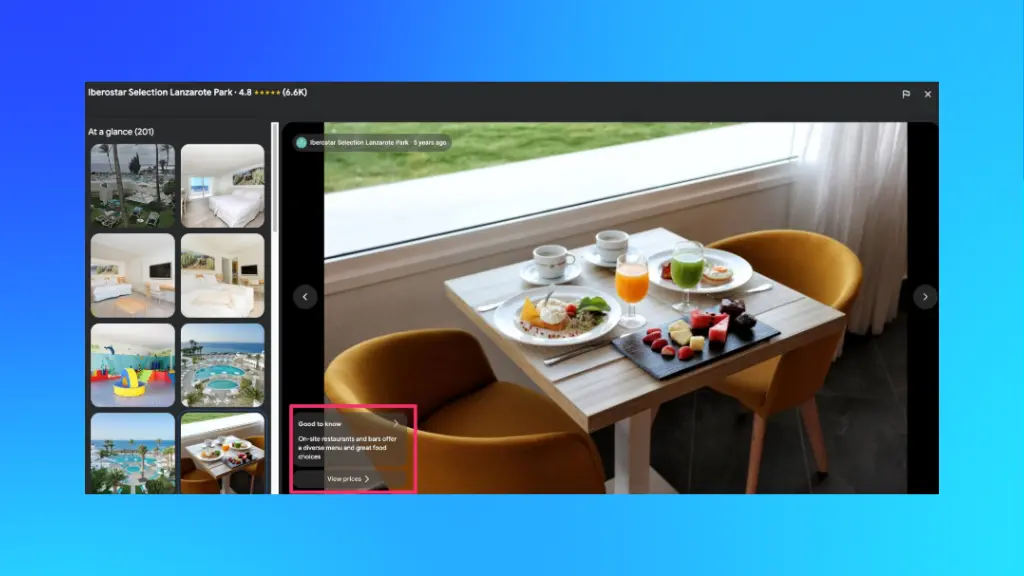
Google has begun adding AI-generated “Good To Know” labels to hotel photos displayed in local search results. These labels surface quick, visual insights directly on images, which gives users additional context without needing to click through to a listing or website.
This update signals a deeper integration of AI interpretation into visual search elements. Rather than images acting purely as supporting assets, Google is now actively extracting and presenting meaning from them. As a result, photos are becoming information carriers within the search experience and a more influential signal for local SEO.
The Gurus’ take
This change reinforces a broader shift in how Google evaluates and surfaces local businesses. Visual assets are no longer passive; they are being assessed, interpreted and summarised by AI. For hotels, and by extension other location-based businesses, image quality, relevance and accuracy now play a more direct role in how listings are perceived and prioritised.
This raises the bar for local SEO. Photos that clearly reflect real-world experiences, spaces and services are more likely to align with what Google’s systems surface as “good to know”. Generic, outdated or loosely related images risk misrepresenting a business or failing to contribute meaningful signals in local results where competition and user intent are high.
Your action plan
- Audit existing local image libraries for accuracy, relevance and clarity.
- Prioritise authentic, well-lit photos that clearly show key features and amenities.
- Remove outdated or misleading images that could generate incorrect AI interpretations.
- Align visual content with real customer expectations.
- Treat images as a core component of local SEO, not a secondary optimisation.
Reddit Expands Reminder Ads Beta for Time-Sensitive Campaigns
Reddit is expanding access to its Reminder Ads beta, allowing advertisers to notify users about upcoming launches, releases or events they’ve previously expressed interest in. These ads enable users to opt in to receive a reminder notification at a later date.
The expansion suggests growing confidence in the format’s ability to support planning and anticipation-based behaviour. Rather than competing for instant clicks, Reminder Ads are designed to sit upstream in the decision journey, particularly within communities where users actively discuss upcoming products, events or moments they care about.
The Gurus’ Take
This format aligns closely with how Reddit users already behave. Much of Reddit’s value comes from intent that forms early (through discussion, comparison and shared anticipation) well before a purchase or conversion moment. Reminder Ads acknowledge that reality, giving brands a way to stay present without forcing urgency too early.
Advertising on Reddit can become a part of a broader social media marketing strategy. It introduces a more patient and context-aware approach. Instead of pushing users towards immediate outcomes, Reminder Ads support campaigns where timing matters more than speed. That said, success will depend heavily on relevance. If reminders feel disconnected from genuine community interest, they risk being ignored or disabled altogether.
Your action plan
- Identify campaigns where timing, launches or scheduled events drive demand.
- Align Reminder Ads with organic community discussions and sentiment.
- Prioritise messaging that adds value and context rather than urgency.
- Test reminders alongside standard formats to understand incremental impact.
- Track opt-in and reminder engagement as indicators of genuine intent.
Meta Business Suite Adds Threads Accounts for Global Advertising
Meta has added support for Threads accounts within Meta Business Suite, allowing advertising on Threads to be managed alongside Facebook and Instagram as part of global ad campaigns. This update simplifies how brands oversee assets and campaigns across Meta’s ecosystem.
While this does not yet signal a full expansion of ad formats within Threads itself, it removes a key structural barrier. By bringing Threads into the same management environment, Meta is laying the groundwork for tighter integration and easier activation as advertising capabilities on the platform continue to evolve.
The Gurus’ take
Meta is positioning Threads as a long-term part of its advertising ecosystem, not a standalone experiment. Centralising account management reduces friction for advertisers and lowers the operational cost of testing Threads as a channel when opportunities emerge.
Viewed another way, this change is about preparedness. Threads can now be incorporated into existing account structures, reporting setups and governance processes before advertising activity expands. That sequencing is typical of Meta’s platform rollouts. Infrastructure comes first, followed by monetisation once usage patterns and user behaviour are more clearly established.
Your action plan
- Add Threads accounts to Meta Business Suite where relevant to future campaigns.
- Track updates to ad formats, placements and targeting as advertising on Threads continues to evolve.
- Align Threads content planning with broader Meta platform messaging and brand voice.
- Approach Threads as an experimental channel before treating it as a core performance driver.
- Put internal processes in place so activity can scale efficiently if advertising options expand.
Meta Ends Recurring Marketing Messages API for Messenger
Meta has officially shut down its Recurring Marketing Messages API for Messenger. Brands can no longer send automated or scheduled marketing messages to users through this framework. The feature previously allowed businesses to maintain ongoing promotional communication with users who had opted in, often as part of broader social media marketing lifecycle or retention campaigns.
With the API now offline, any campaigns or workflows relying on recurring Messenger messages will no longer function in the same way. Brands must shift to alternative messaging approaches within Meta’s platform rules, such as one-off notifications, user-initiated conversations or other compliant engagement formats.
The Gurus’ Take
This change reflects a broader tightening of how Meta governs direct messaging for marketing purposes. Persistent, automated outreach is increasingly at odds with how platforms want users to experience private messaging environments. The emphasis is shifting towards user-controlled, context-driven interactions rather than ongoing brand-led pushes.
This is less about losing a tool and more about adapting social media marketing strategies. Messenger can still play a role in customer journeys, but it needs to be anchored in clear consent, relevance and timing. Brands that leaned heavily on recurring automation will need to rethink how they nurture relationships without overstepping platform boundaries or user expectations.
Your action plan
- Identify and pause any workflows dependent on the Recurring Marketing Messages API.
- Review Messenger’s remaining compliant use cases and messaging policies.
- Shift lifecycle strategies towards user-triggered or event-based communication.
- Rebalance messaging efforts across owned channels such as email, SMS or in-app notifications.
- Beyond promotional reach, reassess how messaging supports broader customer experience.
Turn platform volatility into clarity with Online Marketing Gurus
Volatility doesn’t automatically signal risk, but misunderstanding it does. When visibility shifts across Discover, search, paid media or platform-led campaigns, the priority is understanding what’s actually driving the change and whether it reflects a performance issue or a broader platform recalibration.Online Marketing Gurus works with brands to interpret updates like these in context. We connect search engine optimisation, generative engine optimisation, paid media, content and platform behaviour into a clearer strategic view. If you’re assessing how recent changes affect visibility, demand capture or channel mix, speak with OMG. Let us help separate noise from signal and identify what to adjust next in how you approach digital marketing in Australia.

About the author
Read More Blogs
-
 10 minutes read
Are Your Search Campaigns Ready for the Google Ads Migration?

Last updated on:
-
10 minutes read
More AI In Search, More Ads In AI & More Choice For Social Users: This Week’s Updates
Last updated on:
-
Last updated on:



Stop Guessing What Your Marketing Should Do Next.
Your free $4,000 strategy session shows where your digital marketing is leaking performance across search, paid media, content and conversion. You leave knowing what to fix first and what a stronger strategy could produce.