

How to Set Up a Simple Google Ads Testing Framework for Campaign Optimisation


Last updated:
31 December 2025
|
7 minutes readKey Takeaways
- Google Ads Testing Framework involves using drafts and experiments to test changes without impacting live campaigns.
- Drafts allow campaign edits in parallel, enabling controlled testing and risk-free optimisation.
- Experiments enable a percentage of traffic split to assess changes in copy, bids, or targeting.
- Key metrics, like click-through rate and conversion rate, determine experiment success.
- Once validated, successful experiments can be rolled into live campaigns, improving ROI.
How To Optimise Your Campaign With Google Ads Testing Framework
Experimentation is a HUGE part of Google Ads – that is where Google ads testing framework comes in to play.
When you test and learn, you can see what works, tweak your ads for optimised performance, and uncover new opportunities that your competitors haven’t tapped into yet.
Here’s the thing: if you don’t know what you’re doing, testing can be a costly endeavour. It’s easy to sink a ton of budget into experiments without ever getting tangible results or seeing an uptick in performance. That’s where Google Ads’ experiments come in.
Google Ads campaign drafts and experiments are a great way to propose and test changes to your Search and Display ads, WITHOUT needing to tinker with your live ads. In this guide, we’ll cover how to set up your experiments, how to decide what to test, and how to measure your results.
What are campaign drafts and experiments?
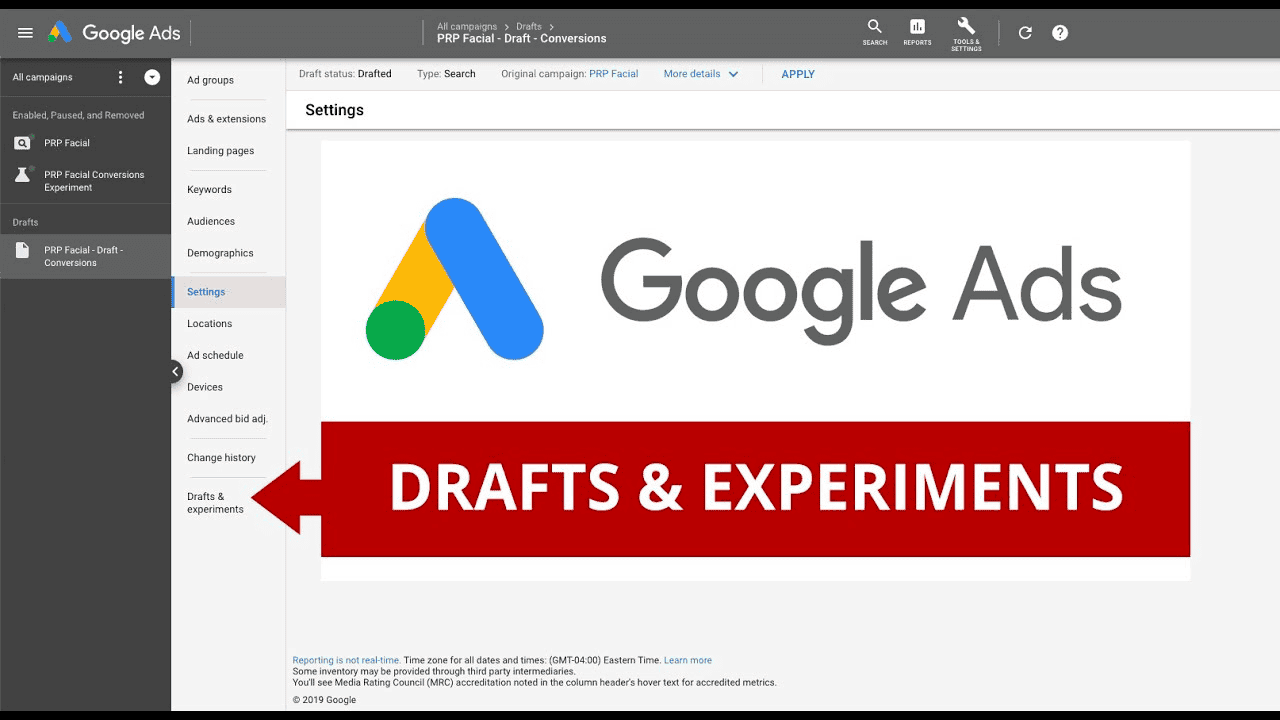
Campaign drafts allow you to prepare multiple changes to a campaign without affecting its performance. Drafts are essentially a mirror of your existing campaign set-up, where you can make tweaks as needed. Once you’ve finished your draft, you can either apply these updates to your original campaign, or run them as an experiment.
Campaign experiments are a way to test the performance of your draft before converting it into a full-fledged campaign. When a user performs a search via Google or sees an ad on the Display Network, Google will randomly activate your original campaign or your experiment. The rate at which Google activates one or the other will depend on how you’ve split the traffic share during the experiment set-up phase.
While your experiment is running, you can track its performance against your original campaign to see your test stacks up. Once the experiment ends, you can either convert it into an entirely new campaign, or apply your experiment to your original campaign.
Tip: You can only run one of your drafts as an experiment at any given time, so be sure to pick and choose the one that you think will deliver the best results.
How to set up a draft
Setting up a draft in Google Ads is pretty straightforward. All you have to do is navigate into the Drafts & experiments section in Google Ads, and select Campaign Drafts at the top of the page. Select the + button, then pick the campaign you want to duplicate. Google Ads will automatically create a draft that mirrors your existing campaign set-up.
Bear in mind that there are some features you can’t change in your draft, such as:
- Ad schedule report
- Category & search terms
- Auction Insights
- Display Placements report
- Scheduled email reports
- Bid landscapes
- Ad customisers that use “Target campaign” or “Target ad group”
- Keyword diagnosis
- Shared budgets
How to set up a Google ads testing framework
Once you’ve created your draft, it’s time to set up your experiment.
- Hop into Google Ads and click on Drafts & experiments, then select the + button. From here, you can select the draft that you want to turn into an experiment.
- Set a name for your experiment.
- Choose the start date and end date. Google allows you to automatically set up a run time for your experiment or, if you want to flip it off manually, you can select “none”.
- Enter the percentage of your original campaign’s budget that you want to allocate for your experiment (i.e. 10%).
- Choose if you want to split your experiment by users or searches under the “Advanced options” tab. Cookie-based means that each user will only see one version of your campaign, while search-based will randomly assign either your experiment or your original campaign when a search occurs.
- Save your experiment.
Monitoring your experiment’s performance
We can’t stress this enough: an experiment isn’t just set and forget. You should be monitoring your experiment’s performance on a regular basis to see how it’s tracking against your original campaign, and pause it if needed.
At any point during your experiment, you can monitor results using the performance scorecard:

Image source: Ignite Visibility
This scorecard compares your experiment’s performance against the original campaign for key metrics, including clicks, CTR, average CPC, cost, conversion rate, cost per conversion, and more. You can also modify the metrics you want to display, based on your overarching campaign goals.
If you hover your mouse over the second line, you’ll also find a treasure trove of additional information on your campaign, including:
- Statistical significance: Google will identify whether the variance in performance is statistically significant. If your campaign is marked as not statistically significant, the variance you see could be due to pure chance, your data set may be too small to draw a conclusion, or your campaigns might need more time to run.
- Confidence interval: This reflects Google Ads’ confidence in the performance difference. For example, it might say something like “There’s 95% chance that your experiment sees a +10% to +20% difference for this metric when compared to the original campaign.”
Tracking your experiments
Unless you’re a PPC manager who’s across ads accounts all day, then it’s hard to track what tests you’re running if you don’t track your ideas and experiments. Do this through your own convention system within the ads account, and create a spreadsheet to store the results of your tests. This allows you to reflect on what works and what doesn’t, and prevents any double-ups in the future.
You may also want to review:
Proven Ways To Stop Google Ads Click Fraud | Google Ads vs Facebook Ads: Which Is Better For Your Business? | Guide to looker studio / Google data studio | The Ultimate Guide To Google Ads Ad Extensions | Ultimate Guide to Google Display Network in 2022 | Complete Guide to Google Ads Keyword Match Types and Analysis | Advertiser’s Guide to Google’s Responsive Search Ads & Best Practices | Google Ads Dashboards: Reporting, Metrics and Target KPIs | How Long To See Results With Google Ads? | How to Properly Set Up Your Google Analytics Tracking for Google Ads | Google Ads: How to Lower CPA to Better Scale Your Campaigns | Guide to Google Ads Bidding Types, Strategies and Bid Adjustments | How to Set Up a Simple Google Ads Testing Framework for Campaign Optimisation | Bing Ads vs Google Ads: Where Should You Invest Your Time And Money? | Google Ads: What You Need to Know About CTR and Other Benchmarks | Should I Inhouse Or Outsource Adwords Management? | The Ultimate Guide To Google Ads
Final thoughts
We are the Australian leaders in online digital marketing as well as the top SEO agency in Australia. We know what it takes. Creating optimised Google Ads campaigns isn’t rocket science, but it is hard work. It requires careful planning, precise targeting, sharp ad creative, constant monitoring, and regular testing if you want to finetune your campaigns for conversions and revenue. Reach out to the #1 PPC Agency in Australia if you need help with your campaigns.

About the author
Read More Blogs
-
 10 minutes read
Are Your Search Campaigns Ready for the Google Ads Migration?

Last updated on:
-
10 minutes read
More AI In Search, More Ads In AI & More Choice For Social Users: This Week’s Updates
Last updated on:
-
Last updated on:



Stop Guessing What Your Marketing Should Do Next.
Your free $4,000 strategy session shows where your digital marketing is leaking performance across search, paid media, content and conversion. You leave knowing what to fix first and what a stronger strategy could produce.