

What is Google Panda?


Last updated:
25 July 2025
|
14 minutes readKey Takeaways
- Google Panda is a core algorithm update introduced in 2011 to downgrade low-quality or thin content and reward high-value pages.
- Initial rollout impacted ~12% of English searches, marking a major shift toward content quality.
- Panda penalised duplicate content, content farms, spammy UGC, and high ad-to-content ratios.
- Recovery relied on content auditing: removing poor pages, improving depth, adding author transparency, and fixing link quality.
- Since 2016, Panda’s signals have been part of Google’s core ranking algorithm, making quality focus a lasting priority.
Guide To Google Panda – Their Core 2011 Algorithm Update
Pigeons, Pythons, Penguins and now Pandas. Google sure has a thing for for animal alliteration (see what I did there?). Today we’re going to dig deep into one of Google’s most prolific search algorithm updates: Google Panda!
The world of content marketing and search engine optimization (SEO) was shaken up with this change to Google’s search results ranking algorithm.
Let’s see how and why this is considered one of biggest algorithm updates in Google’s history.
Why did Google launch the Panda core algorithm update?
Google launched the Panda core algorithm update in 2011. The aim if this update was to address concerns about the quality of content in search engine results.
Back then, many websites were ranking highly despite having low-quality, shallow and even spammy content. These websites often used black hat tactics like keyword stuffing, duplicated content, and clickbait headlines to artificially inflate their rankings. Naturally, this resulted in poor user experience.
The main goal of the Panda update was to:
- Improve Content Quality: Google wanted to reward websites with high-quality, original, and useful content, while penalising sites that used manipulative SEO tactics and offered little value to users.
- Combat Content Farms: A major target of Panda was content farms—websites that churned out large volumes of low-quality articles to capture search engine traffic. These websites typically had little to no expertise in the topics they covered and aimed solely at ranking for search terms to generate ad revenue.
- Enhance User Experience: Panda was designed to improve the overall search experience for users by providing more relevant, authoritative, and engaging content, ensuring that users find useful, well-written information when they perform a search.
- Reward Originality and Expertise: The update placed a higher value on content that demonstrated originality, expertise, and thoroughness. Websites that provided in-depth and well-researched content on specific topics saw an increase in their rankings.
Google aimed to create a more meaningful and user-centric search result experience. Through the Panda update, google was able to understand and reward content that truly served user needs. It also helped to discourage shady ranking tactics focused solely on manipulating search engine results.
What does Google Panda do?
Google’s Panda update was introduced to reduce the amount of low-quality, thin content in organic search results and reward unique, compelling, authoritative and trusted websites.
It was initially released 23 Feb 2011 in the US, and worldwide on 12 August 2011.
Since then, Google has released almost 30 Panda updates.
The first hit affected nearly 12 percent of English Google search queries to a noticeable amount.
Google Panda: A Focus on Quality
For our Australian website owners, understanding the Google Panda update remains crucial for long-term success. This significant algorithm change emphasized the importance of delivering a truly positive user experience. Instead of trying to game the system, the most effective strategy lies in focusing on creating high-quality content that resonates with your audience. When we prioritize providing valuable, informative, and engaging material, we naturally foster an environment where visitors are more likely to stay longer, explore further, and ultimately have a much better interaction with your site.
This holistic approach not only aligns with Google’s guidelines but also builds trust and loyalty within our Australian online community.
So how does the Google Panda algorithm work?
Panda determines a site’s quality by asking 23 questions, including:
- ‘Is this the sort of page you’d want to bookmark, share with a friend, or recommend’, and
- ‘Does the page provide substantial value when compared to other pages in search results?’
Essentially, it is a machine learning tool part of Search Engine Optimisation (SEO) that determines how a human would rate a webpage.
It targets low-quality websites, affecting their Google rankings.
When Panda initially hit, the websites that were affected received a MASSIVE drop in traffic overnight.
However, identifying Google Panda updates has become a lot more difficult since 2013 because Google stopped announcing them.
In 2016, Google confirmed they had merged Panda into the core Google algorithm as a core ranking signal.
This said, it doesn’t necessarily act in real time.
So how do you know when you’ve been hit with a Google Panda penalty?
If your website experienced a Google ranking drop and you see less organic traffic, there’s a good dance Google penalised your site.
Here’s a great flowchart from Moz:
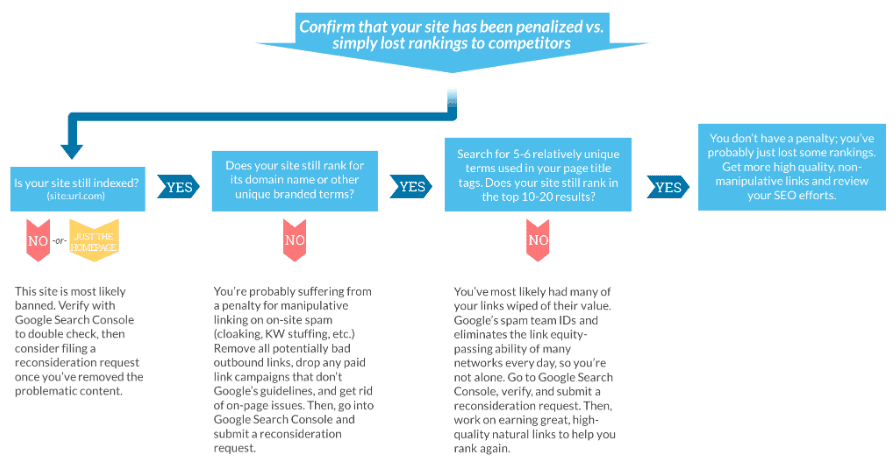
Source: Moz
Just a quick note: If you see that your website’s rankings are down and your web traffic has taken a hit, it may not be because of a Panda penalty. There are many other factors that can affect these things, such as:
- Seasonal demands: If you’re a business offering reef snorkeling packages, you probably won’t get a lot of website traffic during the winter months.
- Competitors: Remember to keep tabs on competitors in your industry who can out-SERP you (Search Engine Results Page).
- Manual penalties: You can check Google Search Console for any reports
- Another P: Confirm whether another Google penalty, such as one from Google’s Penguin algorithm update, is affecting your rankings instead.
You can also use tools such as the Website Penalty Indicator and SEMrush’s audit tool to check how Panda’s penalty (and other penalties) have affected your site in SERPs.
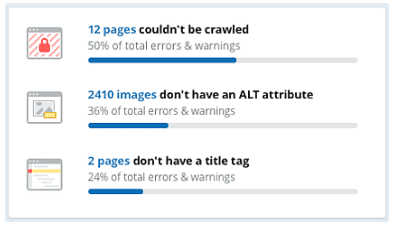
Source: Hubspot
The Google Panda Algorithm: Understanding Its Impact on Your SEO Strategy
The Google Panda Algorithm was introduced to improve the quality of search results by filtering out low-quality, spammy content from appearing in search engine results. Panda specifically targets websites that provide thin, irrelevant, or duplicate content, rewarding those with high-quality, original content that adds value to the user experience.
If you want to avoid penalties from Panda, it’s crucial to focus on improving the quality of search results for your target audience. This means ensuring that your content is well-researched, comprehensive, and aligns with what users are searching for.
By continually updating your site with relevant and engaging content, enhancing your user experience, and ensuring technical SEO best practices, you can help maintain or improve your rankings in the face of ongoing Google algorithm updates like Panda.
18 do’s and don’ts to futureproof your website and SEO strategy:
So, what can I actually do to avoid getting penalised in the first place?
Very glad you asked.
It isn’t easy to escape the Panda loop. In fact, it can take websites anywhere from months to years to recover from a Panda penalty.

Up until 2013, you wouldn’t know whether your website had received until the following Google Panda evaluation occurred.
Now, it is more difficult to determine this as Google has stopped announcing Panda rollouts.
However, there are a few certain things you can do to avoid getting caught in the trap.
Here’s a comprehensive list to get you started.
1. Avoid: Thin content.
This is content with very little text, or content with very little relevance. For example, a page describing the events of World War II in one sentence.
2. Do: Share information.
Write long and informative content pieces.
3. Avoid: Lack of authority + trustworthiness.
Google has stated that an expert, trustworthy and authoritative website is one users would feel comfortable providing sensitive information, such as credit card details.
For example, a blog piece on the Australian healthcare system with no author box isn’t as credible as a blog with one.
This would likely mean Google sees your website as less trustworthy because it doesn’t provide necessary information.
4. Do: Be transparent.
Make sure your site is a site you as a content marketer would trust enough provide sensitive information. You can make your site more trustworthy and credible by building backlinks and allowing guest posting.
5. Avoid: Duplicate content.
This is content that appears at multiple locations. A location is defined as one with a unique URL address, so this can be plagiarised content from other websites, or even identical content across multiple pages of one website.
6. Do: Make your content unique.
If there is duplicate content on your website, ensure there is a 301 redirect in place to relevant pages.
Here’s an example of how duplicate content confuses bots…which Google Panda ends up flagging as untrustworthy.
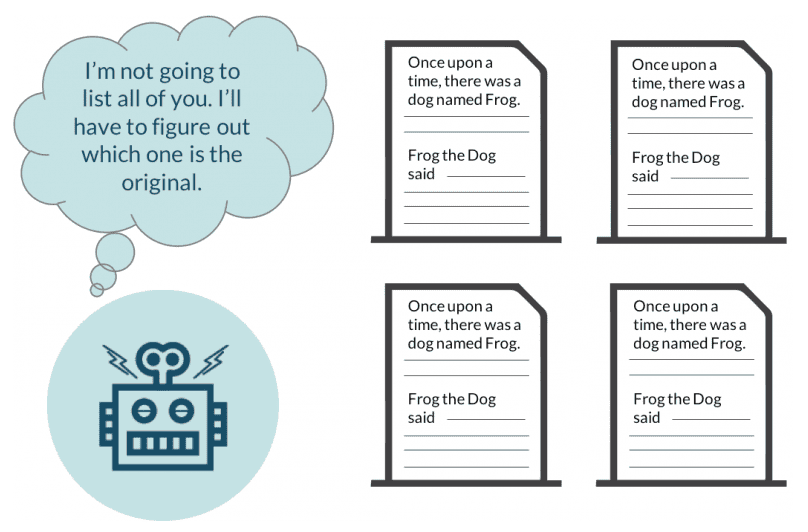
Source: Moz
7. Avoid: Low-quality user-generated content (UGC).
This is also known as user-generated spam. Domain authority is not built from opinions, but evidence. An example of this is landing pages and short blog posts with multiple spelling and grammatical errors.
8. Do: Write information-heavy pieces.
Ensure your blog pieces are long, informative and credible. And edit them before you publish!
A great tip is to include author bios within every blog piece.
This makes your content credible, and allows your audience to see another human is behind the content creation.
9. Avoid: High ad-to-content ratio.
Intrusive or excess marketing isn’t fun for users to navigate, and certainly isn’t fun for bots.
A page dominated by online advertisements and lacking in enough content that actually pertains to the search queries will automatically be targeted by Panda as having low-value.
Here’s an example. Look at the amount of text on this page versus the number of advertisements. Talk about annoying!

Source: Home Hacks
10. Do: Prioritise your content.
Place ads on your webpage, but don’t let them dominate it.
Your content is the most important part of the webpage, and it should take centre stage.
11. Avoid: Low-quality and broken affiliate links.
These are pretty self explanatory.
An excess of links that are broken or lead to poor-quality sites will automatically raise Panda’s eyebrows.
12. Do: Check your links.
Make sure you your have a strong backlink profile. This means that you have good Backlinks from credible sites (sites that are ranked high in SERPs).\
13. Avoid: User blocking.
Websites blocked by multiple users have obviously been blocked for a reason.
This indicates to Panda that these are low-quality websites. On they go on Panda’s list.
14. Do: Assess and edit.
Make sure you are aware if multiple people are blocking your website and assess why, if so.
You can access this by checking whether:
- Google Search results show labels such as “This site may harm your computer” or “This site may be hacked” next to your site.
- Your browser displays an interstitial page when you try to open your page
- If you are a verified site owner in Search Console and receive warning emails from Search Console
- Checking warnings in the security Issues report for your site
Are your links broken? Is your content spammy? Is it irrelevant? It might be time for a content refresh.
15. Avoid: Content farming.
High volume and short content that covers a wide range of search enquiries.
While this may seem great at first, this type of content is aggregated from other websites, or written by low-paid writers to hit as many target keywords as possible, similar to keyword stuffing.
Content farms lack authority because their sole purpose is to gain rankings for every conceivable search term.
16. Do: Be original.
Create unique and high quality content. Panda LOVES original content.
Even if your content is relevant and unique, make sure you give it a good edit every few years.
(It is generally good practise to edit your content as often as required, such as with every major update of a program if your content centres around that).
This makes sure your content stays fresh. After all, fresh and new content is higher quality than out of date content.
Side note: Google recommends optimising content for users, rather than optimising it for Google’s Panda algorithm.
Why?
Well, user activity ultimately will determine the popularity and credibility of a site. On top of this, Google’s algorithm can still confuse users.
So the best and most foolproof plan is to optimise for your audience, and optimise for topics, not just keywords.
Bonus tip: Google advises content markets don’t delete pages with low-quality content, but rather amend these pages to become high-value (unless you need to delete content for branding purposes)
Rather, Google recommends you either nonindex or improve content.
17. Avoid: Misleading and deceptive content.
Content that doesn’t match search queries but still appears in results raises suspicions.
For example, if your webpage promises information on the World Bank but then only has content relating to Monopoly, the board game, it will likely result in high bounce rates.
Failing to deliver a promise is a big no no for Panda.
18. Do: Fact check
Ensure your content is true! One way to test it? Look at credible websites on the same topic and see what they say.
Also remember to check your title tag, headings and URL are accurate and reflect the topic of your webpage.
Understanding the Google Panda Algorithm Update: Enhancing Your Site’s Quality
The Google Panda algorithm was introduced to reward high-quality sites and penalise those with thin or low-quality content. This update aimed to improve search results by prioritising websites that offered valuable, original, and well-structured content.
To align with Panda’s focus on content quality, businesses must focus on creating content that is both informative and engaging. Simply generating content for the sake of quantity won’t cut it; instead, aim to create content that answers user queries in a meaningful way, provides value, and fosters trust.
Ensuring your site’s security, such as protecting credit card information and maintaining proper data privacy protocols, also plays a role in demonstrating your site’s credibility and trustworthiness. A well-crafted, high-quality website that prioritises user experience and security is more likely to perform well under Panda’s scrutiny.
TRIVIA TIME: Who Named Google’s “Panda” Algorithm?
Did you know, Panda was originally called ‘Farmer’, after content farms? It was then renamed “Panda” based off of Google algorithm engineer – Navneet Panda. Navneet Panda was a Google engineer who worked on developing the algorithm update, which was designed to reduce the ranking of low-quality content and reward high-quality websites. The Panda update was first released in February 2011 and had a significant impact on search engine rankings, particularly targeting websites with thin or duplicate content, keyword stuffing, or poor user experience. The name “Panda” was likely chosen after Navneet Panda himself, although Google never officially confirmed this, and it has become widely accepted within the SEO community.
Understanding the Google Panda Algorithm Update: Enhancing Your Site’s Quality
The Google Panda algorithm was introduced to reward high-quality sites and penalise those with thin or low-quality content. This update aimed to improve search results by prioritising websites that offered valuable, original, and well-structured content, while demoting sites that failed to meet these standards.
To align with Panda’s focus on content quality, businesses must focus on creating content that is both informative and engaging. Simply generating content for the sake of quantity won’t cut it; instead, aim to create content that answers user queries in a meaningful way, provides value, and fosters trust.
In addition to great content, maintaining a high-quality site means paying attention to factors like site speed, user experience, and security. Protecting credit card information and ensuring proper data privacy protocols also help in building trust with users and improving your site’s credibility. A well-crafted, high-quality website that prioritises user experience and security is more likely to perform well under Panda’s scrutiny.
Over to you
Panda is a core Google algorithm update that has, and continues to, rapidly shape modern SEO.
Understanding this, as a marketer, or SEO agency expert, means you can implement a strategy that drives results for the long haul — new algorithm updates, no worries!
Want to futureproof your SEO and online digital marketing efforts from the ground up? Our A to Z SEO Guide covers everything you need to know — from what factors search engines rank by, to actionable strategies for generating real revenue results.

About the author
Read More Blogs
-


Last updated on:
-
Last updated on:
-
 11 minutes read
Google’s Fourth Spam Update of the Year Landed, and Search Console Got Multimodal Filters
Last updated on:




Stop Guessing What Your Marketing Should Do Next.
Your free $4,000 strategy session shows where your digital marketing is leaking performance across search, paid media, content and conversion. You leave knowing what to fix first and what a stronger strategy could produce.