






 1300 433 071


- Home
-

- Blog
-
- AI Marketing Blogs
-
- SEO vs GEO vs AEO: What’s the Difference?
SEO vs GEO vs AEO: What’s the Difference?
Search has quietly undergone its biggest transformation since Google first moved beyond simple keyword matching.
What started as traditional search engine optimisation (SEO) – ranking web pages in Google and other search engines – has now expanded into AI-driven discovery, where answers are generated, summarised and delivered across multiple platforms.
Key Takeaways
-
SEO, GEO and AEO optimise for different discovery experiences
-
SEO focuses on rankings and organic traffic
-
GEO focuses on being cited in AI-generated answers
-
AEO focuses on delivering direct, concise answers
-
Strong SEO foundations support GEO and AEO, but don’t guarantee visibility
-
Brands that adapt early will benefit from increased AI-driven exposure
Today, users don’t just “search” anymore. They ask questions in ChatGPT, rely on Google’s AI Overviews, use voice assistants and expect instant, authoritative answers without clicking through ten links. This leads to a decrease in traffic to the site and a significant decrease in Click-Through-Rate (CTR).
That shift has given rise to two newer optimisation “mindframes”: Generative Engine Optimisation (GEO) and Answer Engine Optimisation (AEO), with optimising for SEO still at the core of it.
Although GEO is relatively new to the game and we’ve previously looked at the differences between GEO and SEO, AEO is the newest kid on the block. Both GEO and AEO relate to visibility across AI Search, however as AI Search evolves, it’s important to differentiate each and what is required for a different optimisation approach.
Understanding the difference (and knowing where, how and why to invest) is now critical for businesses that want to remain visible as search behaviour continues to fragment.
SEO vs GEO vs AEO: Key Differences Explained
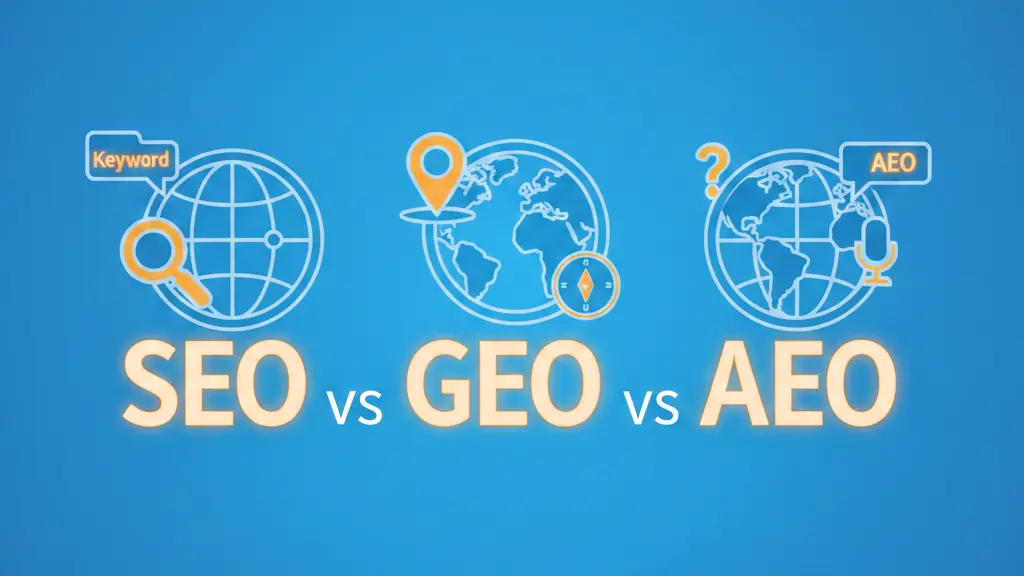
At a high level, SEO, GEO and AEO all aim to improve visibility, but they do so in fundamentally different ways.
SEO is about where your page ranks.
GEO is about whether your brand is referenced.
AEO is about whether your content becomes the answer.
Understanding these distinctions helps businesses avoid chasing the wrong tactics; or worse, assuming one strategy covers them all.
Search Engine Optimisation (SEO)
SEO is the foundation of digital visibility and remains the most established optimisation discipline.
It emerged alongside traditional search engines, with the goal of helping web pages rank prominently for relevant queries. While algorithms have evolved dramatically – incorporating machine learning, intent analysis and quality signals – the core purpose of SEO remains the same: improve brand visibility and drive qualified organic traffic from search engines.
For businesses, SEO is often the highest-ROI long-term channel. It targets users actively searching for products, services or information, and builds sustainable visibility that compounds over time.
SEO primarily targets platforms like Google and Bing, focusing on organic results that appear below ads and AI-generated features.
What Is SEO?
SEO is the practice of optimising your website to rank in traditional search engine results pages (SERPs). This includes technical performance, on-page optimisation, content quality and authority signals such as backlinks.
Is SEO still relevant with AI search?
Yes. AI-powered search still relies heavily on indexed, authoritative content. Strong SEO ensures your site can be discovered, crawled, understood and trusted by both search engines and AI systems.
What does SEO optimise for?
SEO optimises for rankings, organic traffic and long-term visibility across keyword-based search queries.
Generative Engine Optimisation (GEO)
GEO is a response to the rise of large language models (LLMs) and generative AI platforms that create answers instead of listing links.
As tools like Google AI Overviews, ChatGPT, Perplexity and other AI search interfaces gained adoption, brands realised visibility was no longer guaranteed by rankings alone. Instead, AI systems synthesise information from multiple sources, and only cite or reference content they consider authoritative, clear and reliable.
For businesses, GEO represents an opportunity to own visibility inside AI-generated responses, even when users never click through to a website.
GEO targets generative platforms rather than traditional SERPs, making it especially important for brand authority, top-of-funnel awareness and trust-building.
What Is GEO?
GEO focuses on optimising content so it is referenced, cited or paraphrased by generative AI systems such as Google AI Overviews, ChatGPT and Perplexity.
How is GEO different from SEO?
SEO targets rankings. GEO targets inclusion. You may not rank first (or at all) but still be cited as a trusted source within an AI-generated answer.
What types of content perform best for GEO?
Clear, factual, well-structured content written with authority. Definitions, comparisons, frameworks and expert-led explanations are more likely to be referenced by LLMs.
Answer Engine Optimisation (AEO)
AEO focuses on a different behaviour entirely: users asking direct questions and expecting immediate answers.
This trend accelerated with featured snippets, voice search and “People Also Ask” boxes; and continues today through AI-powered answer experiences. Unlike SEO, which rewards depth and breadth, AEO prioritises clarity, conciseness and precision.
“If SEO focused on driving clicks, AEO is focused on driving clarity with enriched, real-time data. GEO helps establish credibility through authoritative voice.” – Microsoft playbook on AEO and GEO
For businesses, AEO is about winning high-intent moments where a single answer satisfies the query. When done well, it positions brands as authoritative and trustworthy, even when users never visit the site.
A common misconception is that AEO is “just snippets”. In reality, it requires intentional content structuring and question-led optimisation.
What Is AEO?
AEO is the optimisation of content to directly answer specific user questions, often surfaced via featured snippets, voice search and AI summaries.
Is AEO just featured snippet optimisation?
No. Featured snippets are part of AEO, but modern AEO also includes voice assistants and AI-powered answer boxes.
What makes content suitable for AEO?
Clear questions, concise answers, structured formatting and unambiguous language. If your content can be read aloud as an answer, it’s likely AEO-friendly.
How AI Search Shift Is Blurring the Lines
Search is no longer confined to search engines.
Large language models have changed how users discover information; asking questions in AI tools instead of typing queries into Google. This creates new opportunities for brands to gain exposure through citations, summaries and references, but it also increases competition for trust and authority.
Google itself reflects this shift, blending traditional rankings, AI-generated summaries and conversational search experiences into a single ecosystem.
What is the difference between Google AI Overviews and Google AI Mode?
AI Overviews summarise information directly in search results, while AI Mode offers a more conversational, exploratory experience.
In October 2025, Google officially tested blending AI Mode into AI Overviews, and towards the end of January 2026 Google released the update where follow-up questions in AIO jump you directly into AI Mode. This signals a move toward a unified AI-driven search experience: This convergence means SEO, GEO and AEO signals increasingly influence the same results; just surfaced in different ways.
How to Optimise Content for All Three (Without Overcomplicating It)
The biggest mistake brands make is chasing tactics instead of clarity.
Strong optimisation across SEO, GEO and AEO starts with fundamentals:
- Technical SEO foundations
- Clear content structure
- Expert-led, authoritative writing
- Question-led formatting
- Consistent topical depth
Do I need separate content for each strategy?
Not necessarily. Well-structured content can support SEO, GEO and AEO simultaneously when written with intent and precision.
Why GEO Is Becoming a Competitive Advantage
AI search is still early-stage, which means fewer brands are actively optimising for it.
That creates a familiar dynamic: lower competition, higher visibility and stronger brand recall for early movers; similar to early SEO and early paid search.
As AI-generated answers become more prominent, being cited repeatedly builds authority that compounds across channels.
Is GEO measurable?
Yes. While traditional rankings don’t apply, third-party tools now measure AI visibility, citation frequency and brand presence across generative platforms — allowing performance to be tracked and optimised.
How OMG Helps Brands Win Across SEO, GEO & AEO
At OMG, SEO remains the foundation of everything we do. We build strong, technically sound SEO strategies first, because without crawlable, authoritative and well-structured content, visibility in AI-driven search simply doesn’t scale.
From there, we layer in GEO and AEO as strategic extensions of SEO, optimising high-value content so it can be interpreted, cited and surfaced across AI-driven platforms and answer-based search experiences.
Our GEO services help brands turn existing SEO equity into AI visibility; becoming trusted sources in generative answers, protecting organic share of voice and building authority that compounds as search continues to evolve.
Search is changing. The brands that treat AI optimisation as an add-on to strong SEO foundations won’t just keep up, they’ll lead.

About the Author
Andrew Raso
Share