











 1300 433 071


- Home
-

- Blog
-
- Website Optimisation Blogs
-
- Enterprise SEO Considerations [Ultimate Guide 2026]

Enterprise SEO Considerations [Ultimate Guide 2026]

Enterprise SEO has always been a different beast, but in 2026, it feels like the beast grew extra heads and started lifting weights. The stakes are higher, and the brands winning search today treat SEO as a serious business operation rather than a side project.
This cheat sheet is built for those brands. The ones with sprawling websites, strict governance rules, dozens of teams and a long list of commercial goals riding on visibility. If your business already invests heavily in marketing and has talent on deck, this is your Ultimate Enterprise SEO Guide for 2026.
Key Takeaways
-
Enterprise SEO is a distinct discipline built for scale, complexity and cross-functional coordination.
-
Technical stability is the backbone that allows large sites to grow without breaking search performance.
-
Content engines and topical authority, not traditional tactics, drive category-wide visibility.
-
Generative SEO matters in 2026, as AI systems reward clarity, structure and depth.
-
Enterprise SEO link-building relies on defensible, high-value authority programs that compound over time.
-
Enterprise SEO tools unlock deeper diagnostics, automation and commercial grade reporting.
-
Outsourcing to a partner with proven enterprise SEO skills, tools and experience accelerates execution, reduces risk and strengthens long-term competitiveness.
What is Enterprise SEO?
Enterprise SEO is the discipline used by large organisations to manage visibility, performance and structure across websites that often contain thousands of URLs, multiple product lines and complex internal workflows. It looks similar to traditional SEO on the surface, but the mechanics, scale and decision-making are very different. Every small decision has a ripple effect across thousands of URLs.
At the same time, the opportunities are enormous. Enterprise-level SEO is one of the most cost-effective ways for established brands to improve market share, reduce acquisition costs and strengthen category dominance. Most businesses consider an enterprise SEO package because growth has outpaced their systems.

Here are some scenarios we see in the field:
- The site has multiplied faster than the governance.
- The teams have expanded faster than the workflows.
- The environment has become too complex for standard SEO tools and templates.
- Organic performance becomes inconsistent despite strong brand equity.
- Multiple teams produce content without a shared SEO framework.
- Technical debt accumulates and slows down progress.
- The organisation plans to scale internationally or expand product lines.
At its core, corporate enterprise SEO is about influence: influence over how search engines see your brand, how customers discover you (or continue to choose you) and how internal teams make decisions that impact search. It is about giving your business the structure and intelligence to grow at scale without compromising quality or compliance.
How enterprise SEO differs from standard SEO
Enterprise SEO has its own environment, challenges and expectations. These are the core distinctions:
- Scale and complexity: Enterprise websites often include thousands of pages generated across multiple systems. Managing crawl depth, templates, navigation and indexation becomes a structural challenge, not a simple checklist.
- Governance and workflows: Every change touches multiple stakeholders. Marketing, development, product, legal and brand teams all influence the final outcome. SEO specialists work within these layers while keeping progress consistent.
- Technical decision weight: Small issues have big consequences. A misplaced canonical, a blocked template or a CMS restriction can impact entire sections of the site.
- Investment in data and software: Enterprise SEO software and advanced analytics tools are must-haves. Traditional ones cannot keep up with the volume and granularity required for enterprise reporting.
- Cross channel influence: SEO decisions affect paid search, CRO, UX and brand. Enterprise teams plan with the entire marketing ecosystem in mind.
Enterprise SEO audit: the non-negotiable foundations
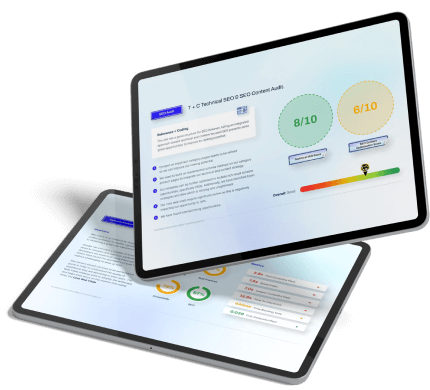
A real enterprise SEO audit looks past surface level checks and digs into how the entire site behaves at scale. It examines technical systems, content depth, workflow constraints and structural risks that influence long term performance. For large brands, this assessment becomes the blueprint for every improvement that follows.
- Content auditing goes deeper than your standard QAs. Enterprise sites demand a full view of duplication, thin sections, compliance issues, outdated material and how content operations perform across teams. The goal is to understand whether the site builds topical authority or fractures it through inconsistent output.
- Governance also matters. Workflows, sign-offs, CMS restrictions and interdepartmental delays often limit progress more than technical issues. An enterprise SEO audit reveals where these bottlenecks sit.
- The final lens is risk. Large sites tend to carry hidden vulnerabilities, from legacy templates to unmanaged redirects. Identifying these early prevents future traffic losses and sets a stable foundation for the strategy ahead.
The Anatomy of a high-performing enterprise SEO strategy
The best brands win in search because they build systems that scale, instead of doing quick fixes here and there. These principles are true for standard SEO too, but enterprise environments multiply the stakes.
I. Technical SEO for enterprise sites
Technical SEO at enterprise scale is less about fixing issues and more about engineering a system that can handle constant growth without breaking. Because large brands operate with sprawling architectures and multiple teams pushing updates, the technical layer needs to support all of that while keeping search engines fully informed.
- Scalable site architecture is the starting point. Enterprise sites perform best when categories, subcategories, filters and internal linking follow a predictable hierarchy. Clean pathways prevent crawl waste and give search engines a clear understanding of how the ecosystem fits together.
- Enterprise level crawling and rendering introduce complexities that smaller sites never face. JavaScript frameworks, dynamic components and faceted experiences create interpretation hurdles. Teams here rely on advanced crawlers, log file analysis and controlled rendering environments to validate how search engines experience the site, not just how users do.
- Template management becomes critical. A single template can power thousands of URLs, which means one mistake scales instantly. Enterprise SEO programs track template behaviour as its own performance layer, with strict rules for markup, metadata, structured data and internal links.
- Performance work also scales differently. Site speed and Core Web Vitals must be solved at template and component level, not page by page. This approach keeps improvements consistent across the entire footprint.
- International signals must be airtight for those operating across regions. Hreflang management, regional content mapping and platform consistency determine whether search engines understand how your global presence fits together.
II. Content excellence
The most successful corporations in the world don’t rely on traditional content practices. They operate content engines that run on structure. Central frameworks keep everyone aligned, consistent templates maintain quality at scale and a unified publishing system. And at the heart of every powerful content engine is a team of sharp writers who know how to turn ideas into clear, confident, search-ready material.
Topic ownership and authority building for large brands
Topical authority is the currency of corporate enterprise SEO, and large brands earn it by owning categories, not keywords. It’s about demonstrating depth, breadth and consistency across an entire subject area, so search engines trust your brand more than any competitor.
A few core actions drive this:
- Building full topic clusters that cover every relevant subtopic
- Creating supporting assets like guides, FAQs, tools and resources
- Linking related pages together to form clear semantic relationships
- Structuring content, so search engines understand hierarchy and intent
- Refreshing high-value pages to keep information current and competitive
- Integrating product, editorial and support content into one category ecosystem
Mapping content to user journeys
Enterprise teams map content to every stage of the buyer journey, which tends to become complex at scale. Here are some examples:
- Product discovery: category overviews, high-level guides, introductory resources
- Problem awareness: educational articles, diagnostic tools, explainer content
- Comparison and evaluation: product comparisons, feature breakdowns, use case pages
- Purchase readiness: product pages, pricing information, tailored landing pages
- Support and retention: FAQs, troubleshooting guides, how-to resources, post purchase content
This creates a pathway where users move smoothly between informational, commercial and transactional pages. Logical internal linking connects each stage, so both users and search engines understand how the journey flows across URLs.
Handling content refreshes at volume
This is a core enterprise SEO skill that often goes undervalued. With thousands of pages over decades of operations, outdated content accumulates fast. Enterprise operations manage refresh cycles programmatically. Data informs which pages lose relevance, which templates underperform and which topics need expansion. Instead of one-off updates, refreshes run in waves across categories and templates, so the entire ecosystem stays competitive.
Generative SEO for AI driven search environments
Generative AI SEO or GEO is now a core factor in enterprise content operations. As Google’s AI Overviews and conversational search assistants like ChatGPT and Gemini surface more aggregated answers, enterprise brands must optimise for visibility beyond the classic ten blue links. Companies need content that is structured, precise and deeply authoritative so AI systems confidently pull from it.

For example, if you’re already a highly authoritative brand for certain keywords, GEO becomes essential because it helps you keep surfacing for new AI generated queries and maintain the relevance and authority you’ve worked hard to build.
Generative SEO involves:
- Creating content with clear, factual statements that LLMs can interpret reliably
- Strengthening topical authority, so your brand is chosen as a preferred source
- Adding concise summaries, definitions and entity rich content to support AI extraction
- Marking up information with structured data when relevant
- Improving internal linking so relationships between concepts are obvious
- Maintaining accuracy and freshness so AI systems treat your content as trustworthy
At scale, GEO becomes part of the content engine rather than a separate project. The stronger and clearer your content ecosystem is, the more likely AI-powered search features your brand in their generated responses.
III. Enterprise SEO link-building
For enterprise SEO, link-building is about protecting brand reputation and creating a durable competitive advantage. Large brands operate under stricter scrutiny, heavier risk profiles and a much broader digital footprint. This means their strategy must be defensible and integrated with wider marketing activity.
Link acquisition frameworks for enterprise
Prominent companies need link acquisition systems that run continuously and support multiple categories at once. Instead of chasing isolated opportunities, these organisations build structured programs that generate authority month after month. These frameworks often include:
- Category level asset development
- Recurring digital PR cycles
- Always-on outreach engines
- Partnerships and industry collaborations
- Data-led campaigns that can be refreshed annually
Digital PR at enterprise level
Digital PR is a high value authority driver at scale. Unlike traditional outreach, it builds both brand equity and SEO authority simultaneously, making it one of the most sustainable enterprise link-building channels.
The central idea is to build authority by producing assets worth linking to. Such assets make the brand linkable on merit rather than persuasion. Beyond volume, the focus is on value, relevance and helpfulness for the target audience.
Examples include:
- Proprietary data studies released to media
- Expert commentary and thought leadership placements
- Reactive newsjacking tied to timely search trends
- Interactive assets or tools covered by publishers
- Industry reports and annual insights
- Content collaborations with recognised organisations
- Consumer surveys that generate headline friendly angles
- Comparison resources and whitepapers
Measurement and reporting for enterprise SEO link-building
Enterprise reporting looks at authority flow across categories, the impact of links on rankings, link velocity health, competitor benchmarking, digital PR coverage and long term authority growth patterns. Insights feed back into content planning, PR timing and campaign prioritisation.
When link-building operates at this level, enterprise sites gain a structural advantage that compounds year after year. Content ranks stronger and category leadership becomes harder for competitors to challenge.
IV. The technology facet: Enterprise SEO tools and software stack
Standard tools cannot handle the volume, granularity or cross-functional reporting needed at scale. Below is a clean snapshot of the core categories in an enterprise SEO software ecosystem.
| Category | Purpose | What they handle | Example tools |
| Rank-tracking for enterprise SEO | Track rankings at scale across categories, product lines, locations and intent types | Query segmentation, template tracking, multi region visibility | seoClarity, BrightEdge, Semrush Enterprise |
| Crawl and diagnostics tools | Understand site behaviour at depth and detect technical issues early | Large crawls, JavaScript rendering, log file analysis, indexation shifts | Screaming Frog, Botify, Deepcrawl |
| Analytics and measurement platforms | Tie organic performance to commercial outcomes | Traffic, conversions, revenue attribution, template performance | GA4, Adobe Analytics, Looker |
| Content intelligence platforms | Strengthen topical authority and content quality | Topic clustering, duplication detection, competitive gap analysis | MarketMuse, Clearscope, Surfer |
| Automation and monitoring systems | Reduce manual workload and catch anomalies instantly | Alerting for index drops, broken templates, ranking volatility | ContentKing, Little Warden, seoClarity Alerts |
| Data warehouses and BI environments | Centralise SEO and business data for advanced reporting | Unified dashboards, forecasting, financial modelling | BigQuery, Snowflake, Power BI |
Choosing the right enterprise SEO tools depends on organisational maturity. Early stage teams may focus on enterprise SEO rank-tracking and diagnostics, while mature programs can prioritise automation or content intelligence. Integrating SEO data with BI dashboards is where enterprise SEO becomes commercially powerful. When search data sits alongside revenue, inventory and customer insights, leaders gain real clarity. Decisions become sharper and growth becomes predictable.
Building your Enterprise SEO Roadmap
Below is a quick list of measures for large organisations navigating technical debt, content scale and cross departmental dependencies.
1. Start with a full enterprise SEO audit
Your roadmap should begin with clarity, because you can’t fix what you don’t measure. A comprehensive audit we described earlier becomes the baseline for all prioritisation and planning.
2. Categorise opportunities into strategic buckets
Group everything into four streams:
- Technical improvements
- Content development and refreshes
- Link-building and digital PR
- Collaboration and governance upgrades
- Automation and monitoring enhancements
This keeps the roadmap balanced instead of overcrowded in one area.
3. Prioritise using an impact versus complexity model
Enterprise sites always have more opportunities than resourcing. Rank each item based on potential commercial impact and implementation difficulty. High impact and low complexity tasks move first, while high complexity work can be broken into phased rollouts to avoid disruption.
4. Plan realistic timeframes
From experience, we can say enterprise SEO strategies require tremendous patience, because dev cycles, QA checks, CMS restrictions and stakeholder approvals all take time. Most organisations work best with quarterly roadmaps and monthly review cycles to reassess priorities based on performance data.
5. Align owners and expectations
It’s an industry-best practice to assign an owner to every initiative. Define what success looks like, what dependencies exist and which teams need to contribute. Clear ownership prevents delays and keeps momentum consistent.
6. Review, recalibrate and expand
The roadmap is supposed to evolve as insights accumulate. Each quarter, update your priorities based on new data, competitive shifts, algorithm changes and internal capacity.
Should you outsource your enterprise-level SEO?
While this guide gives you the fundamentals, there are times when outsourcing is simply the smarter path. As we’ve explored in this guide, enterprise SEO is what brings in tremendous opportunity, but it also demands deep technical expertise, constant monitoring and cross-functional coordination among often fragmented departments.
Most internal teams simply do not have the bandwidth or specialised enterprise SEO skill set to run this at full scale. This is where a dedicated partner becomes invaluable. They bring clarity, structure and advanced capability to an environment that is often chaotic.
Key reasons organisations outsource enterprise SEO include:
- Specialised technical expertise for complex architectures, rendering systems and large-scale indexing
- Advanced enterprise SEO tools that provide deeper diagnostics, smarter automation and richer insights
- Faster execution because agencies bypass internal bottlenecks and move work through established workflows
- Stronger governance with documented processes and performance standards
- Greater authority growth through sophisticated enterprise SEO link-building and masterful digital PR
- Better forecasting and reporting tied to BI level metrics and commercial outcomes
- Risk reduction through proactive monitoring, auditing and compliance alignment
Lastly, it’s worth emphasising the value of perspective. Internal teams are often too close to their own website, workflows and legacy decisions to see the gaps clearly. Familiarity creates blind spots. A specialised SEO partner enters with fresh eyes, unbiased diagnostics and a broader view of how your site stacks up against industry standards.
That outside perspective spots issues your team may have normalised and opportunities that were hiding in plain sight.
Reap the benefits of enterprise SEO with OMG
The benefits of enterprise SEO become significantly stronger when supported by external specialists who focus exclusively on search. Online Marketing Gurus brings over a decade of experience, world-class SEO talent and a proven track record with high-profile clients, including Calvin Klein, LG, Casio and more. Our team combines technical depth and award-winning execution to help large brands dominate the most competitive categories.
If you want a roadmap shaped by real experience and backed by Australia’s leading digital marketing agency, contact us for a free enterprise SEO audit and strategy session.
Alongside enterprise SEO packages, we also deliver specialised international, B2B, eCommerce and local SEO services to support every stage of your growth.

About the Author
Andrew Raso
Share