







 1300 433 071


- Home
-

- Blog
-
- News & Industry Updates
-
- AI-Powered Ads Expand With Nano Banana Pro and Google’s First 3-Pack Overview Ads
AI-Powered Ads Expand With Nano Banana Pro and Google’s First 3-Pack Overview Ads
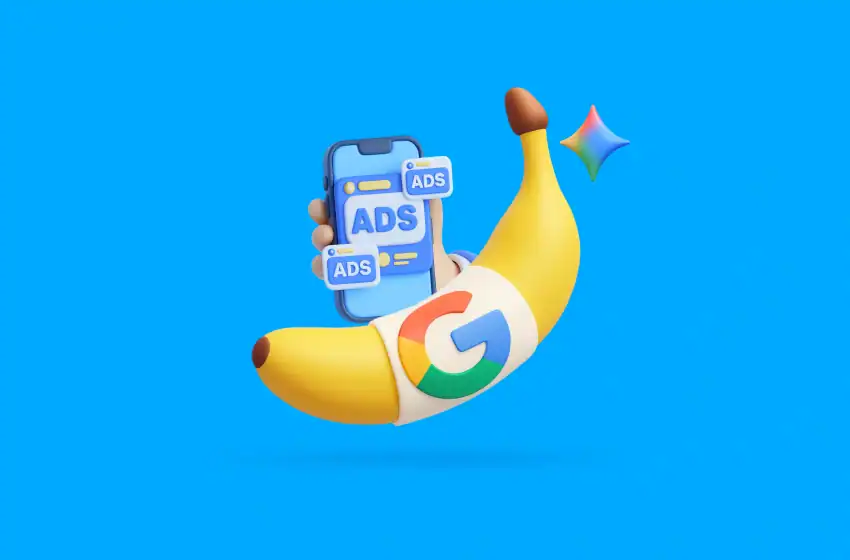
AI-driven advertising is entering a phase defined by smarter creative generation, clearer data signals and tighter control across platforms. Google is rolling out its first AI Overview ads and expanding creative automation with Nano Banana Pro. Meta is pushing deeper into metaverse-ready content tools, while TikTok introduces new AI content controls. Even Google Search Console is evolving with precision filters for branded queries. These digital marketing updates show how AI is becoming part of the core workflow for campaign creation, distribution and measurement, shaping the way digital advertisers operate day to day.
Key Takeaways
-
Brand visibility becomes clearer: Google’s new brand vs non-brand filters in Search Console give SEO teams more reliable insight into what drives discovery and what strengthens loyalty.
-
AI-generated surfaces expand into local search: AI Overview ads entering the Local 3 Pack mark a new paid entry point in spaces previously led by organic local optimisation.
-
Creative workflows shift towards modular builds: Nano Banana Pro introduces structured asset assembly inside Google Ads, moving creative production closer to a component-based system.
-
Demand Gen setup becomes more intuitive: Google’s simplified workflow reduces friction in campaign creation and helps advertisers build stronger creative and audience foundations from the start.
-
Immersive formats gain momentum: Meta’s new spatial and 3D tools signal a push towards mixed-reality creative, reshaping how assets are designed across digital marketing.
-
Content preferences tighten on TikTok: AI content limits and clearer labelling give users more control over their feed, influencing how creators balance AI-assisted and traditional production styles.
Google Search Console Adds Brand Query Filters
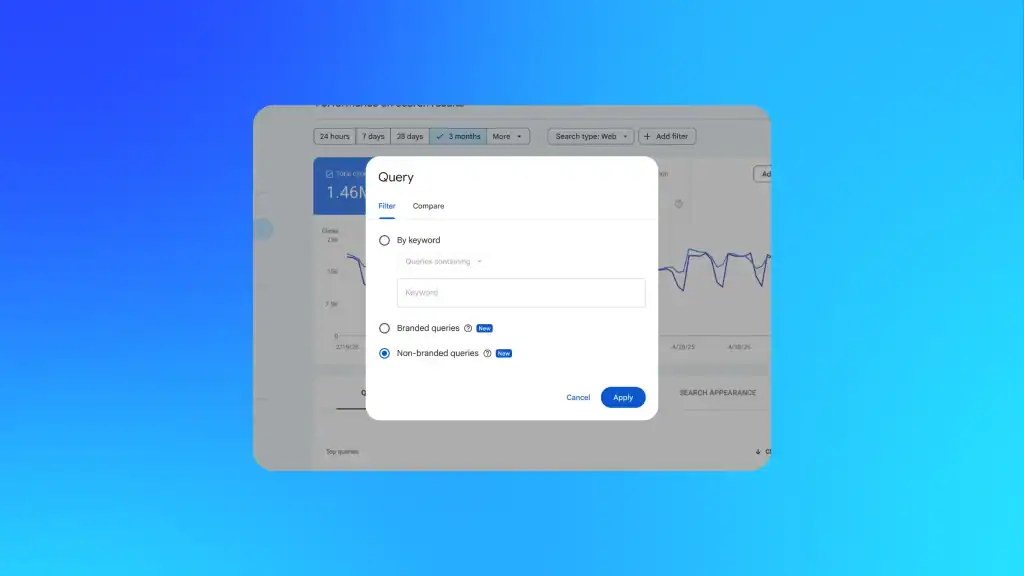
Google is rolling out a dedicated filter in Search Console that separates branded queries from non-branded queries, giving teams far more precision in understanding how users discover a site. Instead of manually stitching together partial data from regex filters or third-party tools, Search Console will soon show how much traffic is tied to people actively searching for the brand name versus users landing through broader industry, product or problem-based queries.
This shift strengthens visibility into two critical journeys: discovery, where content earns attention in competitive search spaces, and loyalty, where brand awareness drives direct search behaviour. For many teams, it also means cleaner trend analysis, better forecasting and a more reliable baseline for understanding true organic growth.
The gurus’ take
This update finally gives search teams a clean separation between demand you generate and demand you capture. With branded and non-branded segments split at the source, it becomes easier to understand the real impact of new content, technical improvements, or algorithm changes.
For SEO in Australia, where many businesses rely on blended reporting across multiple channels, this clarity supports better decision-making as it becomes possible to see which levers are growing reach versus reinforcing brand familiarity.
Your action plan
To make the most of the new brand query filter and build cleaner reporting foundations:
- Separate branded and non-branded reporting structures: Review your current performance reports and shift towards a dual-view model that separates branded and non-branded data to avoid inflated growth trends.
- Identify strongest discovery drivers: Analyse non-branded queries to identify content that consistently drives new visibility, then prioritise similar opportunities in your content roadmap.
- Monitor brand demand: Track branded query volume alongside PR, paid campaigns and offline activity to understand what actually strengthens brand demand.
- Refine forecasting: Use the cleaned-up segmentation to refine forecasting models and set more realistic performance expectations across discovery, mid-funnel and brand-led search.
Google Unveils First AI Overview Ads in the Local 3-Pack
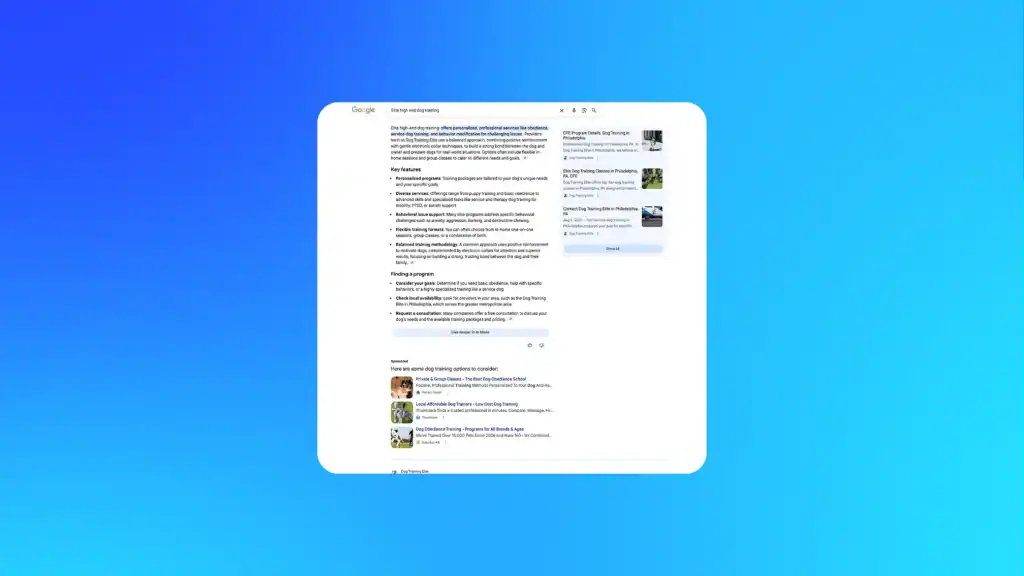
Google has started testing its first AI Overview ads inside the Local 3 Pack, allowing advertisers to appear directly within AI-generated summaries for location-based searches.
When users look for nearby services or businesses, the AI Overview may surface an ad block that blends into the local results interface, positioned above or alongside the traditional map listings. These placements draw from a mix of contextual signals, query intent and advertiser relevance to determine which local businesses appear. The test introduces a new entry point for paid visibility in an area previously dominated by organic local rankings and map pack optimisation.
The gurus’ take
Paid placement inside the Local 3 Pack signals a shift in how commercial intent is monetised within local search. Visibility that once depended heavily on local SEO, reviews and proximity is now shaped by AI-driven ad selection. This also creates a new competitive layer where local presence depends on how well businesses align with emerging AI surfaces.
As generative engine optimisation becomes a larger part of discovery, paid and organic visibility inside AI-generated results will increasingly operate as a single ecosystem rather than two separate channels.
Your action plan
To position local campaigns for these new AI-powered placements:
- Review location-based performance baselines: Identify which services and suburbs already generate strong demand so you know where AI Overview ads could create incremental reach.
- Strengthen relevance signals in local campaigns: Audit keywords, extensions and location targeting to make sure your ads align cleanly with the types of local queries that AI Overviews summarise.
- Align landing pages with local intent: Ensure each service area page communicates location, service type and key details clearly, as AI-driven placements draw heavily on contextual relevance.
- Track impression share across map-adjacent surfaces: Monitor changes in impression share, CTR and conversions in campaigns targeting local queries to identify early signs of AI Overview inventory being introduced into your account.
Google Ads Drops Nano Banana Pro for Smarter Creative Builds
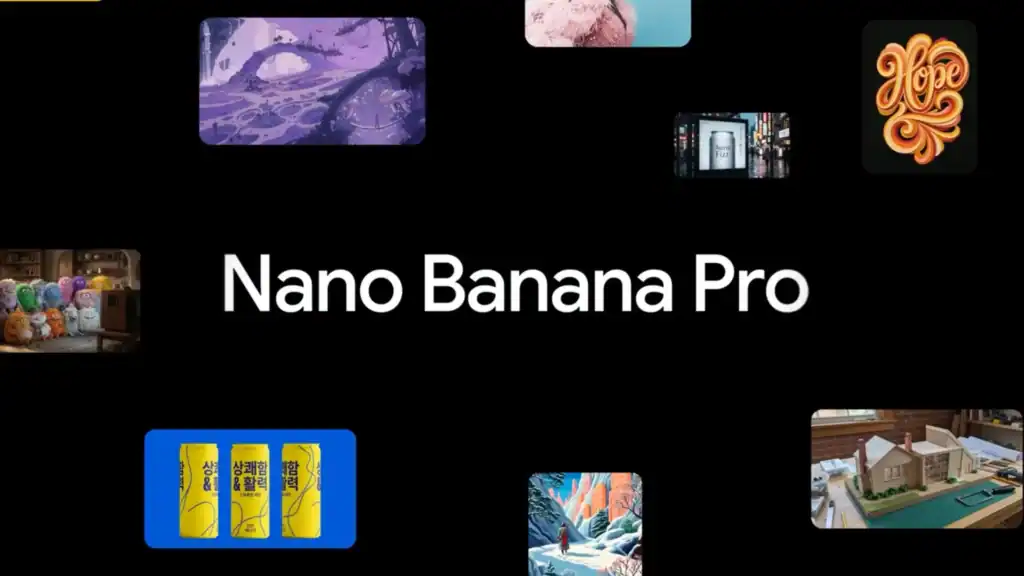
Nano Banana Pro introduces a more engineered approach to creative assembly inside Google Ads. Instead of treating assets as standalone uploads, the tool breaks visuals, headlines and descriptions into modular building blocks that can be combined in far more controlled ways.
The interface highlights missing formats, uneven coverage and weak variation, guiding users to produce a fuller creative set before launch. It also brings clearer logic to how assets are grouped, making it easier to build campaigns that need multiple placements, formats or language variants. The update represents a shift towards structured creative architecture, where ads are assembled from well-defined components rather than a loose collection of files.
The gurus’ take
Creative generation in Google Ads is shifting towards a system that behaves more like a production pipeline than a loose collection of assets. By breaking creative inputs into modular pieces, Nano Banana Pro supports a workflow where variation, testing and refinement become more efficient.
It also reflects Google’s broader move towards asset-level optimisation, where performance depends on how well components work together rather than how a single ad is crafted. This sets the stage for a more engineered style of creative development inside Google’s automated ecosystem.
Your action plan
Nano Banana Pro performs best when the asset library behind it is organised with intent:
- Organise assets into clear thematic groups: Categorise visuals and copy by intent, product line or audience so the automation layer can assemble combinations that make sense within each campaign.
- Review asset coverage before campaigns launch: Use the tool’s prompts to identify missing formats, weak variations or imbalanced sets, especially in campaigns running across multiple placements.
- Expand headline and description libraries: Provide Google Ads with enough diversity to generate meaningful combinations, not just superficial swaps of similar phrases.
- Track performance at the asset level: Shift analysis towards individual components to see which visuals or messages consistently contribute to high-performing combinations.
Google Introduces a Cleaner Setup Flow for Demand Gen
The Demand Gen campaign workflow is getting a simplified setup experience inside Google Ads. The updated flow reduces the number of steps required to build campaigns and places key creative, audience and bidding inputs into a clearer, more linear sequence.
Visual previews have been expanded so advertisers can see how assets render across placements before launching, and the system now highlights missing components earlier in the process. The result is a setup path that reduces friction and provides a more structured view of everything needed to activate Demand Gen campaigns across Google’s visual inventory.
The gurus’ take
Demand Gen has always worked best when creative variety and audience definition come together cleanly, and the new workflow reflects that principle. By tightening the setup path, Google is steering advertisers towards a build process that feels closer to a full-funnel content pipeline rather than a traditional PPC configuration.
The update also shows Google’s continued push towards interface simplification, where high-volume creative formats sit on top of more guided systems that prevent incomplete or low-quality campaign builds.
Your action plan
A cleaner setup flow gives you more control over the structure behind each Demand Gen campaign:
- Audit your current asset library: Having a complete set of images, videos and copy ensures the guided prompts surface meaningful recommendations instead of highlighting avoidable gaps.
- Align audiences with clear intent segments: Map your upper, mid and lower funnel audiences so the simplified interface can reflect a cohesive structure rather than a collection of broad targeting options.
- Use the expanded previews to refine creative fit: Check how assets appear across YouTube, Discover and Gmail placements, then make adjustments to avoid mismatches between format and message.
- Review bidding and budget settings after setup: The streamlined flow can mask how small changes influence delivery, so validate that your bidding choices still make sense for campaign objectives.
Meta Drops New Creative Tools for Metaverse Content
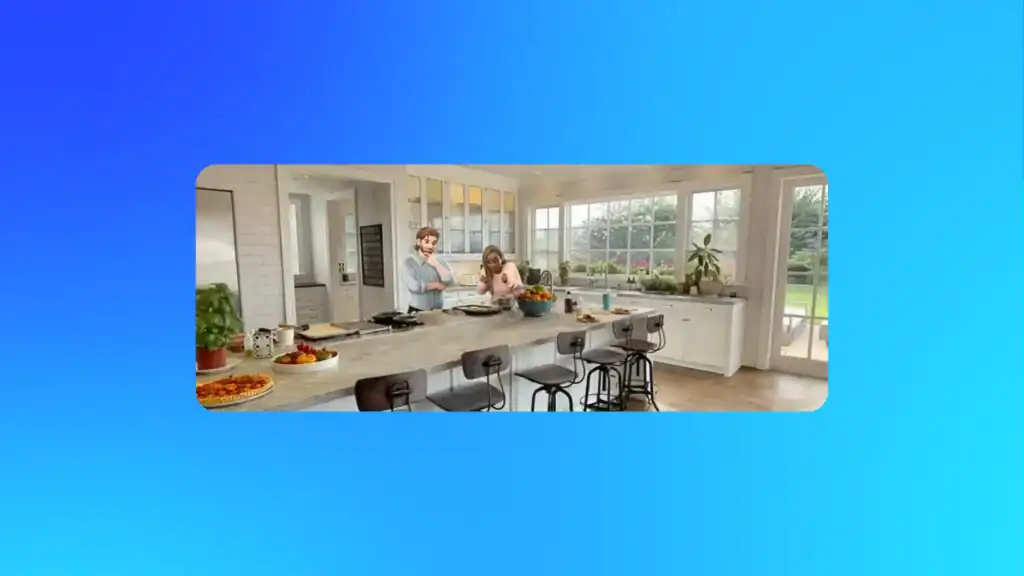
New creative tools are being introduced across Meta’s platform to support 3D, AR and other immersive formats. The update includes ready-made templates, lightweight object builders and spatial previews that show how assets will behave inside mixed-reality environments.
These features make it easier to produce interactive visuals directly within Meta’s ecosystem, reducing the need for external design workflows. The additions also support a wider range of placements, from simple AR effects to fully immersive ad units, creating a more consistent path for building metaverse-ready creative across modern digital marketing environments.
The gurus’ take
The shift towards spatial formats changes how creative assets need to be built. Instead of flat visuals, the focus moves to depth, scale and movement, with assets behaving more like digital objects than traditional ad units.
The new tools make that transition easier by giving creators a controlled environment to design and test immersive elements before they reach live placements.
As Meta broadens its mixed-reality surfaces, these capabilities form the groundwork for ad experiences that feel more integrated with the environments they appear in.
Your action plan
Use Meta’s expanded creative toolkit to prepare for spatial and immersive formats:
- Build assets with 3D adaptability in mind: Prioritise visuals and objects that can transition between flat placements and spatial environments without losing quality or clarity.
- Experiment with AR-ready templates: Test Meta’s built-in structures to understand how interactive elements change user engagement across different surfaces.
- Review how spatial assets appear across Meta placements: Use environment previews to validate that scale, lighting and movement translate correctly before campaigns go live.
- Create a naming and storage system for immersive assets: Organise 3D objects, textures and layered files so future iterations can be produced faster as Meta expands spatial ad formats.
TikTok Adds AI Content Limit Setting for Users
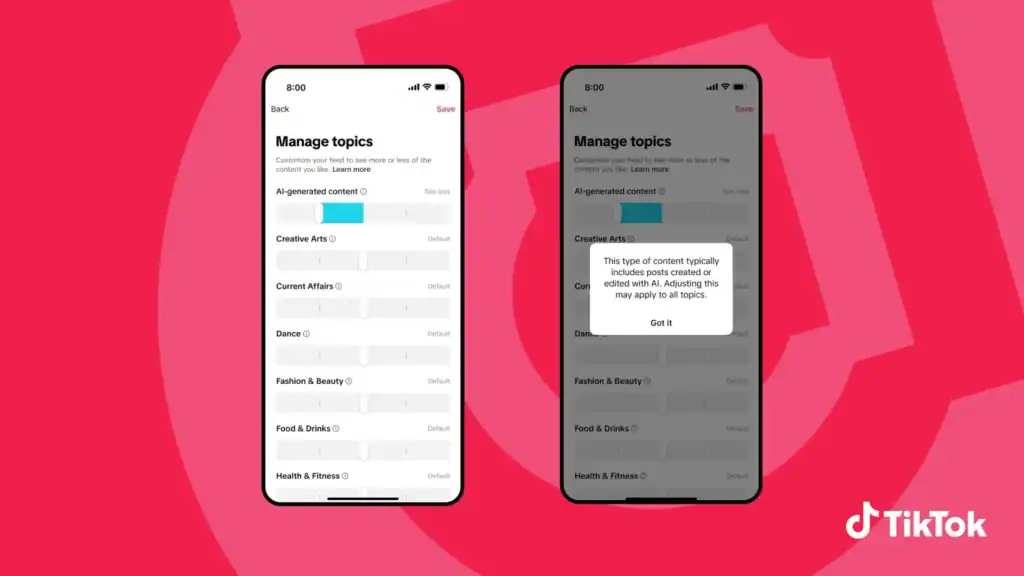
TikTok is rolling out a new control that lets users set limits on how much AI-generated content appears in their For You feed. The feature allows people to choose a lower, standard or higher mix of AI content, giving the recommendation system a clearer signal about what users want to see.
Alongside this, TikTok is expanding its labelling system for AI-assisted and fully AI-generated posts, making these classifications more visible as creators adopt TikTok’s built-in AI tools. The update follows a steady rise in synthetic and AI-enhanced videos across the platform and is designed to balance user preference, transparency and creative experimentation without disrupting the core feed experience.
The gurus’ take
TikTok’s new control changes how content is weighted inside the recommendation system and creates a more complex environment for creators and brands. Content that relies heavily on AI visuals or automated editing may see distribution shift depending on how users set their preference mix.
For social media advertising, this adds a contextual layer that shapes how ads sit against surrounding content, especially in feeds where users opt for less AI-generated material. It also places a stronger emphasis on clarity, authenticity cues and narrative structure, as these become deciding factors in how content performs in a more personalised and preference-driven feed.
Your action plan
Try a more adaptive content approach to help maintain performance as TikTok calibrates AI preferences:
- Evaluate your current use of AI tools across TikTok assets: Identify which videos rely on AI enhancement or synthetic visuals so you can monitor whether the new setting affects their reach.
- Develop parallel creative styles: Produce both AI-assisted and traditionally shot variations of key videos to see how performance differs across audiences with different AI content preferences.
- Analyse engagement changes after rollout: Look for shifts in watch time, completion rate and interactions, particularly on videos with strong AI visual elements or automated edits.
- Refine storytelling fundamentals: Ensure pacing, narrative clarity and intent carry the content, so performance is not overly dependent on visual effects that may be filtered out more often.
Build a smarter creative and performance system with Online Marketing Gurus
AI updates from Google, Meta and TikTok are changing how digital marketing campaigns are created and optimised. Strong results now depend on clear data, reliable creative processes and a strategy that adapts quickly as new formats and surfaces are released.
Online Marketing Gurus helps brands turn these shifts into a competitive edge. We connect PPC, paid social and SEO with the latest AI capabilities like generative engine optimisation to create strategies that move faster and perform stronger across every channel.
If you’re ready to build a marketing engine built for what’s next, our team is here to help. Talk to the Gurus about your next campaign.

About the Author
Andrew Raso
Share