







 1300 433 071


- Home
-

- Blog
-
- Marketing Blogs
-
- Black Friday Digital Marketing Guide
Black Friday Digital Marketing Guide
Black Friday has evolved from a US shopping frenzy into one of Australia’s biggest retail events. Australians spent an estimated $6.7 billion over the Black Friday and Cyber Monday weekend in 2024. For marketers, this season is a high-stakes, high-reward opportunity that demands planning and precision across channels.
Black Friday marketing is the perfect test of integrated strategy, where SEO, PPC, Google Ads and social media all work together for measurable results. This guide unpacks each discipline and shows how to approach them with purpose.
Key Takeaways
-
Black Friday in Australia now rivals Christmas in sales volume, proving it’s a major moment for brands ready to capitalise.
-
Successful Black Friday marketing starts early. Campaigns built months ahead dominate search rankings, outperforming last-minute efforts and securing stronger visibility across SEO, paid media and social channels.
-
eCommerce dominates Australian Black Friday sales, demanding seamless omnichannel experiences that connect browsing, social engagement and purchase without friction across devices.
-
Integrated strategies win. When SEO, PPC, Google Ads and social campaigns align, performance compounds.
-
Brands that analyse data post-sale gain the real advantage. Tracking, reporting and refining every campaign turn seasonal wins into long-term digital growth.
Understanding the Australian Black Friday landscape
Black Friday’s rise in Australia is a relatively recent phenomenon. Before 2013, the event barely registered in local calendars. But as eCommerce matured and major retailers jumped in, Australian shoppers caught on quickly. Now, the final weekend of November consistently records the highest online traffic of the year.
- Australians approach Black Friday marketing with a longer consideration phase. Consumers research earlier, compare deals and often delay purchases until discount season kicks in. For marketers, this means early visibility and consistent engagement matter more than flash discounts.
- Recent ANZ transaction data shows that over 76% of sales during the Black Friday to Cyber Monday period happen online, confirming the shift towards eCommerce as the primary battleground.
- Cyber Monday, which follows the Friday rush, extends the opportunity for brands to capture late buyers. Australian retailers often use this window to re-target audiences who browsed but didn’t convert.
Laying the foundation: data, strategy and timing
Every great Black Friday campaign begins long before November, and data should be the compass that steers your digital marketing strategy. For one, analysing last year’s traffic, conversions and keyword performance can reveal which channels drive the most ROI and where your audience interacts most actively.
Start by segmenting your audience by behaviour and intent:
- Researchers: Users comparing products and reading reviews weeks before.
- Bargain hunters: Those who convert only when discounts hit.
- Loyal customers: existing buyers waiting for exclusive offers.
Each group requires distinct messaging and timing. A strong Black Friday marketing plan targets them all with precision, like using SEO to capture intent early, Google Ads to convert high-intent searchers and social campaigns to re-engage visitors throughout the funnel.
Timing is everything. Campaigns should start teasing offers two to three weeks out, peak on the Friday and continue through Cyber Monday. Using tools like Google Analytics 4 (GA4) and Search Console provides data clarity on what’s driving clicks, while Meta Ads Manager helps refine audience targeting in real time.
SEO for Black Friday: building long-term visibility
SEO in Australia forms the backbone of any serious Black Friday marketing strategy. While paid campaigns deliver immediate traction, SEO sets the stage for lasting presence and trust. The smartest brands start optimising months in advance, not days before.
1. Start early: SEO doesn’t like rushing
You probably already know that search engines reward consistency and preparation. That means those who wait until November to optimise for Black Friday are already behind. Here are a few steps to consider:
- Refresh last year’s Black Friday pages and reuse URLs with updated offers. This builds link equity and helps maintain rankings.
- Create content hubs around your top-performing categories and optimise them for seasonal queries like “Black Friday furniture deals Australia” or “Black Friday skincare sale Sydney.”
- Coordinate with your broader marketing calendar. Align your Black Friday pages, campaigns and content rollout with upcoming product launches, seasonal promos or PR pushes. Early coordination avoids overlaps and keeps every department rowing in the same direction.
2. Balance seasonal and evergreen keywords
Black Friday might be seasonal, but your SEO foundation shouldn’t be. Therefore, it’s a great practice to blend short-term keywords (e.g. “Black Friday tech deals 2025”) with evergreen ones that drive ongoing traffic.
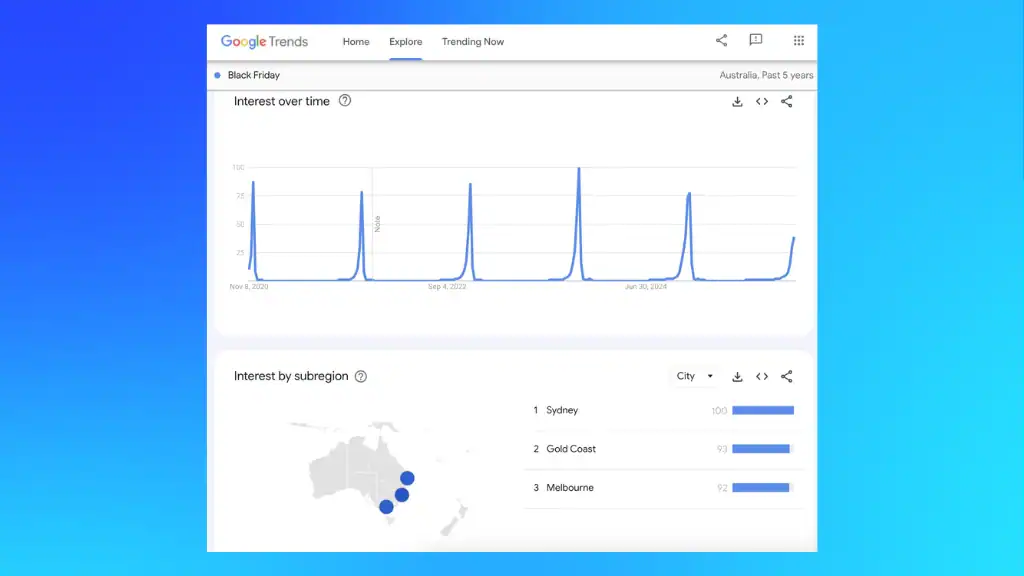
Use tools like Google Trends and Ahrefs to identify how Australian consumers search in the lead-up to Black Friday. Build intent-driven clusters around phrases like:
- Best Black Friday sales Australia
- Black Friday discounts near me
- Cyber Monday Australia deals
From experience, these tend to attract both early researchers and impulse buyers.
3. On-page optimisation that converts
Small details have big payoffs, and that’s more pronounced during Black Friday. To start, consider updating meta titles and descriptions with your offer specifics and time-sensitive language. Use structured data to help Google display rich snippets like prices and product availability.
Critically, your Black Friday landing pages should feature clean design, scannable content and internal links guiding users deeper into your funnel. This includes linking to key service pages. These internal pathways not only improve UX but also boost relevance signals for local intent.
4. Invest in content and backlinks to build authority
During the lead-up to Black Friday, content marketing becomes your loudspeaker. Great marketers publish buying guides, comparison blogs or “top deals” articles. You can also try to collaborate with influencers, niche publishers and affiliate partners to build backlinks that elevate your authority.
Do not neglect your Digital PR strategy. Journalists often curate pre-Black Friday deal lists, and credible editorial coverage can give your brand an edge algorithms can’t replicate.
In the age of AI-generated content, authentic media mentions build authority and trust in ways automated campaigns can’t match. A well-pitched press release featuring exclusive offers, backed by genuine data or expert commentary, can earn placements in major publications and drive referral traffic that compounds your SEO efforts long after the sale ends.
5. Local SEO still matters
Even for online-first brands, local search visibility is a key driver. If your operations rely on local revenue, consider optimising your Google Business Profile and ensure your NAP (Name, Address, Phone) details are accurate. Include location-based modifiers like “Sydney” or “Melbourne” in your content to capture nearby buyers searching for local deals or same-day pick-up options.
PPC and Google Ads: maximising ROI in peak season
When competition spikes and attention spans shrink, paid advertising steps in as your high-performance engine. A smartly structured Google Ads campaign can attract buyers at the right moment for immediate conversions.
1. Budget planning: compete without burning cash
As you probably know (and dread), ad costs soar during November, especially for retail and eCommerce. The smart move we recommend is to analyse historical CPC trends and allocate budget strategically. Do this while focusing on your top-selling products or highest-margin categories.
Use Target ROAS or Maximise Conversions bidding strategies to keep efficiency high while still staying competitive. If you’re running multiple campaigns, shift more budget toward branded and remarketing keywords closer to the event. These audiences are warmer and more likely to convert.
2. Crafting ad copy that sells fast
Black Friday isn’t the time for subtlety, so your ads should scream value (but stay classy). We constantly see great results with marketing messages that emphasise urgency and clarity. Quips like “Ends Tonight,” “Limited Stock” or “Biggest Sale of the Year” are just a few examples.
Countdown timers and dynamic ad extensions can also create that essential sense of FOMO without overdoing it. The best-performing Black Friday campaigns combine emotional triggers (exclusivity, urgency, excitement) with functional clarity (price, offer, delivery time).
That said, compliance should always guide your tactics, especially in sectors like finance, health and beauty where advertising claims are regulated. Avoid language that could mislead or overpromise, and make sure all offers meet platform and ACCC advertising standards. Creativity wins attention, but compliance keeps your campaign live.
3. The landing page seals the deal
Clicks mean nothing without conversions. Before redesigning or launching new campaigns, audit your existing Black Friday landing pages. Here are some standards you can start with:
- Look at bounce rates, scroll depth and conversion flow. Identify where users drop off and what content keeps them engaged. This helps refine your design and messaging based on data, not guesswork.
- Your Black Friday landing page should be lightning fast, mobile-first and laser-focused on the offer. Eliminate friction: no unnecessary menus, no distractions.
- Highlight trust signals like reviews, shipping information and secure payment icons. These small cues reduce hesitation and lift conversion rates.
- Track every interaction through GA4 and Google Ads conversion tracking. Set up micro conversions such as “add to cart” or “email sign-up” to identify which ad groups are warming up leads, not just closing them.
Be aware that Google Ads takes a strict stance on destination mismatch. If the ad promises one thing but sends users to a landing page that doesn’t match the offer or destination URL, the ad may be disapproved or penalised.
4. Smart timing and bid adjustments
For Black Friday ads, timing might very well be the law. Schedule ads to go live earlier than your competitors, as many Australian shoppers browse on Thursday night or Friday morning before official sales begin. Utilise ad scheduling and audience insights to hit those pre-sale windows.
After the rush, shift spend to remarketing ads for Cyber Monday. Re-engage users who visited but didn’t purchase, with tailored copy like “Missed our Black Friday deal? Here’s one last chance.”
Social media advertising: building buzz and conversion momentum
When it comes to Black Friday marketing, social media ads are your loudspeaker, because they’re fast, visual and perfectly built for urgency. The advantage lies in fusing creativity with strategy, so your campaigns generate buzz and conversions.
Make sure that you research what works for Black Friday Social ads. Have a look at what Sophie, our Social Media guru, has to say.
1. Strategise on a platform level
Not every platform performs equally. In Australia, Meta (Facebook and Instagram) still dominates for retail and eCommerce sales, but TikTok’s influence is growing fast, especially for Gen Z and younger millennial audiences.
The key is understanding each channel’s role. Facebook could be your conversion powerhouse and Instagram the driver for visual engagement and discovery. Meanwhile, TikTok can help you generate hype and virality. A multi-platform approach helps you hit every stage of the funnel.
We recommend working with a Facebook Ads agency that knows how to blend data and storytelling, or an Instagram marketing agency that can make your creative stand out in a sea of sale stickers.
2. Your creatives must stop the scroll
Black Friday shoppers scroll fast, and you have mere seconds to show why your deal is worth their click. Strong imagery, quick motion and clear value propositions are essential.
It’s worth noting that for some industries, video ads outperform static creatives, so think about prioritising short-form videos or carousel formats that highlight your offer from multiple angles. Keep the copy short, benefit-driven and visually matched to your brand tone.
Throughout the process, don’t forget about consistency. Every ad (across Meta, TikTok or YouTube), should look like part of the same campaign family. Visual and message alignment builds familiarity, which directly influences purchase confidence.
3. Hitting the right audience at the right time
This is a great time to leverage your customer data to its fullest. Upload your CRM lists and website audiences to create lookalike segments. These tend to convert higher because they mirror your existing buyers.
We’ve also seen retargeting as a secret weapon for many. Consider reconnecting with users who’ve viewed your products but haven’t purchased. Hit them with limited-time deals or incentives like free shipping. Don’t forget to layer your audiences by behaviour (e.g. “viewed product” vs. “added to cart”) and serve messaging that fits their stage in the journey.
4. Foster social proof and community engagement
It’s a known fact that consumers trust people more than brands. In your social media management, feature testimonials, user-generated content and review snippets to create social proof. If you can, highlight real customers rather than generic models. This makes your offers feel more authentic.
Interactive formats like live shopping sessions, countdown posts and polls drive engagement and keep the excitement going. Momentum is currency on social, so keep your brand in the conversation right through Cyber Monday.
The power of a unified Black Friday marketing blueprint
A successful Black Friday marketing campaign doesn’t treat SEO, PPC and social as silos. They’re a single, connected machine.
Use SEO to build early awareness, PPC to capture intent and social ads to nurture and convert. Each channel should feed the other with data:
- SEO identifies which keywords are gaining traction. You can feed those into Google Ads.
- PPC uncovers high-performing copy and CTAs. You can apply those insights to social creatives.
- Social campaigns reveal which offers generate the most engagement. Consider testing those in search ads.
A unified message across all touchpoints keeps your brand consistent and avoids the “who are you again?” effect when users switch between platforms.
Timeline and execution
Think of your campaign in three phases. Here’s a simplified example you can use as bones for your campaign.
- Pre-launch: Tease upcoming offers, build email lists and optimise SEO pages.
- Launch week: Go heavy on PPC, remarketing and social countdowns.
- Post-sale: Re-market with “last chance” or “extended sale” messaging, then collect feedback and reviews.
Tracking, reporting and post-mortem analysis
Once the dust settles, the real work begins: measuring what actually worked. Use GA4 to evaluate traffic sources, conversion paths and assisted conversions. Cross-check with ad platform data to confirm attribution accuracy. Track not only conversions, but also micro-metrics like dwell time and add-to-cart rates; these reveal friction points you can fix for next year.
Evaluate each channel:
- Did SEO pages rank in time?
- Which keywords drove the highest-value traffic?
- Which PPC campaigns had the best ROAS?
- Which social ads delivered the strongest engagement?
When treated right, these findings turn into actionable insights. Use them to plan your next seasonal push, whether that’s Christmas, Boxing Day or EOFY. The point we’re trying to drive home is that seasoned marketers don’t just ride trends; they build systems that perform better each cycle.
Partner with the gurus for your next Black Friday campaign
The truth is, Black Friday marketing isn’t about luck or one-off wins. It’s about data, timing, creativity and execution all moving in sync. Every click, search and ad impression should have a purpose: to convert attention into action. With the right mix of SEO strategy, paid search precision and social storytelling, your brand can own the Black Friday weekend instead of just surviving it.
If you want a team that lives and breathes this stuff year-round, you’re looking at the best digital marketing agency in the country. At Online Marketing Gurus, you’ll work with award-winning specialists trusted by over 1,000 brands. Whether you’re growing fast in Sydney or scaling big in Melbourne, our local teams are ready to craft a strategy that delivers national impact.
Ready to make this your highest-performing season yet? Claim your free digital marketing strategy session today, or reach out to us for more information.

About the Author
Andrew Raso
Share